

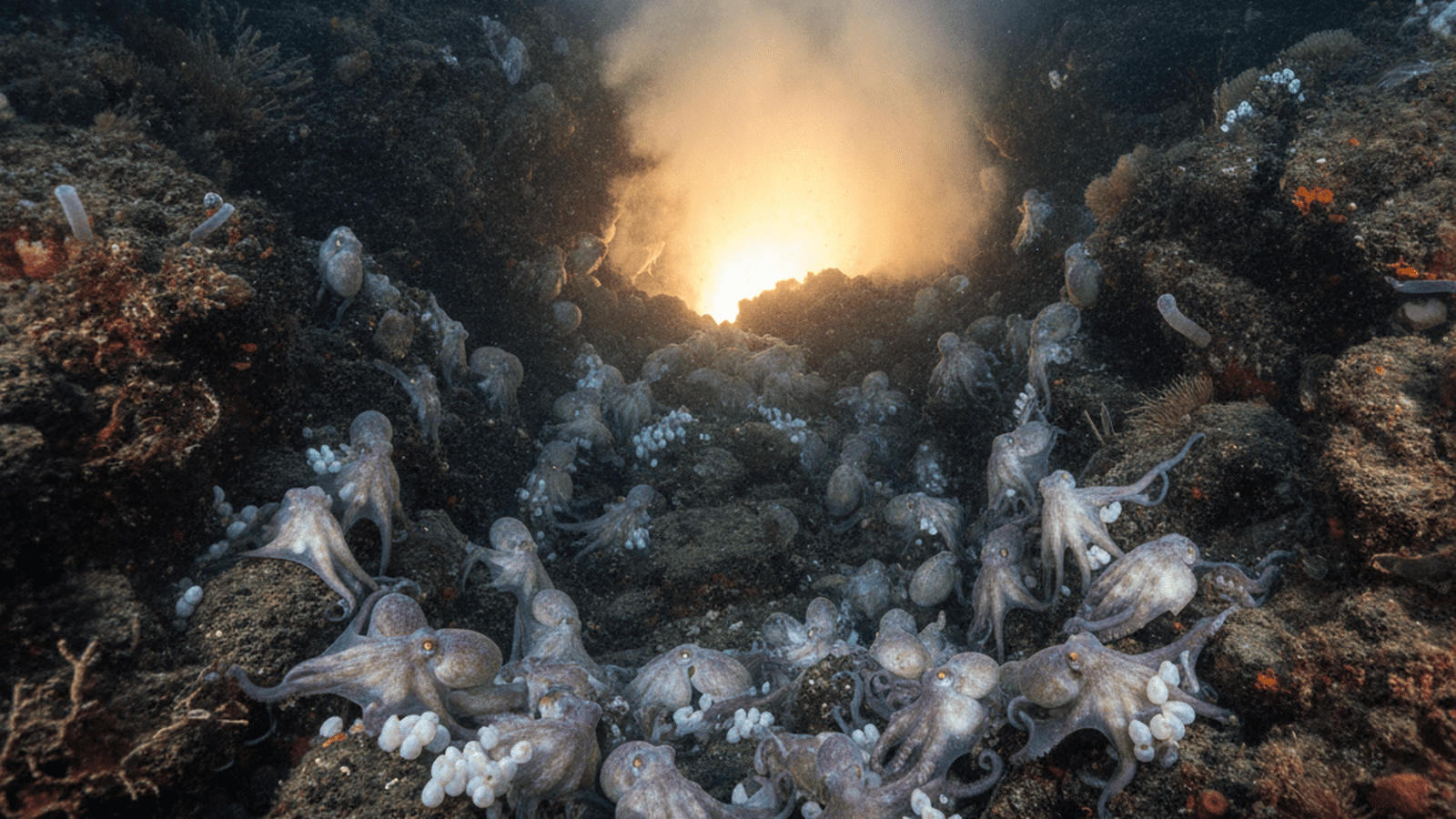
An international research team has discovered a new deep-sea octopus nursery at the Dorado Outcrop off the coast of Costa Rica. This finding, only the third of its kind globally, reveals that certain octopus species utilize low-temperature hydrothermal vents to incubate their eggs in the otherwise frigid depths.
TLDR: Scientists exploring the Dorado Outcrop have identified a rare deep-sea octopus nursery nearly 3,000 meters below the surface. The expedition documented a new species of Muusoctopus and confirmed that hydrothermal venting plays a crucial role in the reproductive cycles of these cephalopods, highlighting the need for deep-sea habitat protection.
An international team of researchers has announced the discovery of a new deep-sea octopus nursery located at the Dorado Outcrop, a small rocky mound off the Pacific coast of Costa Rica. The expedition, titled “Octopus Odyssey” and led by the Schmidt Ocean Institute, utilized the advanced research vessel Falkor (too) and the ROV SuBastian to explore the seafloor at depths of approximately 2,800 meters. This discovery marks only the third time scientists have identified a site where deep-sea octopuses aggregate to brood their eggs, a behavior that fundamentally challenges the long-held view of these creatures as strictly solitary.
The nursery is primarily inhabited by a previously undescribed species of Muusoctopus, a genus of small to medium-sized octopuses that lack an ink sac. During the dives, researchers observed hundreds of individuals clustered together, with females positioned over their egg clutches in a protective stance. The octopuses were found in specific areas where low-temperature hydrothermal fluids seep out of the basaltic rock. These fluids are slightly warmer than the surrounding near-freezing seawater, creating a specialized micro-environment that is conducive to the long incubation periods required by deep-sea cephalopods.
The significance of the Dorado Outcrop discovery lies in its confirmation that hydrothermal venting is a critical factor in the reproductive success of certain deep-sea species. In the frigid temperatures of the deep ocean, metabolic processes are extremely slow, and egg development can take several years. By seeking out these warm-water seeps, the octopuses can significantly reduce the time it takes for their embryos to develop, thereby increasing the chances of survival for their offspring. This behavior suggests a level of environmental selection and social aggregation previously underestimated in deep-sea biology, indicating that these animals actively seek out geological features to enhance their reproductive fitness.
In addition to the Muusoctopus nursery, the expedition documented a wealth of other marine life, including deep-sea skates, tripod fish, and a variety of sponges and corals. The team also explored several other seamounts in the region, finding evidence of similar hydrothermal activity and biological diversity. These findings suggest that the underwater mountains off Costa Rica may host a network of interconnected habitats that support a wide range of specialized organisms. The ROV SuBastian’s high-definition cameras allowed for the first-ever detailed observations of these species in their natural environment, providing invaluable data for taxonomists and ecologists.
The discovery has immediate implications for marine conservation policy in Costa Rica. While the country has a strong record of protecting its terrestrial and coastal environments, its deep-sea territories remain largely unexplored and unprotected. The data gathered during the “Octopus Odyssey” will be used to support the establishment of a marine protected area around these seamounts, shielding them from the potential impacts of deep-sea mining and commercial fishing. This move would align with international efforts to preserve biodiversity in the deep ocean and ensure that these unique nurseries remain undisturbed.
Future research will involve long-term monitoring of the Dorado Outcrop to track the hatching success of the octopus eggs and the movements of the hatchlings. Scientists also hope to determine the exact chemical composition of the hydrothermal fluids and how they influence the local microbial communities that form the base of the food web. As deep-sea exploration technology continues to advance, discoveries like the Dorado nursery highlight how much of the ocean’s biological complexity remains to be understood. The team plans to return to the site with autonomous sensors to record temperature fluctuations over a full annual cycle, further unraveling the mysteries of these deep-sea nurseries.

Mason Reed serves as a Staff Writer for Just Right News, where he spearheads the Future Frontiers & Special Projects desk. In an era defined by rapid technological shifts and evolving social landscapes, Mason provides a steady, principled voice, examining the innovations of tomorrow through the lens of traditional American values. His work is most prominently featured in his signature series, “The Next Horizon,” where he explores the intersection of emerging technology, national sovereignty, and the preservation of individual liberty.
A native of San Diego, California, Mason’s worldview was shaped by the unique culture of his hometown. Growing up in a region defined by its strong military presence and its history of maritime industry, he developed a deep-seated respect for the institutions that provide national stability and the entrepreneurial spirit that drives the American economy. This upbringing instilled in him a belief that true progress is not found in discarding the past, but in building upon a foundation of proven principles. His reporting often reflects this San Diego influence, emphasizing the importance of a robust national defense and the necessity of maintaining a competitive edge in the global marketplace.
Now based in San Francisco, Mason operates from the heart of the world’s technological engine. Living and working in the Bay Area provides him with a front-row seat to the advancements—and the ideological challenges—emanating from Silicon Valley. While many in the region embrace a “move fast and break things” mentality, Mason’s reporting serves as a vital counterweight. He offers Just Right News readers a “boots on the ground” perspective, documenting how radical local policies and the concentration of tech power impact the everyday lives of citizens. His proximity to the industry allows him to cut through the marketing jargon of big tech to uncover the real-world implications for privacy, free speech, and the nuclear family.
In his “Future Frontiers” beat, Mason tackles complex subjects ranging from the ethics of artificial intelligence to the burgeoning private space race. He approaches these topics with a healthy skepticism toward centralized bureaucracy, championing instead the decentralized innovations that empower individuals. Through “The Next Horizon,” he highlights the pioneers and thinkers who are working to ensure that the future remains a place where human dignity and constitutional rights are protected. He believes that the rapid pace of change requires more than just technical expertise; it requires a moral compass rooted in the Western tradition.
Throughout his tenure at Just Right News, Mason has remained committed to the idea that the future is something to be shaped, not merely accepted. His writing is characterized by a rigorous defense of American exceptionalism and a belief that the country’s best days lie ahead, provided it remains true to its founding ideals. Whether he is investigating the impact of automation on the American workforce or profiling the next generation of aerospace engineers, Mason Reed ensures that his readers are equipped with the insights they need to navigate a changing world with confidence and clarity.