

Nigeria has activated Ebola preparedness measures as WHO and Africa CDC seek $518 million for a continental response plan amid outbreaks in DRC and Uganda.
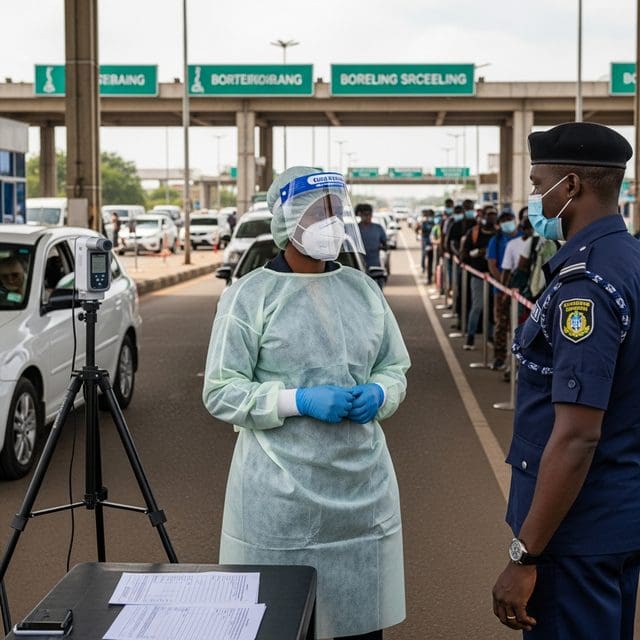
Nigeria has moved to a higher state of Ebola readiness as the World Health Organization and Africa CDC try to raise hundreds of millions of dollars for a continent-wide response plan. The country’s health ministry says it activated nationwide preparedness measures on June 2 even though no confirmed Ebola case has been reported in Nigeria.
The Ministry of Health and Social Welfare said the steps include border screening, health-declaration forms, improved integrated disease surveillance and event-based reporting, coordination through the Public Health Emergency Operations Centre, and rapid-response readiness. The Nigeria Centre for Disease Control had already issued a national Ebola preparedness advisory on May 28 and published Ebola case definitions on May 31, suggesting the country was already in an active guidance phase before the latest ministry announcement.
The timing reflects how quickly a disease threat in one part of Africa can become a policy problem well beyond the immediate outbreak zone. WHO says the current Ebola outbreak in the Democratic Republic of Congo and Uganda involves the Bundibugyo strain, for which there is no licensed vaccine or specific treatment. In practical terms, that leaves containment dependent on surveillance, community engagement, infection prevention, clinical care, and fast cross-border coordination.
WHO and Africa CDC launched a six-month continental preparedness and response plan on June 5, covering June through November 2026. The agencies are seeking $518 million to fund surveillance, laboratory testing, infection prevention and control, clinical care, logistics, and essential health services. That is a large ask in a global aid environment already strained by war, debt, climate disasters, and competing public-health priorities.
For Nigeria, the issue is not just whether imported cases can be spotted, but whether the system can sustain the kind of readiness WHO is urging. Nigerian health officials have flagged laboratory biosafety and biosecurity, specimen transport, frontline worker training, triage, and rumor verification as core concerns. Those are the less visible parts of outbreak response, and they are often the first to buckle when budgets are thin or donor attention shifts elsewhere.
WHO’s outbreak update says the situation is complicated by insecurity, a remote but densely populated area, and significant population and trade movement. That matters for neighboring countries, especially large transit hubs such as Nigeria, where border traffic and internal mobility can give a virus more paths than health ministries can easily monitor.
The American stake is not abstract. Ebola preparedness in Africa is part of the same global-health architecture that U.S. taxpayers are regularly asked to support through foreign aid, multilateral agencies, and emergency response funds. Advocates frame that spending as insurance against cross-border spread; critics point out that emergency pledges too often arrive after outbreaks are already underway, with little scrutiny of whether money strengthens durable national systems or simply circulates through international bureaucracies.
There is also a broader lesson for development policy. Pandemic readiness depends less on summit language than on ordinary capacities: functioning labs, trained staff, clear reporting lines, and public trust. Nigeria’s move shows how much of the burden still falls on national institutions even when WHO is centrally involved.
No fresh COVID-19 development stood out in the latest material beyond routine situation reports and earlier isolated cases, so Ebola preparedness is the sharper current story. That may be a narrow headline, but it captures a wider truth about global health: the gap between international plans and local capacity is where outbreaks are either contained or allowed to spread.

Rachel Vaughn serves as a Senior Correspondent for Just Right News, where she leads the network’s coverage of Global Health, Climate, and Development. With a career defined by intellectual rigor and a commitment to principled reporting, Rachel provides a vital conservative perspective on some of the most complex and high-stakes issues facing the world today. Her work is characterized by a refusal to accept bureaucratic narratives at face value, focusing instead on how international policies impact national sovereignty, individual liberty, and the American taxpayer.
Raised in New Haven, Connecticut, Rachel grew up in an environment dominated by elite academic discourse. This upbringing provided her with a front-row seat to the inner workings of the American establishment, but it also instilled in her a healthy skepticism of the “ivory tower” consensus. She learned early on that while academic theories may sound promising in a lecture hall, they often fail to account for the practical realities of the working class. This background drives her to bridge the gap between high-level policy discussions and the common-sense concerns of everyday citizens, ensuring that her reporting remains grounded and accessible.
Now based in Burlington, Vermont, Rachel operates from a unique vantage point within one of the nation’s most progressive political landscapes. Living and working in a region that often serves as a testing ground for radical social and environmental experiments allows her to witness the real-world consequences of these policies firsthand. From her base in the Green Mountain State, she provides Just Right News readers with essential “boots on the ground” reporting, documenting the friction between local mandates and the constitutional freedoms of the individual. Her presence in Burlington ensures that her critiques of globalist agendas are informed by a direct understanding of how those ideologies manifest at the local level.
In her acclaimed feature series, “Planetary Stakes,” Rachel explores the intersection of international development and environmental stewardship. She rejects the alarmism often found in mainstream media, opting instead for a sober analysis of the economic and geopolitical costs of global climate agreements. Her reporting frequently highlights the importance of market-driven innovation and the role of American leadership in fostering global health without ceding authority to unelected international bodies. Through “Planetary Stakes,” she has become a leading voice for those who believe that true conservation and public health are best achieved through transparency, accountability, and the protection of private property rights.
Throughout her tenure at Just Right News, Rachel has distinguished herself as a journalist who is unafraid to ask difficult questions of global institutions. Whether she is investigating the influence of non-governmental organizations on domestic policy or analyzing the fiscal transparency of international health initiatives, her goal remains the same: to provide her audience with the facts necessary to navigate an increasingly interconnected world. Her blend of East Coast intellectual heritage and her current immersion in the political heart of the Northeast makes her an indispensable asset to the newsroom and a trusted source for readers seeking a principled, conservative take on the issues that define our era.