

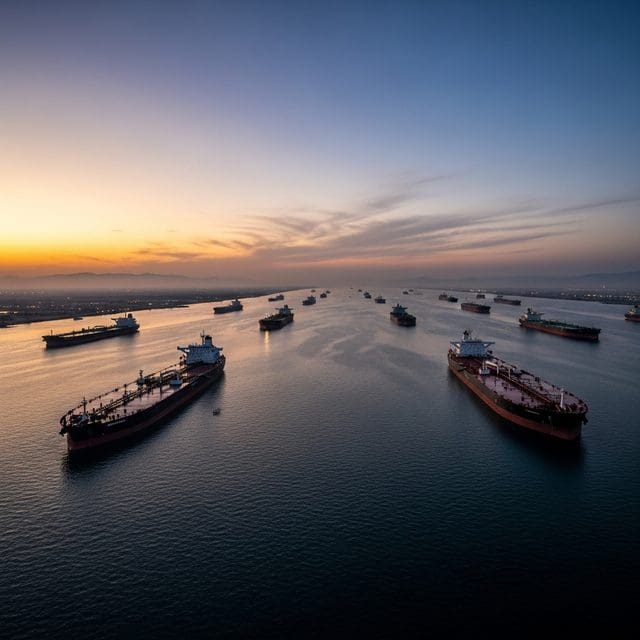
Implementation risks in the Strait of Hormuz and ongoing refinery strikes in Russia challenge global energy stability despite recent diplomatic breakthroughs and domestic nuclear progress.
The global energy landscape remains on a knife-edge as the diplomatic triumph of a tentative U.S.-Iran peace deal meets the hard reality of regional instability. While President Trump asserted on June 19 that the agreement averted a global depression, live AIS tracking data tells a more cautious story. Outbound commercial traffic in the Strait of Hormuz has returned to a near-complete standstill, despite a brief surge in tanker activity earlier in the week. Kpler data reported by CNBC indicated that while transits reached a peak of 20 oil tankers on June 19, this remains a fraction of the more than 100 daily transits recorded before the conflict began. The fragility of the reopening is further exacerbated by ongoing fighting between Israel and Hezbollah, which forced the postponement of follow-up nuclear negotiations in Switzerland involving U.S. envoys Steve Witkoff and Jared Kushner.
Industry analysts warn that even if the deal holds, clearing the backlog of approximately 500 trapped vessels could take up to eight weeks. This logistical bottleneck ensures that while spot prices may fluctuate, the fundamental tightness in the oil market persists. The G7 leaders have thrown their support behind the Trump administration’s memorandum of understanding, yet the gap between diplomatic signatures and operational reality remains wide. For the American taxpayer, this means the relief at the pump remains vulnerable to the next flare-up in regional hostilities. Republican operatives are reportedly bullish on the political impact of the MOU, noting that gas prices have already begun to dip, but the underlying supply chain remains fractured. The Pakistan-mediated agreement, signed in Switzerland, was intended to end the Iran war, but the persistence of regional skirmishes suggests that the road to energy stability will be longer than the signing ceremony implied.
Simultaneously, the war in Eastern Europe continues to degrade global refining capacity. Ukraine’s sustained drone campaign against Russian oil infrastructure has begun to manifest as significant domestic fuel shortages within Russia. These strikes on refineries and depots not only constrain the Kremlin’s logistics but also remove significant volumes of refined products from the international market. Russia has responded by intensifying strikes on Ukrainian energy assets, including at least 14 petrol stations in a single week, adding immense pressure to Ukraine’s internal fuel supply and grid stability. This tit-for-tat destruction of infrastructure highlights the rising cost of energy as a weapon of war. While EU leaders remain divided on creating a back-channel to the Kremlin, Russia has signaled an openness to talks, though the damage to its oil industry continues to mount, creating a supply vacuum that the global market is struggling to fill.
Domestically, the American energy consumer is seeing a mixed bag of indicators. U.S. gasoline prices have dipped below the $4 mark, providing a political tailwind for the administration and evidence that consumer spending remains resilient. However, the long-term reliability of the grid and energy independence remain the primary concerns for market-oriented policymakers. To that end, the Nuclear Regulatory Commission has formally accepted Nano Nuclear Energy’s construction permit application for its KRONOS micro-modular reactor at the University of Illinois Urbana-Champaign. This move into a 12-month technical review signals a shift toward decentralized, high-tech baseload power that could eventually insulate the domestic grid from the volatility of foreign fossil fuel markets. It represents a pragmatic approach to emissions and reliability, focusing on technological innovation rather than ideological mandates.
As the Federal Reserve, led by signals from Kevin Warsh, moves away from forward guidance and fine-tuning, the market must adjust to a more unpredictable economic environment. The intersection of high-stakes diplomacy in the Middle East and the technological evolution of the American power sector suggests a transition period where reliability and cost will be the ultimate metrics of success. For now, the global market remains fixated on the Strait of Hormuz, where the difference between a successful peace deal and a return to total blockade represents millions of barrels of oil and the continued stability of the American taxpayer’s wallet. The arrival of a new Air Force One aircraft, gifted by Qatar, served as a symbolic backdrop at Joint Base Andrews for these high-stakes energy negotiations, but the real work remains in the shipping lanes and the refineries.

Mark Davis serves as the Senior Correspondent for Energy, Climate, and Resource Economics at Just Right News. In an era where the conversation around the environment is often dominated by alarmism and top-down mandates, Mark provides a vital, market-oriented perspective on the complex forces shaping our world. As the lead voice behind the acclaimed feature series “Power and the Planet,” he explores the intersection of environmental policy, global energy markets, and the fundamental economic principles that sustain modern civilization.
Mark’s pragmatic approach to resource management was forged in the high desert of his hometown, Albuquerque, New Mexico. Growing up in a region defined by both its breathtaking natural beauty and its rugged, resource-dependent landscape, he developed an early appreciation for the delicate balance between conservation and utilization. New Mexico’s unique position as a hub for both traditional energy production and cutting-edge scientific research provided Mark with a front-row seat to the evolution of the American energy sector. This upbringing instilled in him a deep-seated belief that true environmental stewardship is inseparable from economic prosperity and technological innovation.
Now based in Boulder, Colorado, Mark operates from the heart of the nation’s climate research community. While Boulder is often seen as a bastion of environmental idealism, Mark utilizes his post to provide a necessary counterweight, grounded in the realities of resource economics. He understands that energy policy does not exist in a vacuum; it has tangible consequences for the American taxpayer, the stability of the national power grid, and the strength of the domestic manufacturing sector. By reporting from the front lines of the climate debate, he is able to challenge prevailing narratives with hard data and a commitment to the principles of the free market.
Throughout his tenure at Just Right News, Mark has distinguished himself by focusing on the “Resource Economics” aspect of his beat. He frequently highlights the hidden costs of rapid energy transitions and advocates for an “all-of-the-above” energy strategy that prioritizes American energy independence. His work often shines a light on the geopolitical implications of resource scarcity, arguing that a secure nation must first be an energy-secure nation. Whether he is analyzing the impact of federal land-use regulations or investigating the supply chains required for new technologies, Mark remains focused on how policy decisions affect the lives and livelihoods of everyday citizens.
In “Power and the Planet,” Mark continues to bridge the gap between complex scientific concepts and the economic realities facing the country. He rejects the false choice between a healthy environment and a thriving economy, instead seeking out solutions that leverage American ingenuity and private-sector competition. For Mark, reporting on the climate is not about following the latest trends, but about ensuring that the conversation remains tethered to the foundational values of liberty, property rights, and fiscal responsibility. His contributions ensure that Just Right News readers receive a comprehensive, clear-eyed view of the challenges and opportunities defining the future of our planet.