

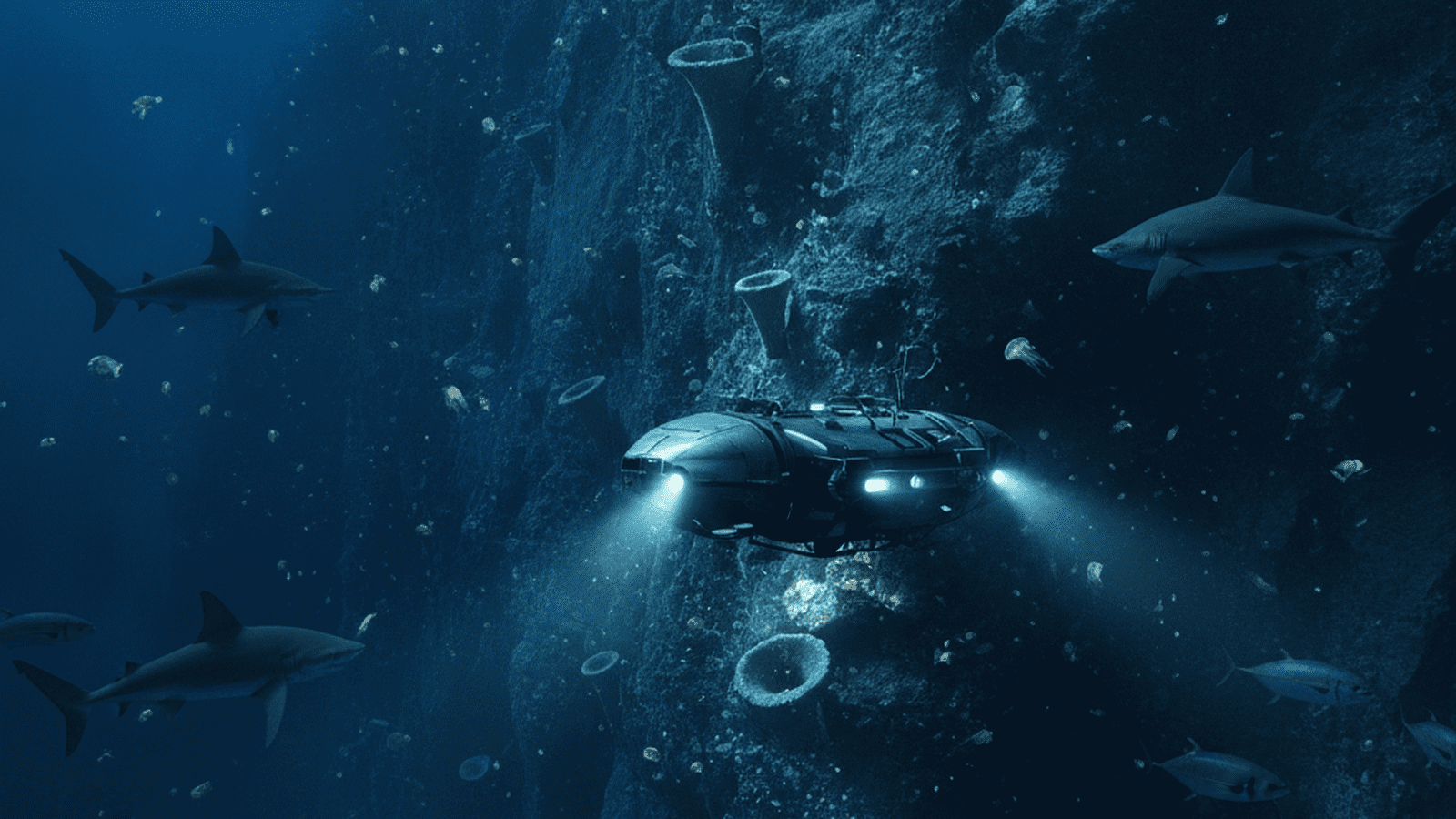
Researchers from the Nekton Mission have identified a previously unknown ecosystem in the Maldives, dubbed the Trapping Zone. Located at depths of 500 meters, this biological hotspot occurs where vertical subsea cliffs intercept the daily migration of tiny organisms, creating a concentrated feeding ground for large predators.
TLDR: A private-sector oceanographic expedition has discovered a unique Trapping Zone ecosystem 500 meters below the surface in the Maldives. Subsea volcanic topography traps migrating micronekton, supporting a massive concentration of sharks and large fish. This discovery reveals a critical link in the deep-ocean food chain and carbon sequestration.
A private-sector oceanographic mission has identified a previously unknown ecosystem in the Indian Ocean, revealing how deep-sea topography creates localized biological hotspots. The discovery, termed the Trapping Zone, was documented by the Nekton Mission, a non-profit research institute, during an extensive survey of the waters surrounding the Maldives. This unique ecological phenomenon occurs at depths of approximately 500 meters, where the vertical migration of marine life meets the sheer cliffs of submerged volcanic mountains.
The Trapping Zone functions as a massive, natural feeding station for large predators. Every day, vast quantities of micronekton—small fish, squid, and crustaceans—ascend from the deep ocean to the surface at night to feed and descend back to the depths during the day. In the Maldives, the steep subsea topography intercepts this migration. Instead of descending into the abyss, these organisms become concentrated against the rock faces of the inner atoll slopes and outer subsea cliffs. This concentration creates a dense layer of biomass that would otherwise be dispersed across the open ocean.
Using the Omega Seamaster II submersible and a suite of autonomous underwater vehicles, researchers observed an extraordinary density of life. The trapped micronekton attract a diverse array of larger species that are rarely seen in such high concentrations at these depths. Observations included schools of tuna, alfonsinos, and several species of deep-sea sharks, such as the bluntnose sixgill shark, the tiger shark, and the bramble shark. The presence of these apex predators indicates a highly productive and stable food source provided by the trapping mechanism.
The geological features of the Maldives, which consist of a double chain of atolls resting on a vast underwater ridge, are central to this discovery. The researchers utilized multibeam sonar mapping to create high-resolution three-dimensional models of the seafloor. These maps revealed the specific trap locations where the currents and vertical walls create the necessary conditions for the accumulation of biomass. The data suggests that the Trapping Zone is not a transient event but a permanent feature of the Maldivian marine environment, sustained by the predictable patterns of vertical migration.
Beyond its role as a feeding ground, the Trapping Zone has significant implications for the global carbon cycle. The concentration of biological activity at these depths facilitates the transfer of carbon from the surface to the deep ocean. As predators consume the trapped micronekton, their waste products and carcasses sink further into the abyss, effectively sequestering carbon for long periods. Understanding these localized hotspots is crucial for developing more accurate models of how the ocean regulates the Earth’s climate and how carbon is stored in the deep sea.
The Nekton Mission’s findings also highlight the importance of private-sector involvement in marine science. By utilizing advanced technology and flexible funding models, private labs can explore regions that are often overlooked by traditional academic or governmental programs. The discovery of the Trapping Zone underscores the fact that much of the deep ocean remains unexplored and that significant ecological structures are yet to be mapped. The mission was supported by various private partners, demonstrating a collaborative approach to ocean exploration.
Future research will focus on determining whether similar trapping zones exist near other oceanic islands and seamounts worldwide. If these features are widespread, they could represent a major, previously unrecognized component of the global marine ecosystem. Conservationists are already using the data from the Maldives expedition to advocate for expanded marine protected areas that include these deep-sea hotspots. Protecting these zones is essential for maintaining the health of pelagic fish stocks and the overall biodiversity of the Indian Ocean, ensuring that these vital links in the marine food web remain intact.

Mason Reed serves as a Staff Writer for Just Right News, where he spearheads the Future Frontiers & Special Projects desk. In an era defined by rapid technological shifts and evolving social landscapes, Mason provides a steady, principled voice, examining the innovations of tomorrow through the lens of traditional American values. His work is most prominently featured in his signature series, “The Next Horizon,” where he explores the intersection of emerging technology, national sovereignty, and the preservation of individual liberty.
A native of San Diego, California, Mason’s worldview was shaped by the unique culture of his hometown. Growing up in a region defined by its strong military presence and its history of maritime industry, he developed a deep-seated respect for the institutions that provide national stability and the entrepreneurial spirit that drives the American economy. This upbringing instilled in him a belief that true progress is not found in discarding the past, but in building upon a foundation of proven principles. His reporting often reflects this San Diego influence, emphasizing the importance of a robust national defense and the necessity of maintaining a competitive edge in the global marketplace.
Now based in San Francisco, Mason operates from the heart of the world’s technological engine. Living and working in the Bay Area provides him with a front-row seat to the advancements—and the ideological challenges—emanating from Silicon Valley. While many in the region embrace a “move fast and break things” mentality, Mason’s reporting serves as a vital counterweight. He offers Just Right News readers a “boots on the ground” perspective, documenting how radical local policies and the concentration of tech power impact the everyday lives of citizens. His proximity to the industry allows him to cut through the marketing jargon of big tech to uncover the real-world implications for privacy, free speech, and the nuclear family.
In his “Future Frontiers” beat, Mason tackles complex subjects ranging from the ethics of artificial intelligence to the burgeoning private space race. He approaches these topics with a healthy skepticism toward centralized bureaucracy, championing instead the decentralized innovations that empower individuals. Through “The Next Horizon,” he highlights the pioneers and thinkers who are working to ensure that the future remains a place where human dignity and constitutional rights are protected. He believes that the rapid pace of change requires more than just technical expertise; it requires a moral compass rooted in the Western tradition.
Throughout his tenure at Just Right News, Mason has remained committed to the idea that the future is something to be shaped, not merely accepted. His writing is characterized by a rigorous defense of American exceptionalism and a belief that the country’s best days lie ahead, provided it remains true to its founding ideals. Whether he is investigating the impact of automation on the American workforce or profiling the next generation of aerospace engineers, Mason Reed ensures that his readers are equipped with the insights they need to navigate a changing world with confidence and clarity.