

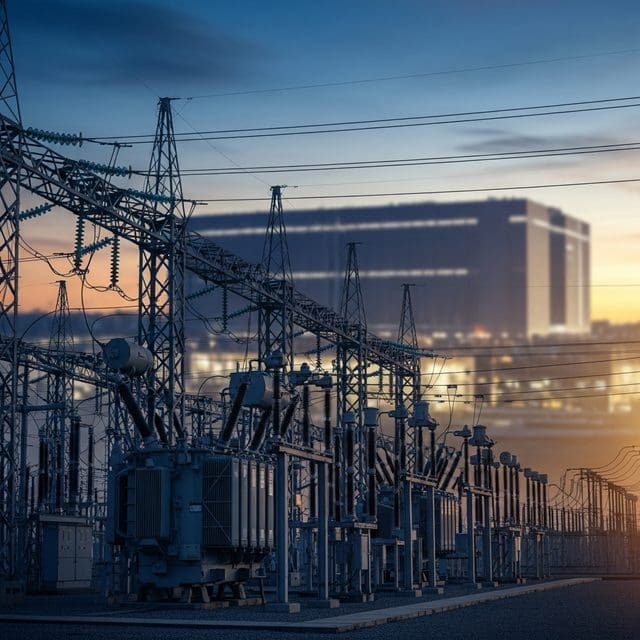
Maryland officials have filed a federal complaint against PJM Interconnection, arguing that residents should not bear the $1.6 billion cost of grid upgrades required to power out-of-state AI data centers.
The rapid expansion of artificial intelligence is colliding with the economic realities of the American power grid. On May 7, 2026, the Maryland Office of People’s Counsel filed a formal complaint with the Federal Energy Regulatory Commission (FERC) against PJM Interconnection. The complaint targets a $1.6 billion transmission cost allocation that would see Maryland residents subsidizing the infrastructure needed to support massive data center clusters, many of which are located across state lines.
This legal challenge follows a period of unprecedented growth in power demand. PJM, which coordinates the movement of wholesale electricity in all or parts of 13 states, has advanced approximately $12 billion in transmission upgrades over the last two years. The regional grid operator projects a 32-gigawatt peak load growth by 2030, with nearly 30 gigawatts of that demand attributed specifically to the data center industry. As AI optimism drives stock valuations for firms like Intel, AMD, and Micron to record highs, the physical infrastructure required to sustain these computations is creating a fiscal burden for traditional ratepayers.
The Maryland Public Service Commission has moved to mitigate these impacts by accelerating the deployment of Virtual Power Plants and Distributed Energy Resource aggregators, with full access slated for early 2028. However, the immediate concern remains the PJM capacity auction costs, which surged from $2.69 billion in 2024 to an estimated $10.39 billion for 2025. Data centers are currently responsible for nearly half of the $47.2 billion in total auction costs projected through May 2028.
Maryland’s intervention argues that the current cost-sharing model violates the Ratepayer Protection Pledge, a policy framework supported by the White House to ensure that industrial energy users pay their fair share of system upgrades. Pennsylvania regulators have taken similar steps, advancing a model tariff designed to insulate residential consumers from the connection costs associated with the PJM demand surge. These state-level actions reflect a growing consensus that the economic benefits of the AI boom must be weighed against the reliability and affordability of the grid for the average taxpayer.
While some companies, such as Polestar, are doubling down on net-zero commitments despite a broader cooling in electric vehicle ambition, the primary challenge for the mid-Atlantic grid is one of raw capacity and cost allocation. The FERC previously directed PJM to revise its tariffs regarding AI data center co-location in late 2025, but the implementation of those revisions remains a point of contention as states fight to keep local utility bills stable.
With energy markets already strained by geopolitical volatility—including recent military exchanges in the Strait of Hormuz that pushed Brent crude past $104—the domestic battle over grid costs represents a second front for energy security. For Maryland and its neighbors, the goal is a pragmatic transition that supports technological innovation without compromising the financial stability of the households that keep the lights on.

Mark Davis serves as the Senior Correspondent for Energy, Climate, and Resource Economics at Just Right News. In an era where the conversation around the environment is often dominated by alarmism and top-down mandates, Mark provides a vital, market-oriented perspective on the complex forces shaping our world. As the lead voice behind the acclaimed feature series “Power and the Planet,” he explores the intersection of environmental policy, global energy markets, and the fundamental economic principles that sustain modern civilization.
Mark’s pragmatic approach to resource management was forged in the high desert of his hometown, Albuquerque, New Mexico. Growing up in a region defined by both its breathtaking natural beauty and its rugged, resource-dependent landscape, he developed an early appreciation for the delicate balance between conservation and utilization. New Mexico’s unique position as a hub for both traditional energy production and cutting-edge scientific research provided Mark with a front-row seat to the evolution of the American energy sector. This upbringing instilled in him a deep-seated belief that true environmental stewardship is inseparable from economic prosperity and technological innovation.
Now based in Boulder, Colorado, Mark operates from the heart of the nation’s climate research community. While Boulder is often seen as a bastion of environmental idealism, Mark utilizes his post to provide a necessary counterweight, grounded in the realities of resource economics. He understands that energy policy does not exist in a vacuum; it has tangible consequences for the American taxpayer, the stability of the national power grid, and the strength of the domestic manufacturing sector. By reporting from the front lines of the climate debate, he is able to challenge prevailing narratives with hard data and a commitment to the principles of the free market.
Throughout his tenure at Just Right News, Mark has distinguished himself by focusing on the “Resource Economics” aspect of his beat. He frequently highlights the hidden costs of rapid energy transitions and advocates for an “all-of-the-above” energy strategy that prioritizes American energy independence. His work often shines a light on the geopolitical implications of resource scarcity, arguing that a secure nation must first be an energy-secure nation. Whether he is analyzing the impact of federal land-use regulations or investigating the supply chains required for new technologies, Mark remains focused on how policy decisions affect the lives and livelihoods of everyday citizens.
In “Power and the Planet,” Mark continues to bridge the gap between complex scientific concepts and the economic realities facing the country. He rejects the false choice between a healthy environment and a thriving economy, instead seeking out solutions that leverage American ingenuity and private-sector competition. For Mark, reporting on the climate is not about following the latest trends, but about ensuring that the conversation remains tethered to the foundational values of liberty, property rights, and fiscal responsibility. His contributions ensure that Just Right News readers receive a comprehensive, clear-eyed view of the challenges and opportunities defining the future of our planet.