

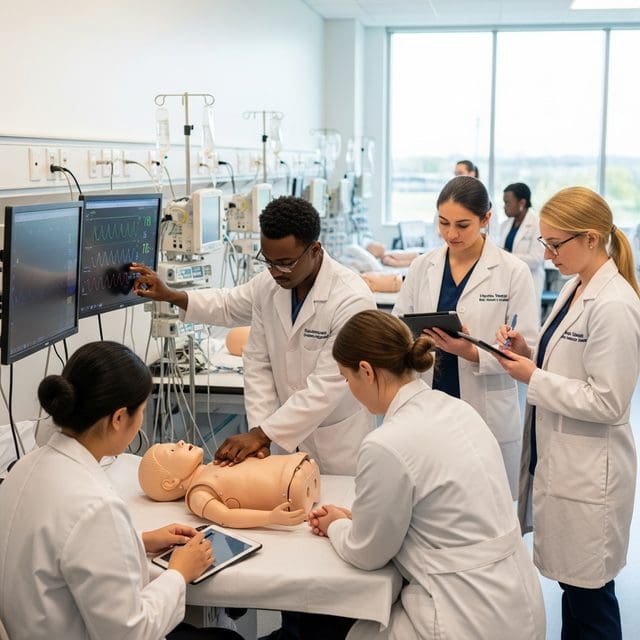
Recent developments in higher education emphasize hands-on medical training and institutional transparency as universities pivot toward high-demand workforce needs and student protection.
The modern educational landscape is increasingly defined by a shift toward tangible outcomes and specialized workforce preparation. As tuition costs at elite institutions like Emory University reach $64,280 for the 2026 edition, the pressure on higher education to deliver measurable value has never been higher. This demand for practical utility is driving a surge in specialized medical training and research intended to address global health challenges.
At BLDE Deemed University in Karnataka, the focus on immediate clinical application was recently demonstrated through intensive neonatal resuscitation training. This move reflects a broader trend where institutions prioritize life-saving skills over theoretical instruction to better equip the healthcare workforce. Similarly, Monash University led a global effort to rename Polycystic Ovary Syndrome to Polyendocrine Metabolic Ovarian Syndrome (PMOS). Published in The Lancet on May 12, 2026, the change aims to improve diagnostic accuracy for 170 million women, illustrating how academic research is being leveraged to refine professional medical standards.
While some institutions focus on clinical excellence, others are expanding their physical infrastructure to accommodate large-scale training. The University of Nebraska Medical Center is advancing its Project Health initiative, a $2.19 billion facility designed to integrate health training, research, and patient care. This massive investment underscores the belief that top-tier facilities are essential for developing the human capital required for the future of medicine. This institutional growth is mirrored by private sector expansion, such as Medical Solutions celebrating 25 years as a healthcare workforce partner, growing from a three-person shop to a major industry player.
However, the path to upward mobility remains fraught with bureaucratic and predatory hurdles. In Sivaganga, the District Collector recently issued a warning against NGOs that have been seizing original Class X certificates from students under the guise of assisting with college admissions. Such practices create unnecessary barriers for young people attempting to enter the workforce or pursue higher education. This follows broader concerns regarding credential fraud, highlighted by past operations like Operation Nightingale, which uncovered 7,600 fake nursing diplomas sold for $114 million.
Financial integrity also remains a primary concern for policymakers. The rise of “ghost student” scams, where AI is used to siphon millions in financial aid from community colleges, has forced administrators to reconsider their digital security and enrollment verification processes. As institutions like National University attempt to bridge the gap through targeted support—such as the $150,000 in Whisper Military Spouse Scholarships awarded this May—the broader challenge remains ensuring that educational spending translates into genuine skill acquisition rather than administrative waste.
Ultimately, the success of the educational sector will be measured by its ability to align with market needs while maintaining rigorous standards of personal responsibility and institutional honesty. Whether through the Elks National Foundation’s $4.9 million in scholarships for high school seniors or Singapore Management University’s new Master of Data Science in Economics focused on AI interpretation, the goal is clear: removing barriers to achievement and focusing on the practical skills that drive the modern economy.
Daniel Owens serves as a Senior Correspondent for Just Right News, where he leads the newsroom’s coverage of Education, Workforce, and Upward Mobility. In an era where the national conversation often overlooks the practical foundations of success, Owens brings a principled perspective to the forefront of the media landscape. His work is defined by a commitment to the idea that a strong society is built on the pillars of quality education, a robust work ethic, and the removal of bureaucratic barriers to individual achievement.
Born and raised in Cleveland, Ohio, Owens’s worldview was shaped by the industrial landscape of the Midwest. Growing up in a city known for its grit and resilience, he witnessed firsthand the transformative power of steady employment and the devastating effects of economic stagnation. This background instilled in him a deep respect for the American worker and a healthy skepticism toward top-down government solutions that often fail to reach the communities they intend to help. As an African American man who has navigated the path to professional success, Owens approaches his beat with a nuanced understanding of how meritocracy and personal responsibility intersect with opportunity. He frequently draws on his roots to highlight the importance of family stability and community-led initiatives in fostering the next generation of leaders.
At Just Right News, Owens is the architect of the acclaimed feature series, “The Learning Curve.” Through this platform, he explores the evolving landscape of American schooling, from the rise of the school choice movement to the revitalization of trade schools and vocational training. He frequently challenges the status quo of higher education, advocating for a return to academic rigor and the practical alignment of degrees with market demands. For Owens, education is not merely about obtaining credentials; it is about equipping young people with the tools necessary to lead self-sufficient, meaningful lives. His reporting on “The Learning Curve” has become essential reading for parents and policymakers who believe that educational competition and parental rights are the keys to a brighter future.
Now based in Raleigh, North Carolina, Owens finds himself at the heart of one of the nation’s most dynamic regions for innovation and growth. Raleigh’s unique blend of traditional values and a fast-paced economy provides the perfect backdrop for his reporting on the modern workforce. From the tech hubs of the Research Triangle to the rural communities of the South, he tracks how shifts in the economy are impacting families and local industries. His reporting often highlights the success stories of entrepreneurs and workers who are thriving by embracing the values of hard work and innovation.
Throughout his career, Daniel Owens has remained a steadfast voice for the student seeking a better path and the worker striving for a better life. His reporting for Just Right News serves as a vital resource for readers who value common-sense solutions to the challenges of the 21st-century economy. By focusing on the intersection of policy and the human spirit, Owens continues to provide a roadmap for how individuals and communities can achieve lasting upward mobility.