

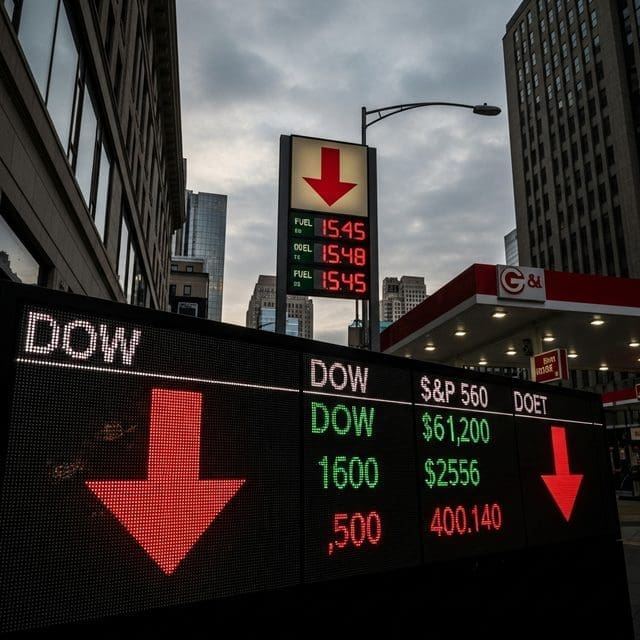
U.S. stock futures retreated as tensions between Washington and Tehran escalated, while households brace for a critical April inflation report impacted by rising energy costs.
The fragile stability of American financial markets faced a dual threat on Tuesday as geopolitical volatility in the Middle East collided with domestic inflationary pressures. Despite the S&P 500 and Nasdaq 100 reaching record highs during the previous session, futures for the major indices signaled a sharp reversal. The Dow Jones Industrial Average futures dropped 44 points, while the tech-heavy Nasdaq 100 saw a more pronounced decline of 0.7% in early trading.
Market sentiment soured following President Donald Trump’s rejection of Iran’s latest peace proposal, which he characterized as totally unacceptable. The President’s assessment that the ceasefire is now on massive life support follows a direct exchange of fire in the Strait of Hormuz on May 7. This escalation has effectively shuttered one of the world’s most vital energy corridors, sending West Texas Intermediate crude prices above $100 per barrel. For the American taxpayer, this geopolitical friction translates directly to higher costs at the pump and increased transportation overhead for consumer goods.
The International Monetary Fund issued a stark warning on Tuesday, noting that a full-scale escalation of the U.S.-Israel conflict with Iran could push the global economy into a recession with lasting structural damage. These concerns are amplified by the pending release of the April consumer-price index report. Analysts expect headline inflation to hit 3.7% year-over-year, driven largely by the surge in jet fuel and gasoline prices since the onset of hostilities. This data will serve as a critical barometer for whether the Federal Reserve can maintain its current monetary trajectory or if further tightening will be required to curb rising costs.
In the technology sector, the momentum of the recent semiconductor rally faced headwinds from abroad. South Korean officials proposed a social tax on artificial-intelligence profits, triggering a selloff in industry giants like Samsung Electronics and SK Hynix. This regulatory shift in Asia, combined with a significant revenue miss from AST SpaceMobile, has introduced fresh skepticism regarding the valuation of high-growth tech stocks. Meanwhile, the U.S. dollar strengthened slightly against its peers, and the 10-year Treasury yield ticked up to 4.44%, reflecting a market seeking safety in the face of uncertainty.
As the Trump administration prepares for a high-stakes summit with Chinese leadership on Thursday, the convergence of trade policy and military tension remains the primary driver of market volatility. For working households, the current environment suggests a period of sustained fiscal pressure. The combination of stalled peace negotiations and the potential for a localized conflict to trigger a broader economic downturn underscores the fragility of the post-pandemic recovery and the necessity of a stable, sovereign energy policy to insulate the domestic economy from foreign shocks.

Jordan Lee serves as the Senior Correspondent for Wall Street, Finance, and Monetary Systems at Just Right News. Based in the heart of the world’s financial capital, New York City, Lee brings a sharp, principled eye to the complex mechanisms that drive the global economy. His reporting is defined by a commitment to fiscal responsibility, the defense of the free market, and a deep-seated belief that a transparent monetary system is the bedrock of a free society.
Raised in Portland, Oregon, Lee’s perspective was forged in a city that has undergone significant cultural and economic shifts. His upbringing in the Pacific Northwest instilled in him a profound appreciation for the industriousness of small business owners and the importance of local economic stability. Watching the evolution of his hometown’s landscape sparked an early interest in how federal fiscal policy and large-scale financial trends eventually trickle down to the average citizen. This background provides him with a unique vantage point; he understands the growing disconnect between the policy-making elite and the reality of Main Street, a theme that frequently resonates throughout his work.
Now operating from his base in New York City, Lee bridges the gap between the high-stakes trading floors of Manhattan and the households of everyday Americans. He views the financial sector not merely as a collection of numbers and tickers, but as a vital engine of American prosperity that requires constant vigilance and accountability. His reporting often highlights the dangers of centralized financial control and the necessity of maintaining a system that rewards merit, risk-taking, and innovation.
As the creator and lead of the featured series, “The Invisible Economy,” Lee pulls back the curtain on the often-opaque world of monetary systems. He specializes in translating the dense jargon of central banking and international finance into actionable insights for the Just Right News audience. His work explores the “invisible” forces—such as inflationary pressures, regulatory creep, and the expansion of the administrative state—that erode the purchasing power of American families. By focusing on these systemic issues, Lee empowers readers to understand the hidden forces shaping their financial independence.
Lee’s journalistic philosophy is rooted in a steadfast commitment to traditional American values. As an Asian American professional who has navigated the competitive corridors of the financial world, he is a vocal advocate for meritocracy and the preservation of the American Dream. He believes that a stable currency and a predictable regulatory environment are essential for national sovereignty and individual liberty. His reporting frequently warns against the risks of government overreach in the private sector, arguing that the most effective solutions to economic challenges arise from competition and individual enterprise rather than bureaucratic mandates.
At Just Right News, Jordan Lee remains dedicated to providing a clear-eyed defense of the taxpayer. Whether he is analyzing market volatility or investigating the long-term implications of national debt, his mission is to provide the truth about where the money is going and what it means for the future of the country. Through his rigorous analysis and principled stance, Lee has become a trusted voice for those who value a strong, sovereign, and fiscally sound America.