

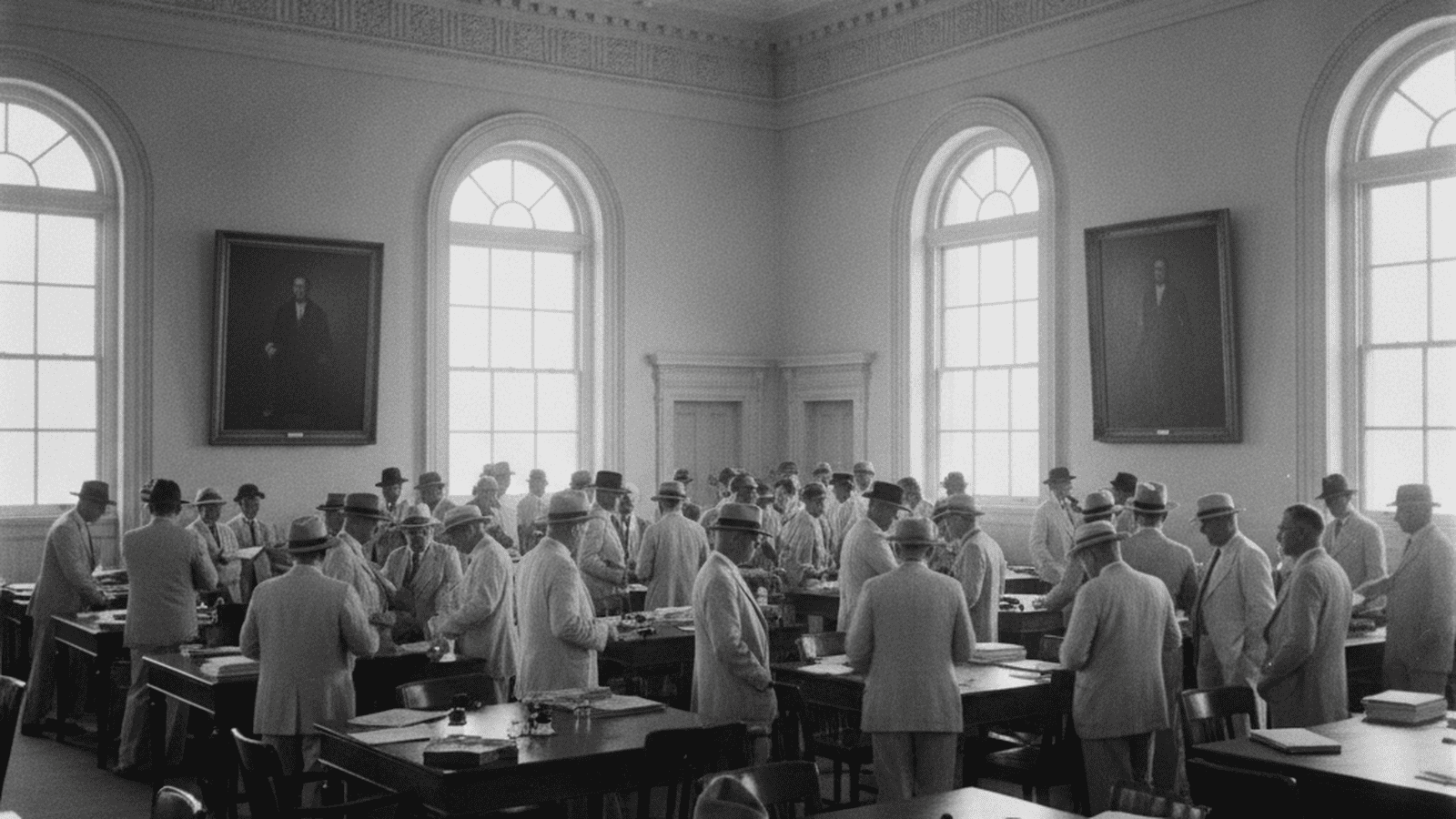
In 1937, Florida became one of the first Southern states to abolish its poll tax, a move that significantly expanded the active electorate during the New Deal era. This legislative shift in the United States signaled a growing tension between traditional disenfranchisement tactics and the populist demands of the 1930s.
TLDR: Florida’s 1937 repeal of the poll tax marked a pivotal moment in Southern political history. Driven by Governor Fred P. Cone and a desire to mobilize voters for New Deal-era policies, the reform dismantled a major barrier to the ballot box, foreshadowing broader national voting rights struggles.
In the spring of 1937, the Florida Legislature convened in Tallahassee to address a relic of the post-Reconstruction era that had long stifled the state’s democratic participation. The poll tax, a mandatory fee required for voting, had served as a formidable barrier to the ballot box for nearly half a century. While ostensibly a revenue measure, its primary function across the American South was the disenfranchisement of low-income citizens. This financial hurdle effectively silenced a large portion of the working class during a time of immense economic upheaval.
The push for reform gained momentum during the 1936 gubernatorial campaign. Fred P. Cone, a veteran politician from Lake City, made the abolition of the poll tax a central pillar of his platform. Cone recognized that the economic hardships of the Great Depression had made the two-dollar tax—equivalent to several days’ wages for many laborers—an insurmountable obstacle. He argued that the “forgotten man” of the New Deal era deserved a voice in the government that was increasingly responsible for his welfare.
Upon taking office in 1937, Governor Cone immediately pressured the legislature to fulfill his campaign promise. The political climate was ripe for change as federal New Deal programs created a new relationship between the citizen and the state. Proponents of the repeal argued that a broader electorate would strengthen the state’s mandate to implement social and economic reforms. They believed that the act of voting should not be a commodity purchased by the wealthy but a right exercised by all.
The legislative battle was intense as traditionalists in the state senate feared that removing the tax would upset the established social and political hierarchy. They argued that the tax ensured only “responsible” citizens with a stake in the community could vote. However, the populist energy of the era proved too strong to ignore. Labor unions and civic organizations mobilized, flooding the capital with petitions demanding the removal of the financial barrier to suffrage.
In June 1937, the Florida Legislature finally passed the repeal bill, and Governor Cone signed it into law. This made Florida one of the first states in the Deep South to abandon the poll tax during the 20th century. The impact was immediate and measurable, with voter registration surging by more than 100,000 people in time for the 1938 primary elections. This influx of new voters shifted the state’s political center of gravity, forcing candidates to address the needs of a more diverse economic constituency.
The repeal did not solve all of Florida’s electoral issues, as other mechanisms of disenfranchisement remained in place for several more years. Nevertheless, the 1937 reform was a significant crack in the wall of Southern exclusionary politics. It demonstrated that even within the constraints of the one-party South, legislative action could expand the democratic process. The move signaled a growing recognition that economic status should not dictate political agency.
Florida’s decision served as a case study for other Southern states and federal reformers who sought to modernize the American electoral system. It highlighted the direct link between economic policy and voting access, a theme that would dominate civil rights discussions for decades. The eventual passage of the 24th Amendment to the United States Constitution in 1964, which prohibited poll taxes in federal elections, drew inspiration from these early state-level successes. Today, the 1937 repeal is remembered as a critical step in the long evolution of voting rights in the United States.

Sophie Carter serves as a Staff Writer for Just Right News, where she anchors the outlet’s critical coverage of Elections, Influence, and Democracy Infrastructure. In an era where the mechanics of voting and the flow of political capital are under constant scrutiny, Sophie provides a steady, principled voice dedicated to the preservation of American institutional integrity and the rule of law.
Raised in Charlotte, North Carolina, Sophie’s perspective was forged in a community that balances rapid modern growth with a deep respect for tradition and civic duty. Growing up in the Queen City, she witnessed firsthand how a robust local culture depends on the trust between the citizen and the state. This upbringing instilled in her a foundational belief that the right to vote is a sacred trust—one that must be protected from both administrative overreach and the encroaching influence of special interest groups. Her reporting reflects these North Carolina roots, emphasizing the importance of community-led governance and the preservation of the individual’s voice in the face of nationalized political movements.
Now based in Atlanta, Georgia, Sophie operates from the heart of one of the nation’s most pivotal and contested political landscapes. Her location allows her to report from the front lines of the debate over election security, legislative reform, and the modernization of voting systems. For Sophie, the “infrastructure” of democracy is not merely a matter of machines and ballots; it is the collection of laws, people, and transparent processes required to maintain public confidence. Her work often highlights the necessity of clear, enforceable standards that ensure every legal vote is counted fairly and that the machinery of our republic remains accountable to the taxpayers who fund it.
Central to her work at Just Right News is her acclaimed feature series, “The Price of a Vote.” Through this ongoing project, Sophie explores the complex web of influence that shapes modern campaigns and policy decisions. She delves into how high-level lobbying, non-governmental organizations, and shifting bureaucratic regulations impact the weight of an individual citizen’s ballot. By examining the financial and structural pressures placed on the electoral process, she provides readers with a comprehensive look at the forces vying for control over the American political system.
Sophie’s approach to journalism is rooted in a commitment to the constitutional framework. She views her role as a watchdog for the voter, ensuring that the systems meant to serve the public remain transparent and free from corruption. Whether she is analyzing the implementation of new voting technologies or investigating the influence of outside money on state-level policy, her work is characterized by a rigorous adherence to facts and a refusal to succumb to the sensationalism that often plagues modern political reporting.
At Just Right News, Sophie Carter continues to be a vital resource for readers who value clarity, conviction, and a defense of traditional American values. Her deep ties to the Southeast and her specialized focus on the mechanics of our republic make her an essential voice in the ongoing conversation about the future of American self-governance. Through her reporting, she remains dedicated to the idea that a secure and honest electoral system is the bedrock of a free and prosperous society.