

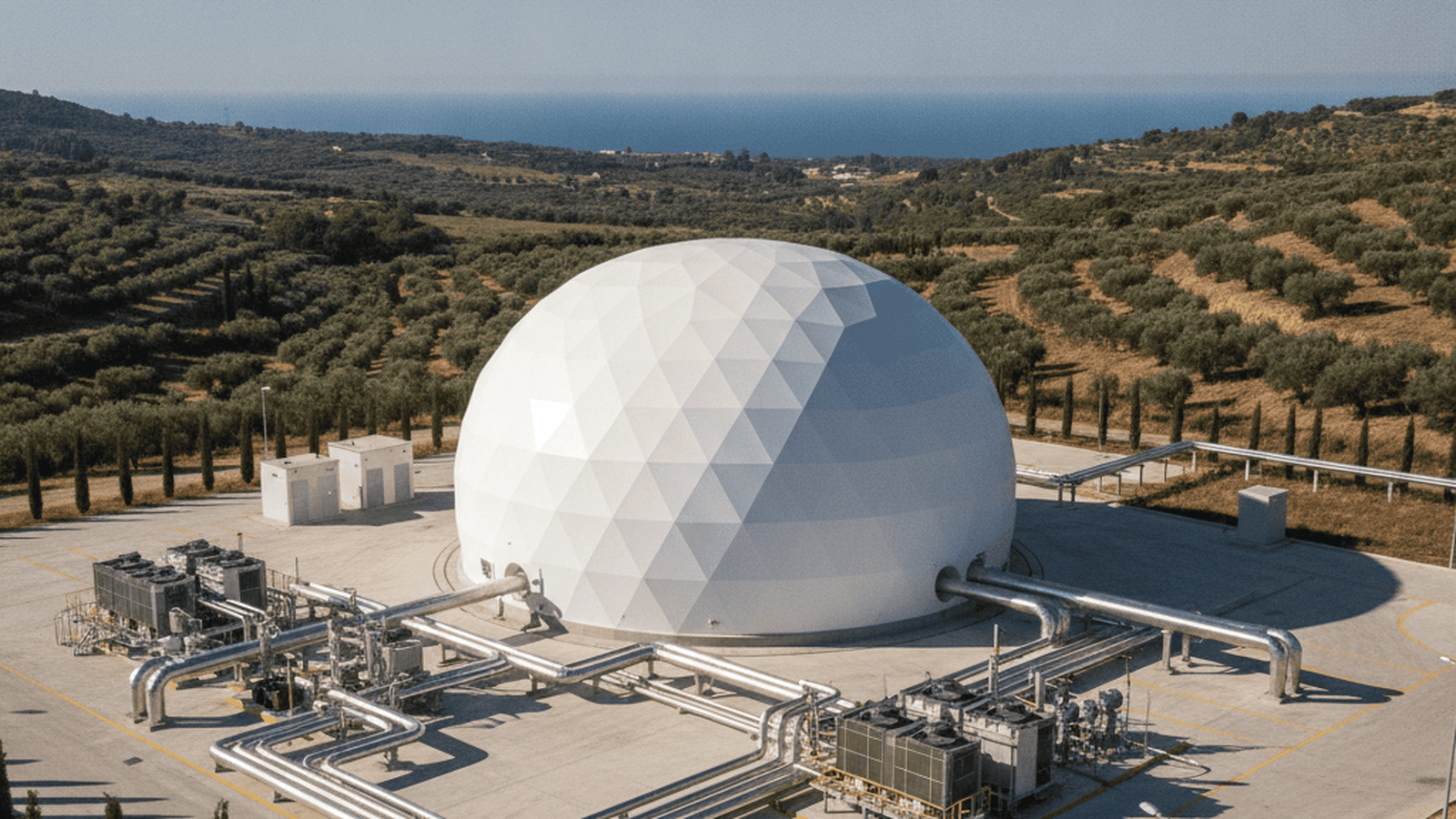
Energy Dome has launched a commercial-scale CO2 battery in Sardinia, Italy, utilizing a closed-loop thermodynamic process to store renewable energy. The system compresses carbon dioxide into a liquid to store power and expands it through a turbine to release electricity with 75% efficiency.
TLDR: Italian energy startup Energy Dome has validated its carbon dioxide-based long-duration energy storage system. By cycling CO2 between gaseous and liquid states, the facility provides a cost-effective, 30-year solution for grid stability that avoids the material constraints of traditional chemical batteries, offering a scalable alternative for renewable energy integration.
Energy Dome, an innovative Italian technology firm, has reached a pivotal milestone in the global energy transition by successfully demonstrating its CO2 battery technology at a commercial scale. The facility, situated in Sardinia, Italy, represents the first of its kind to utilize carbon dioxide in a sophisticated, closed-loop thermodynamic process designed to store and release renewable energy on demand. This breakthrough addresses one of the most significant hurdles facing the green energy sector: the inherent intermittency of wind and solar power. By providing a reliable, long-duration energy storage (LDES) solution, Energy Dome is proving that the transition to a carbon-free grid can be achieved without relying on scarce rare earth minerals or volatile lithium-ion supply chains.
The fundamental operation of the CO2 battery relies on the unique physical properties of carbon dioxide, specifically its ability to transition between gaseous and liquid states under controlled pressure and temperature. During the charging phase, the system draws surplus electricity from the grid—typically during periods of high solar or wind production—to power high-efficiency compressors. These compressors condense CO2 gas into a liquid state. A critical component of this phase is the management of thermal energy; the heat generated during compression is captured and stored in a specialized thermal energy storage system. The resulting liquid CO2 is then stored in high-pressure steel vessels at ambient temperature, effectively locking in the energy potential for extended periods without the self-discharge or degradation issues common in chemical batteries.
When energy demand on the grid increases, the system initiates the discharge cycle. The stored liquid CO2 is reheated using the thermal energy captured during the charging phase, causing it to evaporate and expand rapidly. This high-pressure gas is then funneled through a power-generating turbine, which converts the mechanical energy back into electricity for the grid. Once the gas has passed through the turbine, it is collected in a large, flexible atmospheric-pressure bladder, known as the dome. This closed-loop design ensures that the working fluid is never released into the atmosphere, maintaining a constant mass of CO2 within the system and eliminating the need for continuous refueling or external emissions.
Independent validation of the Sardinia plant has confirmed a round-trip efficiency of approximately 75%. While this is slightly lower than the peak efficiency of some lithium-ion systems, the CO2 battery offers superior long-term economics. Unlike traditional batteries that suffer from chemical degradation over thousands of cycles, the Energy Dome system utilizes standard industrial components—such as off-the-shelf compressors, turbines, and heat exchangers—that have been proven over decades in the oil and gas and power industries. Consequently, the facility boasts an expected operational lifespan of over 30 years, significantly reducing the levelized cost of storage for utility-scale applications.
The Sardinia facility currently serves as a 2.5-megawatt commercial demonstration unit, but the company is already moving toward larger deployments. The standard commercial design is a 20-megawatt plant capable of providing 200 megawatt-hours of storage, enough to power thousands of homes for several hours. Because liquid CO2 is highly dense, the system can store vast amounts of energy in a relatively compact footprint. This spatial efficiency allows for greater flexibility in site selection compared to traditional pumped hydro, which requires specific topography, or compressed air energy storage, which often necessitates underground salt caverns.
Furthermore, the supply chain for these facilities is remarkably sustainable, relying primarily on abundant materials like steel, water, and carbon dioxide. This avoids the geopolitical and environmental risks associated with mining cobalt, nickel, and lithium. The modular nature of the components also allows for rapid deployment and the potential to repurpose existing industrial zones or decommissioned fossil fuel power plants, utilizing existing grid infrastructure to accelerate the transition to clean energy. As global grids move toward 100% renewable energy, technologies like the CO2 battery will be essential for maintaining stability and reliability.

Chloe Foster serves as a Staff Writer for Just Right News, where she spearheads the outlet’s coverage of Media, Culture, and Information Integrity. In an era defined by rapid-fire digital communication and shifting societal norms, Chloe has distinguished herself as a vital voice for readers seeking clarity amidst the noise. Her signature feature series, “The Story Wars,” has become a cornerstone of the publication, offering a deep dive into the ideological battles currently shaping American life and the ways in which mainstream narratives are constructed, disseminated, and often manipulated.
Chloe’s unique perspective is informed by a life lived in two of the nation’s most influential cultural hubs. Raised in Los Angeles, California, she grew up in the shadow of the world’s most powerful media and entertainment apparatus. This upbringing provided her with a front-row seat to the “dream factory,” allowing her to observe firsthand how cultural exports are crafted and how they often diverge from the lived experiences of everyday Americans. Her time in Los Angeles instilled in her a healthy skepticism of manufactured consensus and a passion for uncovering the truths that lie beneath polished public relations campaigns.
Today, Chloe operates from Brooklyn, New York, a vantage point that places her at the epicenter of the modern media landscape. Living and working in a deep-blue urban environment as a conservative journalist has sharpened her reporting, requiring a rigorous commitment to intellectual honesty and a steadfast defense of traditional values. Her base in Brooklyn allows her to engage directly with the institutions and influencers who drive the national conversation, providing Just Right News readers with an “on-the-ground” look at the cultural shifts originating in the Northeast.
As a Hispanic woman, Chloe brings a nuanced understanding of community and heritage to her beat. She frequently explores how media portrayals of the Latino community often overlook the deep-seated faith, entrepreneurial spirit, and family-centric values that define it. Her work challenges the monolithic labels often applied by mainstream outlets, instead highlighting the diversity of thought and the conservative principles that resonate within her community.
In her role at Just Right News, Chloe views “Information Integrity” not merely as a buzzword, but as a mission. She believes that a healthy republic requires a media landscape where facts are prioritized over agendas and where the public is empowered to think for themselves. Through “The Story Wars,” she deconstructs the framing of major news events, exposing bias and providing the context necessary for readers to understand the broader cultural implications of the day’s headlines.
Chloe Foster’s reporting is more than just a collection of articles; it is a sustained effort to reclaim the narrative for those who feel sidelined by the prevailing media establishment. By bridging the gap between her West Coast roots and her East Coast base, she continues to provide essential commentary on the forces that define our shared American culture.