

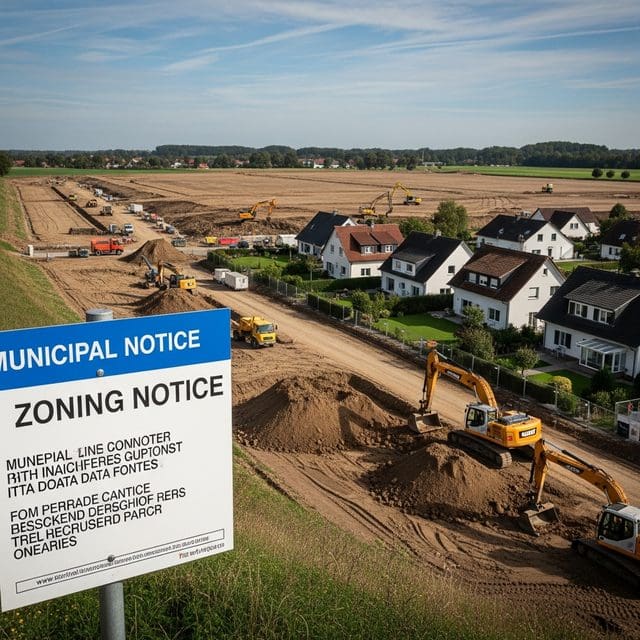
Massive industrial approvals in Texas and New Jersey highlight a growing national trend of prioritizing data centers and logistics hubs over the urgent need for affordable housing and residential stability.
The struggle for local sovereignty and property rights intensified this week as municipal leaders from Texas to New Jersey navigated the delicate balance between industrial economic growth and the preservation of residential communities. As the American taxpayer grapples with an April surge in inflation—where energy and housing costs accounted for a staggering 40 percent of the increase—local zoning decisions are increasingly favoring high-revenue commercial projects over the expansion of the housing supply.
In Red Oak, Texas, a marathon City Council session that stretched until nearly midnight on May 12 concluded with the approval of an 830-acre rezoning request for a massive data center complex. The project, led by DataBank, is set to encompass eight buildings totaling 3.4 million square feet. Phase one alone is expected to demand 240 megawatts of IT power, a significant draw on the local grid. The approval was met with stiff resistance from over 150 residents who voiced concerns about the long-term impact on their quality of life and the displacement of land that could have otherwise supported residential development. This tension reflects a broader national trend where the fiscal allure of data infrastructure often outweighs the immediate needs of families seeking affordable places to live.
Parallel developments are unfolding in Manalapan, New Jersey, where industrial momentum is rapidly transforming the landscape. Mapletree, a Singapore-based development firm, finalized the acquisition of a 96.8-acre site on May 10 for a logistics facility totaling nearly one million square feet. The project, which includes two warehouses of 300,000 and 652,000 square feet, is slated for a 2028 completion. While the developer is targeting LEED Silver certification, the project faces moderate entitlement risks regarding drainage and wetlands under New Jersey Department of Environmental Protection oversight. For Manalapan residents, the primary concern remains the traffic congestion and the erosion of local sovereignty as industrial zoning takes precedence over housing.
Amidst these industrial expansions, the University of Texas at Austin and Greystar provided a rare example of targeted residential development. On May 12, officials broke ground on the Law School Village, a 14-story, 280-unit project designed to house 340 students. This public-private partnership reached financial close on May 7 and represents a strategic attempt to insulate students from the volatile Austin rental market. By focusing on high-density student housing, the university aims to alleviate some of the pressure on the city’s broader housing stock, though such projects remain the exception rather than the rule in the current regulatory environment.
These local battles are occurring against a backdrop of significant global economic volatility. On May 12, the International Monetary Fund warned that escalating conflict in the Middle East could push the global economy toward a recession. Such a downturn would likely solidify the current environment of high interest rates, making it even more difficult for private developers to break ground on affordable housing projects. Furthermore, the U.S. and Iran’s exchange of fire in the Strait of Hormuz on May 7 has already begun to impact markets, with oil prices rising and stock futures falling after the White House labeled recent peace proposals as unacceptable.
As municipal boards continue to prioritize the tax revenue generated by data centers and logistics hubs, the burden of the housing shortage remains squarely on the shoulders of the American family. The decisions made in Red Oak and Manalapan serve as a reminder that without a commitment to market-driven housing solutions and a healthy skepticism of bureaucratic overreach, the preservation of local residential life will continue to be sidelined by the march of industrial expansion.

Deborah Cole serves as a Senior Correspondent for Just Right News, where she spearheads the network’s coverage of Housing, Infrastructure, and Mobility. With a career defined by a commitment to rigorous reporting and a focus on the fundamental pillars of American community life, Deborah brings a principled perspective to the complex issues that dictate how and where we live. Her work is grounded in the belief that sound policy, fiscal responsibility, and respect for private property are the essential foundations of a prosperous society.
Originally from Boston, Massachusetts, Deborah’s upbringing in one of the nation’s oldest and most historically significant cities deeply influenced her professional trajectory. Growing up amidst the architectural legacy and dense urban planning of New England, she developed an early appreciation for the importance of durable infrastructure and the role of local tradition in shaping neighborhoods. Her perspective is informed by the classic American values of her hometown—hard work, community cohesion, and a healthy skepticism of top-down bureaucratic mandates that often overlook the unique needs of individual citizens.
Today, Deborah operates from her base in Austin, Texas, a city that serves as a primary laboratory for her reporting. Austin’s rapid expansion and its status as a hub for innovation and migration provide her with a front-row seat to the most pressing challenges in modern infrastructure and housing. From the Lone Star State, she chronicles the tensions between rapid growth and the preservation of the American Dream, often highlighting how market-driven solutions and deregulation can address the housing shortages that plague many of the country’s metropolitan areas.
At Just Right News, Deborah is perhaps best known for her signature feature series, “Where We Live.” Through this platform, she explores the intersection of public policy and private life, moving beyond mere statistics to tell the stories of families, small business owners, and local developers. Her reporting frequently highlights the importance of mobility—not just in terms of transportation and transit, but as a vehicle for economic opportunity and social stability. She remains a staunch advocate for the taxpayer, consistently scrutinizing government spending on large-scale projects and advocating for transparency in how infrastructure dollars are allocated.
Deborah’s beat is more than just a collection of policy topics; it is an investigation into the physical and legal structures that allow families to flourish. Whether she is reporting on the impact of zoning laws on suburban development or the necessity of maintaining the nation’s highway systems, her work is characterized by a dedication to the facts and a respect for the constitutional principles that protect the rights of homeowners.
As a Senior Correspondent, Deborah Cole continues to be a vital voice for Just Right News, providing the audience with the clarity and context needed to navigate an ever-changing landscape. Her reporting ensures that the values of individual liberty and local sovereignty remain at the forefront of the national conversation regarding the future of our cities and towns. Through her tireless efforts, she remains committed to informing the public on the issues that hit closest to home.