

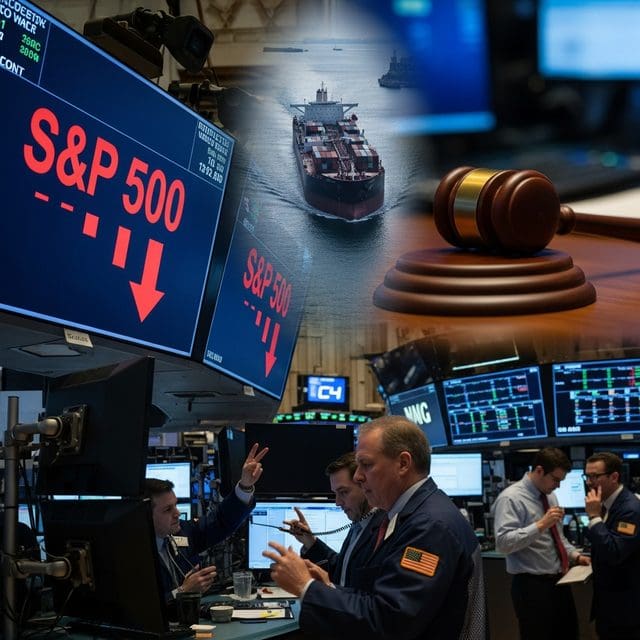
The S&P 500 fell nearly 1% as hot inflation data and escalating conflict in the Strait of Hormuz rattled investors, overshadowing a historic leadership transition at the Federal Reserve.
Wall Street faced a sobering reality check on Tuesday as the S&P 500 (SPY) retreated 0.96%, snapping a streak of record highs that had been fueled by artificial intelligence optimism. The downturn was precipitated by a combination of stubborn domestic inflation data and a deteriorating security situation in the Middle East, forcing American households to grapple with the prospect of higher-for-longer interest rates and surging energy costs. As the benchmark index slid, the broader market reflected a growing sense of unease regarding the stability of the global monetary system and the security of vital trade routes.
The Bureau of Labor Statistics reported that the April Consumer Price Index rose 0.6% month-over-month, a figure that caught markets off guard and signaled that the fight against inflation is far from over. Gasoline and shelter costs were the primary drivers of the spike, reflecting the immediate impact of global supply chain disruptions and a housing market that remains constrained by high mortgage rates. This data arrived just as the 10-year Treasury yield climbed above 4.42%, while the 2-year yield nudged toward 3.96%. These movements suggest that bond markets are bracing for a Federal Reserve that may be unable to pivot toward easing in the near term, despite the looming expiration of Chairman Jerome Powell’s term on May 15.
On the geopolitical front, national sovereignty and energy security have taken center stage. President Trump labeled Iran’s latest peace proposal “totally unacceptable,” a move that sent oil prices toward $105 per barrel. The rejection follows a direct exchange of fire in the Strait of Hormuz earlier this month, which has effectively kept the critical waterway closed. The International Monetary Fund warned that an escalation of the US-Israel conflict with Iran could push the global economy into a recession with lasting damage. Saudi Aramco’s leadership noted that weekly losses of approximately 100 million barrels could delay market normalization well into next year, a direct threat to the pocketbooks of working families.
In Washington, the transition of monetary leadership is underway. Kevin Warsh cleared an initial Senate procedural vote with a 49–44 margin. A final confirmation vote to seat Warsh on the Fed Board is expected Tuesday, with a subsequent vote later this week to confirm him as the successor to Chairman Powell. For the principled defender of the taxpayer, this transition represents a pivotal moment for fiscal discipline. Warsh will inherit a volatile landscape where the VIX volatility index has climbed to 18.38, and shorter-dated signals like the VIX9D have surged nearly 19% as investors scramble for downside protection.
While domestic equities struggled, the “Invisible Economy” of commodities showed significant movement. Copper and silver hit record highs, driven by momentum buying and industrial demand, even as Japan reported a 2.9% drop in household spending—the fourth consecutive decline for that nation. This divergence highlights a global market that is increasingly pricing in scarcity and geopolitical risk over consumer strength. Even specialized sectors saw volatility; AST SpaceMobile shares plummeted following a significant revenue miss, reminding investors that breakthroughs in technology do not always translate to immediate fiscal stability.
For the average household, the day’s movements underscore a tightening economic vise. With existing home sales missing forecasts at a 4.02 million annual rate and the cost of living rising via the CPI, the burden of centralized financial policy and foreign entanglements continues to weigh on Main Street. As the Senate moves toward a final vote on Fed leadership, the focus remains on whether a new regime can restore stability to a fractured monetary system and protect the purchasing power of the American dollar against the backdrop of global conflict.

Jordan Lee serves as the Senior Correspondent for Wall Street, Finance, and Monetary Systems at Just Right News. Based in the heart of the world’s financial capital, New York City, Lee brings a sharp, principled eye to the complex mechanisms that drive the global economy. His reporting is defined by a commitment to fiscal responsibility, the defense of the free market, and a deep-seated belief that a transparent monetary system is the bedrock of a free society.
Raised in Portland, Oregon, Lee’s perspective was forged in a city that has undergone significant cultural and economic shifts. His upbringing in the Pacific Northwest instilled in him a profound appreciation for the industriousness of small business owners and the importance of local economic stability. Watching the evolution of his hometown’s landscape sparked an early interest in how federal fiscal policy and large-scale financial trends eventually trickle down to the average citizen. This background provides him with a unique vantage point; he understands the growing disconnect between the policy-making elite and the reality of Main Street, a theme that frequently resonates throughout his work.
Now operating from his base in New York City, Lee bridges the gap between the high-stakes trading floors of Manhattan and the households of everyday Americans. He views the financial sector not merely as a collection of numbers and tickers, but as a vital engine of American prosperity that requires constant vigilance and accountability. His reporting often highlights the dangers of centralized financial control and the necessity of maintaining a system that rewards merit, risk-taking, and innovation.
As the creator and lead of the featured series, “The Invisible Economy,” Lee pulls back the curtain on the often-opaque world of monetary systems. He specializes in translating the dense jargon of central banking and international finance into actionable insights for the Just Right News audience. His work explores the “invisible” forces—such as inflationary pressures, regulatory creep, and the expansion of the administrative state—that erode the purchasing power of American families. By focusing on these systemic issues, Lee empowers readers to understand the hidden forces shaping their financial independence.
Lee’s journalistic philosophy is rooted in a steadfast commitment to traditional American values. As an Asian American professional who has navigated the competitive corridors of the financial world, he is a vocal advocate for meritocracy and the preservation of the American Dream. He believes that a stable currency and a predictable regulatory environment are essential for national sovereignty and individual liberty. His reporting frequently warns against the risks of government overreach in the private sector, arguing that the most effective solutions to economic challenges arise from competition and individual enterprise rather than bureaucratic mandates.
At Just Right News, Jordan Lee remains dedicated to providing a clear-eyed defense of the taxpayer. Whether he is analyzing market volatility or investigating the long-term implications of national debt, his mission is to provide the truth about where the money is going and what it means for the future of the country. Through his rigorous analysis and principled stance, Lee has become a trusted voice for those who value a strong, sovereign, and fiscally sound America.