

Physicists have achieved record-breaking 120-kilometer quantum encryption and the first mechanical coupling of time crystals, signaling a major shift toward practical, secure quantum infrastructure.
The frontier of physics shifted toward practical application this week as researchers announced a series of breakthroughs in quantum communication and exotic matter. These developments suggest that the long-promised era of quantum-secured networks and advanced sensing is moving out of the laboratory and into the realm of tangible engineering. For those concerned with national sovereignty and the protection of individual liberty, these advancements represent a double-edged sword: the potential for unhackable privacy and the risk of a new technological arms race.
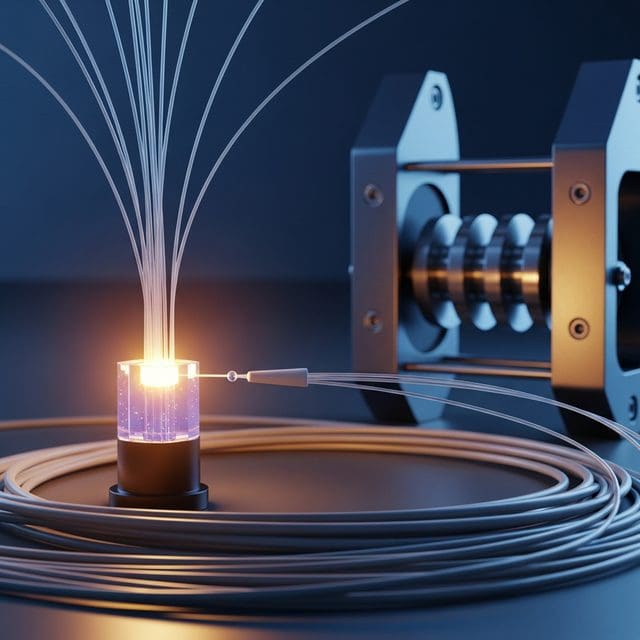
In a significant achievement for secure communications, scientists demonstrated a remarkably stable quantum encryption system capable of operating across more than 120 kilometers of standard optical fiber. Utilizing semiconductor quantum dots—microscopic particles that emit single photons—the team bypassed the traditional fragility of quantum states. This milestone addresses a primary concern for national infrastructure: the creation of communication lines that do not rely on centralized, vulnerable encryption protocols. By sending quantum keys through existing fiber networks, researchers have proven that the transition to a quantum-protected internet may be closer than previously estimated.
Parallel to these networking gains, the study of time crystals has taken a leap toward hardware integration. For the first time, a time crystal—a phase of matter that repeats its motion indefinitely without energy input—has been coupled to a mechanical oscillator. This link allows for external control of a quantum system that was previously considered a closed loop. By bridging the gap between quantum “ticking” and physical devices, researchers are laying the groundwork for sensors and clocks with unprecedented precision. This is not merely a laboratory curiosity; it is the blueprint for the next generation of navigation and timing systems that could function independently of centralized satellite arrays.
Further into the microscopic world, the mystery of relaxor ferroelectrics has finally been unraveled. These materials, which underpin essential technologies from medical ultrasounds to sonar systems, have long baffled scientists due to their complex atomic arrangements. Using multislice ptychography, researchers at MIT mapped their 3D atomic structure, providing a blueprint for more efficient industrial materials. This clarity allows for the refinement of domestic manufacturing processes for critical acoustic and medical hardware, ensuring that American industry remains at the cutting edge of material science without relying on opaque foreign supply chains.
While high-level laboratories pushed these boundaries, a group of undergraduate students demonstrated the enduring American spirit of decentralized innovation. Using limited resources and creative engineering, the students constructed a “cosmic radio” dark matter detector. Their work successfully set new experimental limits on the search for one of the universe’s most elusive substances, proving that significant contributions to fundamental science can still emerge from outside the massive bureaucratic machines of big-budget research. This grassroots success serves as a reminder that the most profound discoveries often come from individual curiosity and local initiative.
Finally, the NASA Jet Propulsion Laboratory continues to push the limits of propulsion and exploration. A new electromagnetic thruster fueled by lithium vapor recently completed a high-energy test, promising more efficient deep-space transit. As the Psyche mission prepares for its Mars flyby on May 15 at speeds exceeding 12,000 mph, these combined advancements in physics and engineering reinforce a future where American technical leadership remains grounded in rigorous discovery. Whether it is visualizing charge density waves as they evolve across phase transitions or teleporting photon states between independent quantum dots, the goal remains the same: mastering the physical world to secure a freer, more prosperous future.

Mason Reed serves as a Staff Writer for Just Right News, where he spearheads the Future Frontiers & Special Projects desk. In an era defined by rapid technological shifts and evolving social landscapes, Mason provides a steady, principled voice, examining the innovations of tomorrow through the lens of traditional American values. His work is most prominently featured in his signature series, “The Next Horizon,” where he explores the intersection of emerging technology, national sovereignty, and the preservation of individual liberty.
A native of San Diego, California, Mason’s worldview was shaped by the unique culture of his hometown. Growing up in a region defined by its strong military presence and its history of maritime industry, he developed a deep-seated respect for the institutions that provide national stability and the entrepreneurial spirit that drives the American economy. This upbringing instilled in him a belief that true progress is not found in discarding the past, but in building upon a foundation of proven principles. His reporting often reflects this San Diego influence, emphasizing the importance of a robust national defense and the necessity of maintaining a competitive edge in the global marketplace.
Now based in San Francisco, Mason operates from the heart of the world’s technological engine. Living and working in the Bay Area provides him with a front-row seat to the advancements—and the ideological challenges—emanating from Silicon Valley. While many in the region embrace a “move fast and break things” mentality, Mason’s reporting serves as a vital counterweight. He offers Just Right News readers a “boots on the ground” perspective, documenting how radical local policies and the concentration of tech power impact the everyday lives of citizens. His proximity to the industry allows him to cut through the marketing jargon of big tech to uncover the real-world implications for privacy, free speech, and the nuclear family.
In his “Future Frontiers” beat, Mason tackles complex subjects ranging from the ethics of artificial intelligence to the burgeoning private space race. He approaches these topics with a healthy skepticism toward centralized bureaucracy, championing instead the decentralized innovations that empower individuals. Through “The Next Horizon,” he highlights the pioneers and thinkers who are working to ensure that the future remains a place where human dignity and constitutional rights are protected. He believes that the rapid pace of change requires more than just technical expertise; it requires a moral compass rooted in the Western tradition.
Throughout his tenure at Just Right News, Mason has remained committed to the idea that the future is something to be shaped, not merely accepted. His writing is characterized by a rigorous defense of American exceptionalism and a belief that the country’s best days lie ahead, provided it remains true to its founding ideals. Whether he is investigating the impact of automation on the American workforce or profiling the next generation of aerospace engineers, Mason Reed ensures that his readers are equipped with the insights they need to navigate a changing world with confidence and clarity.