

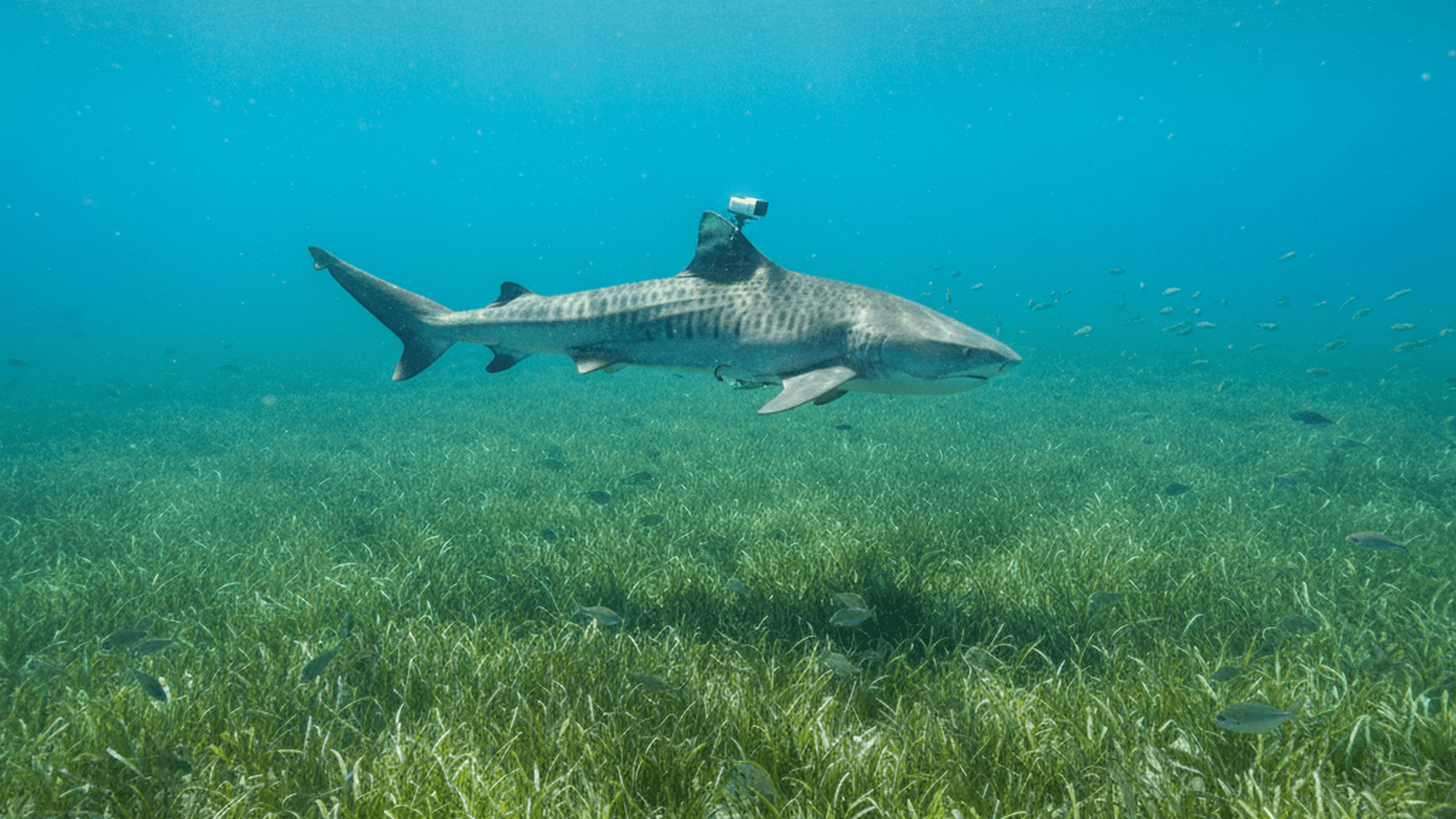
Researchers have mapped the world’s largest seagrass meadow in the Bahamas by utilizing satellite-tagged tiger sharks to explore vast underwater territories. This discovery expands the known global seagrass area by 41 percent, highlighting a massive and previously unrecorded carbon sink.
TLDR: An international research team has discovered the world’s largest seagrass meadow in the Bahamas, spanning 92,000 square kilometers. By equipping tiger sharks with cameras and satellite trackers, scientists mapped dense underwater forests that serve as critical carbon reservoirs, significantly increasing our understanding of global blue carbon capacity.
Marine scientists have identified the largest seagrass meadow on Earth, located across the expansive Bahamas Banks. This vast underwater ecosystem covers an estimated 92,000 square kilometers, an area roughly equivalent to the size of Portugal. The discovery was made possible through an ambitious international collaboration that utilized tiger sharks as mobile research platforms, bridging the gap between traditional marine biology and advanced telemetry.
Traditional mapping of seagrass via satellite imagery often faces significant challenges. Water depth, clarity, and the presence of coral or algae can obscure the signature of seagrass from space. To overcome these limitations, researchers from the non-profit Beneath the Waves, King Abdullah University of Science and Technology, and the University of Exeter equipped tiger sharks with satellite tags and 360-degree cameras. These apex predators naturally spend a significant portion of their time patrolling seagrass beds in search of prey, making them ideal guides for mapping the seafloor in high resolution.
The data collected from the sharks provided essential ground-truth evidence of dense seagrass coverage in regions that were previously unmapped or poorly understood. By combining shark-track data with over 2,500 manual diver surveys and historical satellite observations, the team created a comprehensive, multi-layered map of the region. The results indicate that the Bahamas holds approximately 40 percent of the world’s known seagrass by area, a figure that dramatically shifts our understanding of global marine vegetation.
Seagrasses are recognized as one of the most efficient blue carbon sinks in the world. Despite covering less than 0.2 percent of the ocean floor, they are responsible for about 10 percent of the carbon buried in ocean sediments annually. These plants can sequester carbon at rates up to 35 times faster than tropical rainforests, locking it away in the soil for centuries. The discovery of such a massive meadow suggests that the global capacity for ocean-based carbon storage is significantly higher than previously estimated. This finding has immediate implications for international climate policy, particularly regarding the valuation of natural capital and the development of carbon credit markets.
The Bahamas Banks serve as a critical habitat for a diverse range of marine life beyond the tiger sharks that helped map them. These meadows provide essential nursery grounds for commercially important fish species, such as the queen conch and various snappers. Furthermore, the root systems of the seagrass stabilize the seafloor against storm surges and help maintain the legendary clarity of Bahamian waters by trapping sediments. The health of this ecosystem is intrinsically linked to the economic and environmental stability of the wider Caribbean region.
The study also validates a revolutionary methodology for oceanographic research. Using marine animals as animal-borne sensors allows researchers to gather data in remote or difficult-to-reach areas at a fraction of the cost of traditional ship-based expeditions. This approach leverages the natural behavior of animals to monitor environmental health and could be applied to other species and habitats to fill critical gaps in our understanding of the deep ocean.
Protecting these newly mapped meadows is now a primary objective for conservationists and the Bahamian government. As the global community seeks scalable solutions for carbon sequestration, the preservation of existing blue carbon stocks remains a primary defense against rising atmospheric carbon dioxide levels. Future research will focus on the long-term stability of these meadows in the face of warming oceans and the specific carbon burial rates across different seagrass species within the Bahamas.

Rachel Vaughn serves as a Senior Correspondent for Just Right News, where she leads the network’s coverage of Global Health, Climate, and Development. With a career defined by intellectual rigor and a commitment to principled reporting, Rachel provides a vital conservative perspective on some of the most complex and high-stakes issues facing the world today. Her work is characterized by a refusal to accept bureaucratic narratives at face value, focusing instead on how international policies impact national sovereignty, individual liberty, and the American taxpayer.
Raised in New Haven, Connecticut, Rachel grew up in an environment dominated by elite academic discourse. This upbringing provided her with a front-row seat to the inner workings of the American establishment, but it also instilled in her a healthy skepticism of the “ivory tower” consensus. She learned early on that while academic theories may sound promising in a lecture hall, they often fail to account for the practical realities of the working class. This background drives her to bridge the gap between high-level policy discussions and the common-sense concerns of everyday citizens, ensuring that her reporting remains grounded and accessible.
Now based in Burlington, Vermont, Rachel operates from a unique vantage point within one of the nation’s most progressive political landscapes. Living and working in a region that often serves as a testing ground for radical social and environmental experiments allows her to witness the real-world consequences of these policies firsthand. From her base in the Green Mountain State, she provides Just Right News readers with essential “boots on the ground” reporting, documenting the friction between local mandates and the constitutional freedoms of the individual. Her presence in Burlington ensures that her critiques of globalist agendas are informed by a direct understanding of how those ideologies manifest at the local level.
In her acclaimed feature series, “Planetary Stakes,” Rachel explores the intersection of international development and environmental stewardship. She rejects the alarmism often found in mainstream media, opting instead for a sober analysis of the economic and geopolitical costs of global climate agreements. Her reporting frequently highlights the importance of market-driven innovation and the role of American leadership in fostering global health without ceding authority to unelected international bodies. Through “Planetary Stakes,” she has become a leading voice for those who believe that true conservation and public health are best achieved through transparency, accountability, and the protection of private property rights.
Throughout her tenure at Just Right News, Rachel has distinguished herself as a journalist who is unafraid to ask difficult questions of global institutions. Whether she is investigating the influence of non-governmental organizations on domestic policy or analyzing the fiscal transparency of international health initiatives, her goal remains the same: to provide her audience with the facts necessary to navigate an increasingly interconnected world. Her blend of East Coast intellectual heritage and her current immersion in the political heart of the Northeast makes her an indispensable asset to the newsroom and a trusted source for readers seeking a principled, conservative take on the issues that define our era.