

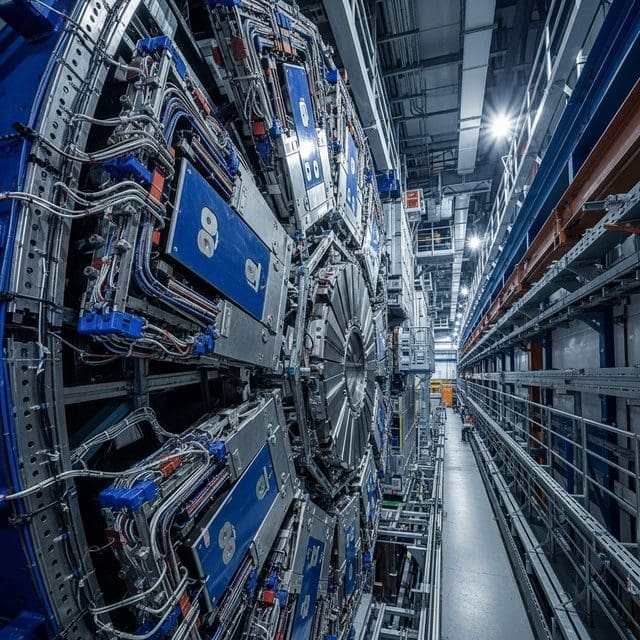
Data from the Large Hadron Collider reveals a rare subatomic transformation that challenges fifty years of scientific consensus, suggesting the existence of undiscovered fundamental forces.
For over half a century, the Standard Model of particle physics has served as the bedrock of our understanding of the subatomic world. It has withstood rigorous scrutiny, yet physicists have long known it is an incomplete map, failing to account for gravity or the mysterious dark matter that permeates the cosmos. This week, researchers at CERN’s Large Hadron Collider (LHC) in Geneva announced a significant crack in that bedrock, reporting a rare particle decay that refuses to follow the established rules, signaling a potential shift in the fundamental laws of nature.
The discovery centers on the B meson, a short-lived particle produced in high-energy proton collisions within the 27-kilometer circular tunnel beneath the Franco-Swiss border. Specifically, the LHCb collaboration analyzed what is known as an “electroweak penguin decay.” In this rare transformation—occurring only once in every million B mesons—a beauty quark turns into a strange quark, emitting a kaon, a pion, and two muons. The angles and energies of these resulting particles are showing a “tension” of four standard deviations from theoretical predictions. In the precise world of particle physics, this represents a one-in-16,000 chance that the result is a mere statistical fluke.
While the finding stops just short of the “five-sigma” gold standard required for an official discovery, the data is bolstered by similar, albeit less precise, results from the independent CMS experiment published earlier in 2025. The consistency across different detectors suggests that the anomaly is not a localized error but a genuine signal of “new physics.” These rare decays are uniquely sensitive to the influence of heavy, undiscovered particles that cannot yet be created directly in a lab. This method of indirect observation has historical precedent; radioactivity was discovered 80 years before the W bosons responsible for it were ever directly observed.
The implications for technological leadership and the pursuit of truth are profound. As the West continues to fund massive international projects like CERN, the discovery of new fundamental particles—such as the hypothesized “leptoquarks” that unite leptons and quarks—could eventually unlock revolutionary energy sources or materials. For the American citizen, these findings represent the absolute frontier of human knowledge, where the most rigid laws of nature are being tested by the most advanced engineering ever devised by man. The Standard Model was built on the 20th-century pillars of quantum mechanics and special relativity, but these new results suggest we are standing on the precipice of a 21st-century revolution.
Critics and cautious theorists point to “charming penguins” as a potential source of the discrepancy. These are complex Standard Model processes involving charm quarks that are notoriously difficult to calculate with precision. However, recent theoretical estimates suggest these effects are insufficient to explain the current data. Furthermore, a combination of theory and experimental data from the LHCb suggests that the Standard Model simply struggles to reconcile these anomalous results. The scientific community is not yet making a definitive claim of a new force, but the evidence is mounting in a way that is becoming impossible to ignore.
The path forward is paved with massive amounts of data. The current study analyzed approximately 650 billion B meson decays recorded between 2011 and 2018. Since that time, the LHCb experiment has already recorded three times as many B mesons during its Run 3 phase. With planned upgrades in the 2030s expected to increase the total dataset fifteen-fold, a definitive confirmation of physics beyond the Standard Model appears to be a matter of when, not if. As these experiments continue, they remind us that even the most established bureaucratic and scientific consensuses are subject to the cold, hard reality of experimental truth.

Mason Reed serves as a Staff Writer for Just Right News, where he spearheads the Future Frontiers & Special Projects desk. In an era defined by rapid technological shifts and evolving social landscapes, Mason provides a steady, principled voice, examining the innovations of tomorrow through the lens of traditional American values. His work is most prominently featured in his signature series, “The Next Horizon,” where he explores the intersection of emerging technology, national sovereignty, and the preservation of individual liberty.
A native of San Diego, California, Mason’s worldview was shaped by the unique culture of his hometown. Growing up in a region defined by its strong military presence and its history of maritime industry, he developed a deep-seated respect for the institutions that provide national stability and the entrepreneurial spirit that drives the American economy. This upbringing instilled in him a belief that true progress is not found in discarding the past, but in building upon a foundation of proven principles. His reporting often reflects this San Diego influence, emphasizing the importance of a robust national defense and the necessity of maintaining a competitive edge in the global marketplace.
Now based in San Francisco, Mason operates from the heart of the world’s technological engine. Living and working in the Bay Area provides him with a front-row seat to the advancements—and the ideological challenges—emanating from Silicon Valley. While many in the region embrace a “move fast and break things” mentality, Mason’s reporting serves as a vital counterweight. He offers Just Right News readers a “boots on the ground” perspective, documenting how radical local policies and the concentration of tech power impact the everyday lives of citizens. His proximity to the industry allows him to cut through the marketing jargon of big tech to uncover the real-world implications for privacy, free speech, and the nuclear family.
In his “Future Frontiers” beat, Mason tackles complex subjects ranging from the ethics of artificial intelligence to the burgeoning private space race. He approaches these topics with a healthy skepticism toward centralized bureaucracy, championing instead the decentralized innovations that empower individuals. Through “The Next Horizon,” he highlights the pioneers and thinkers who are working to ensure that the future remains a place where human dignity and constitutional rights are protected. He believes that the rapid pace of change requires more than just technical expertise; it requires a moral compass rooted in the Western tradition.
Throughout his tenure at Just Right News, Mason has remained committed to the idea that the future is something to be shaped, not merely accepted. His writing is characterized by a rigorous defense of American exceptionalism and a belief that the country’s best days lie ahead, provided it remains true to its founding ideals. Whether he is investigating the impact of automation on the American workforce or profiling the next generation of aerospace engineers, Mason Reed ensures that his readers are equipped with the insights they need to navigate a changing world with confidence and clarity.