

The Trump administration has sanctioned 14 entities linked to Iranian drone production while a temporary ceasefire and prisoner swap take effect on the Ukrainian front.
The Trump administration intensified its economic campaign against the Iranian defense sector on May 8, 2026, blacklisting 11 entities and three individuals across Iran, China, Belarus, and the UAE. The sanctions target the procurement networks for Shahed drone components and satellite imagery services used by Russia in its ongoing conflict with Ukraine. This move underscores a realist approach to the dual-theater challenge facing Washington, as the administration seeks to sever the technical ties between Tehran and Moscow while maintaining leverage in the Persian Gulf.
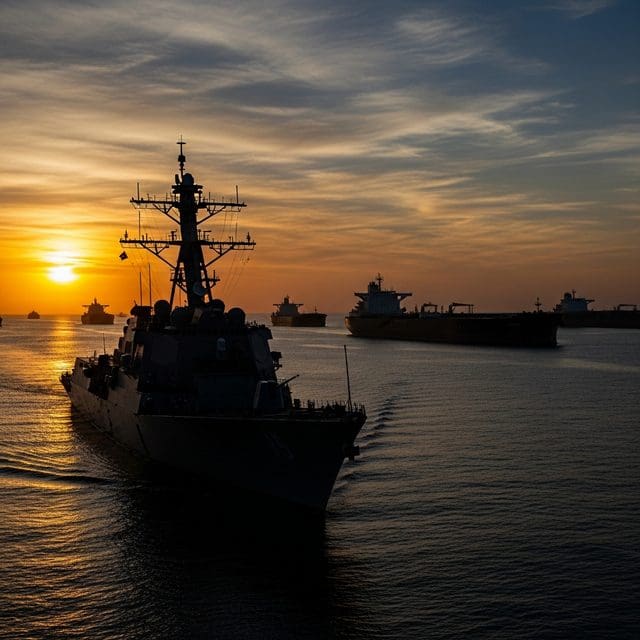
In the Middle East, the geopolitical stakes remain centered on the Strait of Hormuz. Despite recent naval clashes where U.S. forces sank eight Islamic Revolutionary Guard Corps boats, the administration is currently reviewing Iranian responses to a proposed peace deal. President Trump has signaled a willingness to resume kinetic operations if the agreement, which includes the reopening of the strategic waterway, is not finalized. The conflict has already impacted global shipping, with approximately 100 Hong Kong-linked vessels currently stranded in the region, trapping an estimated 2,300 seafarers.
On the European front, a fragile three-day ceasefire between Russia and Ukraine began on Saturday. The pause in hostilities, brokered by the White House, is designed to facilitate a massive prisoner swap involving 1,000 personnel from each side. While the ceasefire offers a brief reprieve, NATO allies are already looking toward long-term security architecture. Canadian Foreign Affairs Minister Anita Anand met with NATO Secretary General Mark Rutte in Brussels to advocate for the seizure of Russian sovereign assets and to address the abduction of an estimated 35,000 Ukrainian children by Russian forces, of which only 2,000 have been returned.
China’s role in these shifting alliances was further highlighted by reports of firms like Xiamen Victory continuing to supply drone engines to the Russo-Iranian axis despite international pressure. Even as Beijing hosted a strategic partnership forum in Athens to promote intercultural dialogue, its industrial base remains a critical node in the defense supply chains of U.S. adversaries. The administration’s latest sanctions specifically target these Chinese intermediaries, signaling that the peace through strength doctrine will increasingly rely on aggressive financial decoupling from those enabling regional instability.
Domestically, the administration continues to align its foreign policy with a broader security mandate. On May 8, the Department of Justice moved to denaturalize 11 individuals accused of providing material support to terrorists and other serious crimes. This domestic enforcement, combined with the pressure on the Iranian regime and the mediation of the Russo-Ukrainian swap, reflects a foreign policy focused on tangible national interests and the restoration of American deterrence in contested maritime and land corridors. While a federal judge recently ruled against the administration regarding the cancellation of certain humanities grants, the White House remains focused on the hard-power realities of the 2026 global landscape.

Olivia Kendall serves as the Senior Correspondent for Geopolitics, Defense, and Foreign Policy at Just Right News, where she provides a principled, conservative perspective on the complex forces shaping the global stage. With a career dedicated to deconstructing the intricacies of international relations, Kendall has become a trusted voice for readers who value national sovereignty, a robust military, and a foreign policy that prioritizes American interests above all else.
A native of Washington, D.C., Kendall’s professional journey is deeply rooted in her upbringing within the nation’s capital. Growing up in the epicenter of American political life, she developed an early and profound understanding of how policy is crafted and, more importantly, how it often fails to account for the values of the American heartland. This unique vantage point allowed her to witness firsthand the rise of globalist bureaucracies, fueling her commitment to reporting that champions the constitutional foundations of the United States. Her background as a British White American further informs her worldview, providing her with a keen appreciation for the Western tradition and the enduring importance of the “Special Relationship” in maintaining global stability.
Now based in Arlington, Virginia, Kendall operates from the doorstep of the Pentagon and the heart of the nation’s defense establishment. Her proximity to the decision-makers in the military and intelligence communities allows her to provide boots-on-the-ground reporting that is both timely and deeply informed. For Kendall, Arlington is more than just a base of operations; it is a daily reminder of the sacrifices made by the men and women in uniform. This connection to the defense community drives her rigorous coverage of military readiness and her advocacy for a “peace through strength” approach to diplomacy.
At Just Right News, Kendall is perhaps best known for her acclaimed feature series, “The World’s Shadow on America.” In this ongoing project, she explores the direct correlation between international developments and the daily lives of American citizens. Whether she is analyzing the encroachment of foreign adversaries in domestic supply chains or the impact of international treaties on local economies, Kendall’s work serves as a vital bridge between distant geopolitical shifts and their consequences at home. She rejects the notion that foreign policy is an abstract concern for elites, instead proving that what happens in the corridors of power in Brussels or Beijing has a tangible “shadow” that falls across every American doorstep.
Throughout her tenure, Kendall has remained a steadfast critic of international overreach and a vocal proponent of a clear-eyed, realistic foreign policy. She brings a sharp analytical mind to her beat, often challenging the prevailing narratives of the mainstream media to uncover the underlying truths that affect national security. Her reporting is characterized by a refusal to compromise on the truth and a dedication to the idea that a strong, secure America is the world’s best hope for liberty. As a Senior Correspondent, Olivia Kendall continues to lead the charge in providing the essential context and conservative insight necessary to navigate an increasingly volatile world.