

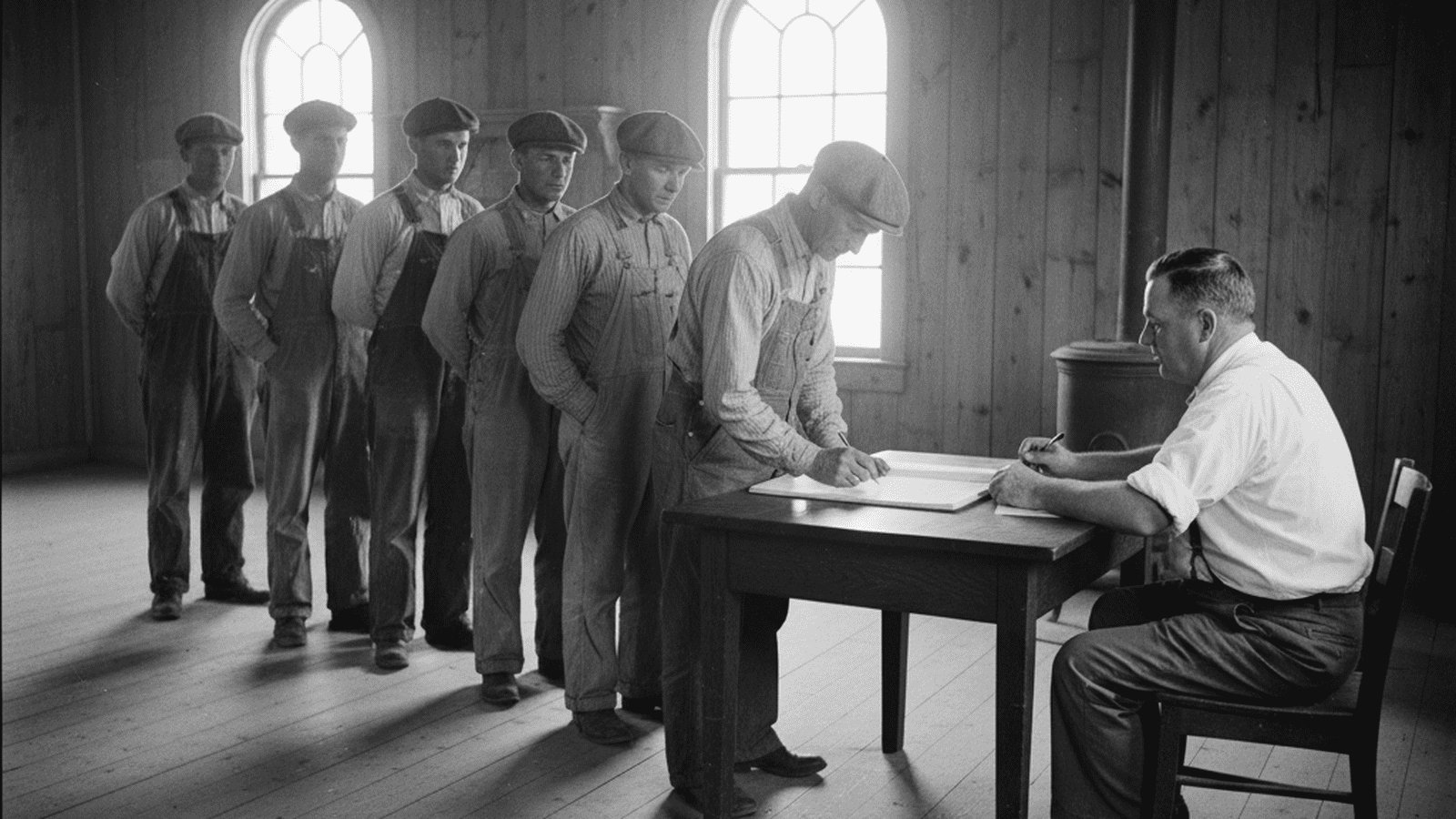
In 1934, Kansas enacted significant election reforms to eliminate party raiding by requiring voters to declare their party affiliation before participating in primary contests. This shift in the United States political landscape aimed to protect party integrity during the height of the New Deal era.
TLDR: Kansas implemented a landmark primary reform in 1934 to stop voters from crossing party lines to sabotage opponents. The law required formal party registration at the polls, a move that solidified the two-party system in the state but sparked intense debate over voter privacy and independent participation.
The political landscape of the Great Plains during the 1930s was defined by the dual pressures of the Great Depression and the sweeping federal changes of the New Deal. In Kansas, these pressures manifested in a fierce struggle over the integrity of the primary election system. By 1934, the state legislature moved to address a phenomenon known as party raiding, where voters from one party would participate in the opposing party’s primary to ensure the nomination of a weak or beatable candidate. This practice had become increasingly common as the state’s Republican establishment sought to fend off the rising tide of New Deal Democrats.
Governor Alf Landon, a moderate Republican who would later become the party’s presidential nominee in 1936, oversaw the implementation of the 1934 primary reform. The new law required voters to formally declare their party affiliation at the polling place before they could receive a primary ballot. Once a voter declared their affiliation, that choice was recorded in a permanent ledger, making it difficult for them to switch sides in subsequent elections without a formal process. This branding of voters was intended to create a more disciplined and predictable electorate.
Proponents of the reform argued that political parties were private associations that had a right to determine their own candidates without outside interference. They contended that party raiding made a mockery of the primary system and allowed organized groups to sabotage their rivals. In the eyes of the reformers, a closed primary system was the only way to ensure that the eventual nominees truly represented the will of the party faithful. The 1934 law was seen as a necessary defense mechanism for a political system under stress.
However, the reform faced significant opposition from those who valued the tradition of the secret ballot and independent voting. Critics argued that forcing a public declaration of party affiliation was a form of intimidation, particularly in small rural communities where political leanings could affect social and business relationships. Labor organizations and independent political movements also decried the law, claiming it was a tool used by the two major parties to entrench their power and stifle third-party challenges. They viewed the requirement as an unnecessary barrier to the free exercise of the franchise.
The 1934 primary was the first major test of the new system. Despite the controversy, the law successfully reduced the incidence of cross-over voting, leading to more traditional outcomes in both the Republican and Democratic contests. Governor Landon’s administration touted the reform as a victory for clean elections and a model for other states in the region. The shift helped Landon consolidate his base, providing him with a stable platform from which to launch his national campaign against Franklin D. Roosevelt two years later.
The legacy of the 1934 Kansas primary reform extended far beyond the New Deal era. It marked a transition toward more rigid partisan structures in the United States, moving away from the fluid, often chaotic primary systems of the early 20th century. Over the following decades, the principles established in this law were refined and expanded, leading to the modern registration systems used today. While the debate over open versus closed primaries continues to be a point of contention in American politics, the 1934 Kansas law remains a pivotal moment in the professionalization of state-level election management. Subsequent reforms in the 1970s and 1990s further codified these procedures, ensuring that the tension between party integrity and voter independence remains a central theme in the administration of U.S. democracy.

Sophie Carter serves as a Staff Writer for Just Right News, where she anchors the outlet’s critical coverage of Elections, Influence, and Democracy Infrastructure. In an era where the mechanics of voting and the flow of political capital are under constant scrutiny, Sophie provides a steady, principled voice dedicated to the preservation of American institutional integrity and the rule of law.
Raised in Charlotte, North Carolina, Sophie’s perspective was forged in a community that balances rapid modern growth with a deep respect for tradition and civic duty. Growing up in the Queen City, she witnessed firsthand how a robust local culture depends on the trust between the citizen and the state. This upbringing instilled in her a foundational belief that the right to vote is a sacred trust—one that must be protected from both administrative overreach and the encroaching influence of special interest groups. Her reporting reflects these North Carolina roots, emphasizing the importance of community-led governance and the preservation of the individual’s voice in the face of nationalized political movements.
Now based in Atlanta, Georgia, Sophie operates from the heart of one of the nation’s most pivotal and contested political landscapes. Her location allows her to report from the front lines of the debate over election security, legislative reform, and the modernization of voting systems. For Sophie, the “infrastructure” of democracy is not merely a matter of machines and ballots; it is the collection of laws, people, and transparent processes required to maintain public confidence. Her work often highlights the necessity of clear, enforceable standards that ensure every legal vote is counted fairly and that the machinery of our republic remains accountable to the taxpayers who fund it.
Central to her work at Just Right News is her acclaimed feature series, “The Price of a Vote.” Through this ongoing project, Sophie explores the complex web of influence that shapes modern campaigns and policy decisions. She delves into how high-level lobbying, non-governmental organizations, and shifting bureaucratic regulations impact the weight of an individual citizen’s ballot. By examining the financial and structural pressures placed on the electoral process, she provides readers with a comprehensive look at the forces vying for control over the American political system.
Sophie’s approach to journalism is rooted in a commitment to the constitutional framework. She views her role as a watchdog for the voter, ensuring that the systems meant to serve the public remain transparent and free from corruption. Whether she is analyzing the implementation of new voting technologies or investigating the influence of outside money on state-level policy, her work is characterized by a rigorous adherence to facts and a refusal to succumb to the sensationalism that often plagues modern political reporting.
At Just Right News, Sophie Carter continues to be a vital resource for readers who value clarity, conviction, and a defense of traditional American values. Her deep ties to the Southeast and her specialized focus on the mechanics of our republic make her an essential voice in the ongoing conversation about the future of American self-governance. Through her reporting, she remains dedicated to the idea that a secure and honest electoral system is the bedrock of a free and prosperous society.