

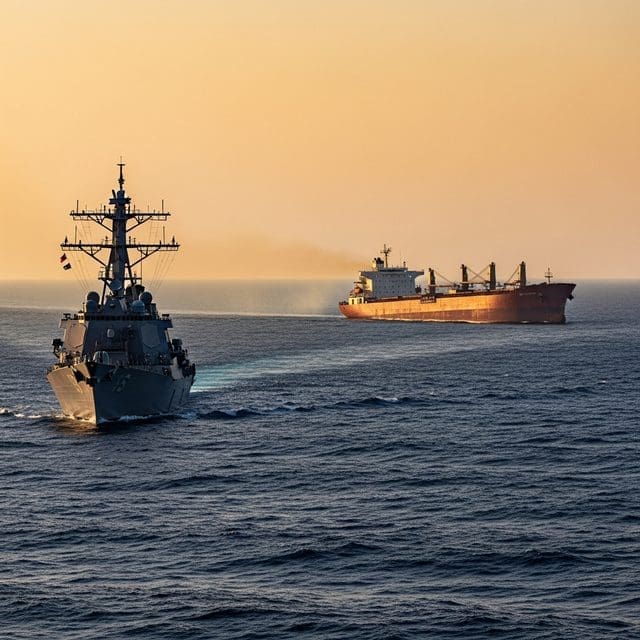
The seizure of an Iranian cargo ship by the USS Spruance has heightened tensions in the Gulf of Oman, threatening a fragile ceasefire and testing the Pentagon’s new ‘Rapid Dominance’ doctrine.
The geopolitical landscape in the Middle East shifted toward open confrontation on April 19, when the U.S. Navy Guided Missile Destroyer USS Spruance intercepted and seized the Iranian-flagged cargo ship Touska in the Gulf of Oman. The vessel, which was reportedly transiting toward the port of Bandar Abbas at 17 knots, was boarded after ignoring warnings for six hours. U.S. forces reportedly fired on the ship’s engine room to disable it before taking control. This incident marks the first boarding since the United States initiated a naval blockade on April 13.
Defense officials indicate the Touska was likely transporting dual-use equipment deemed contraband under current enforcement protocols. The seizure follows a period of heightened vigilance where CENTCOM reported turning away nine other Iranian-bound vessels. Tehran’s joint military command has characterized the operation as “armed piracy” and vowed swift retaliation, further complicating a delicate diplomatic window. Iranian Deputy Foreign Minister Saeed Khatibzadeh previously signaled that Iran would not make concessions on enriched uranium, citing excessive U.S. demands as a barrier to direct negotiations.
This maritime escalation coincides with the unveiling of the “Rapid Dominance” doctrine by Secretary of Defense Pete Hegseth and Joint Chiefs Chairman General Dan Caine. Approved by President Trump, the policy emphasizes pre-emptive capabilities and technological superiority to counter aggression from Iran in the Strait of Hormuz and China in the South China Sea. The doctrine signals a shift toward a realist application of American power, prioritizing the security of vital sea lanes over traditional diplomatic patience.
The timing of the seizure is critical, as a U.S.-Iran ceasefire is set to expire on April 22. While Pakistan has attempted to mediate a second round of talks in Islamabad, the prospects for a renewal appear dim. President Trump warned on April 18 that the U.S. remains prepared to strike Iran again if a comprehensive deal is not reached by the deadline. Meanwhile, European allies are feeling the pressure of these shifting dynamics; German Chancellor Friedrich Merz has requested U.S. participation in a mission to secure the Strait of Hormuz, reflecting growing international concern over energy security and the erosion of maritime law.
As the U.S. focuses on the Middle East, the Western alliance remains committed to the European theater. At a recent Ukraine Defence Contact Group meeting in Berlin, NATO Secretary General Mark Rutte confirmed that 2026 military support for Ukraine would reach $60 billion. This includes a significant pledge from the United Kingdom of 120,000 drones. However, Russian Foreign Minister Sergey Lavrov has dismissed NATO as a U.S.-dominated “aggressive bloc,” warning of a Russian response to continued Western expansion. The convergence of these flashpoints—from the Gulf of Oman to the Ukrainian front—tests the capacity of the United States to maintain a multi-theater deterrent while navigating the economic realities of tariffs and industrial strain at home.

Olivia Kendall serves as the Senior Correspondent for Geopolitics, Defense, and Foreign Policy at Just Right News, where she provides a principled, conservative perspective on the complex forces shaping the global stage. With a career dedicated to deconstructing the intricacies of international relations, Kendall has become a trusted voice for readers who value national sovereignty, a robust military, and a foreign policy that prioritizes American interests above all else.
A native of Washington, D.C., Kendall’s professional journey is deeply rooted in her upbringing within the nation’s capital. Growing up in the epicenter of American political life, she developed an early and profound understanding of how policy is crafted and, more importantly, how it often fails to account for the values of the American heartland. This unique vantage point allowed her to witness firsthand the rise of globalist bureaucracies, fueling her commitment to reporting that champions the constitutional foundations of the United States. Her background as a British White American further informs her worldview, providing her with a keen appreciation for the Western tradition and the enduring importance of the “Special Relationship” in maintaining global stability.
Now based in Arlington, Virginia, Kendall operates from the doorstep of the Pentagon and the heart of the nation’s defense establishment. Her proximity to the decision-makers in the military and intelligence communities allows her to provide boots-on-the-ground reporting that is both timely and deeply informed. For Kendall, Arlington is more than just a base of operations; it is a daily reminder of the sacrifices made by the men and women in uniform. This connection to the defense community drives her rigorous coverage of military readiness and her advocacy for a “peace through strength” approach to diplomacy.
At Just Right News, Kendall is perhaps best known for her acclaimed feature series, “The World’s Shadow on America.” In this ongoing project, she explores the direct correlation between international developments and the daily lives of American citizens. Whether she is analyzing the encroachment of foreign adversaries in domestic supply chains or the impact of international treaties on local economies, Kendall’s work serves as a vital bridge between distant geopolitical shifts and their consequences at home. She rejects the notion that foreign policy is an abstract concern for elites, instead proving that what happens in the corridors of power in Brussels or Beijing has a tangible “shadow” that falls across every American doorstep.
Throughout her tenure, Kendall has remained a steadfast critic of international overreach and a vocal proponent of a clear-eyed, realistic foreign policy. She brings a sharp analytical mind to her beat, often challenging the prevailing narratives of the mainstream media to uncover the underlying truths that affect national security. Her reporting is characterized by a refusal to compromise on the truth and a dedication to the idea that a strong, secure America is the world’s best hope for liberty. As a Senior Correspondent, Olivia Kendall continues to lead the charge in providing the essential context and conservative insight necessary to navigate an increasingly volatile world.