

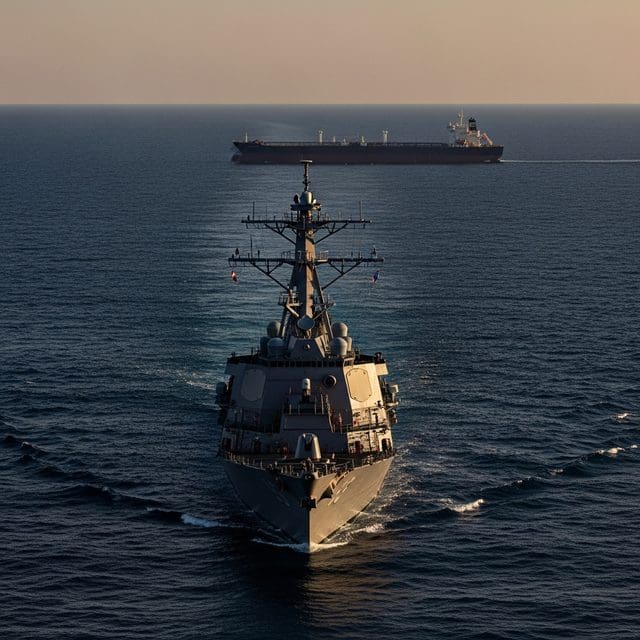
American negotiators arrive in Islamabad to navigate a crumbling ceasefire while a 57-day naval blockade of the Strait of Hormuz sends global tanker rates soaring and energy markets into high-alert.
The strategic deadlock in the Middle East reached a critical juncture this weekend as American envoys Steve Witkoff and Jared Kushner arrived in Islamabad. Their mission centers on a Saturday summit facilitated by Pakistani mediators, intended to prevent the total collapse of a fragile U.S.-Iran ceasefire set to expire within 48 hours. While Washington signals a desire for direct engagement, Tehran’s Foreign Ministry continues to maintain that no face-to-face meetings with American officials are scheduled, positioning Pakistan as a necessary buffer.
The diplomatic friction is underscored by the reality on the water. The Strait of Hormuz has entered its 57th day of near-total closure to commercial shipping. Defense Secretary Pete Hegseth confirmed that the U.S.-led naval blockade is “growing and going global,” a response to prior Iranian gunboat attacks and tanker interceptions. Currently, all nine major global shipping carriers have suspended transit through the artery, leaving over 45 vessels trapped and forcing energy markets to rely on limited pipeline coverage that meets only 35 percent of normal flow. This maritime paralysis has caused tanker ETFs to surge by 600 percent, reflecting the massive costs of rerouting global trade.
While the Pentagon manages the Persian Gulf, the broader geopolitical landscape remains volatile. In Eastern Europe, Ukraine has demonstrated a significant leap in long-range strike capabilities, utilizing drones to hit targets in Yekaterinburg—roughly 1,800 kilometers from the front lines. This escalation follows a massive Russian aerial assault involving over 600 drones that claimed lives in Dnipro. NATO allies have maintained their 2025 commitment of €35 billion in aid, though no new defense packages were announced following French President Emmanuel Macron’s recent pledge to bolster European defense integration.
Adding to the urgency in Islamabad are reports regarding Iran’s nuclear threshold. Current estimates suggest Tehran holds an 11-ton uranium stockpile, theoretically sufficient for 100 nuclear warheads. This capability provides the Iranian delegation with significant leverage as they accuse the United States and Israel of inciting domestic unrest to weaken their negotiating position.
For the Trump administration, the stakes in Pakistan extend beyond regional stability. The outcome of these talks will determine whether the U.S. can transition from a posture of active naval containment to a sustainable diplomatic framework. Without a breakthrough, the expiration of the ceasefire on April 26 threatens to turn a shipping crisis into a direct kinetic confrontation, testing the administration’s commitment to ‘peace through strength’ in an increasingly multipolar environment.

Olivia Kendall serves as the Senior Correspondent for Geopolitics, Defense, and Foreign Policy at Just Right News, where she provides a principled, conservative perspective on the complex forces shaping the global stage. With a career dedicated to deconstructing the intricacies of international relations, Kendall has become a trusted voice for readers who value national sovereignty, a robust military, and a foreign policy that prioritizes American interests above all else.
A native of Washington, D.C., Kendall’s professional journey is deeply rooted in her upbringing within the nation’s capital. Growing up in the epicenter of American political life, she developed an early and profound understanding of how policy is crafted and, more importantly, how it often fails to account for the values of the American heartland. This unique vantage point allowed her to witness firsthand the rise of globalist bureaucracies, fueling her commitment to reporting that champions the constitutional foundations of the United States. Her background as a British White American further informs her worldview, providing her with a keen appreciation for the Western tradition and the enduring importance of the “Special Relationship” in maintaining global stability.
Now based in Arlington, Virginia, Kendall operates from the doorstep of the Pentagon and the heart of the nation’s defense establishment. Her proximity to the decision-makers in the military and intelligence communities allows her to provide boots-on-the-ground reporting that is both timely and deeply informed. For Kendall, Arlington is more than just a base of operations; it is a daily reminder of the sacrifices made by the men and women in uniform. This connection to the defense community drives her rigorous coverage of military readiness and her advocacy for a “peace through strength” approach to diplomacy.
At Just Right News, Kendall is perhaps best known for her acclaimed feature series, “The World’s Shadow on America.” In this ongoing project, she explores the direct correlation between international developments and the daily lives of American citizens. Whether she is analyzing the encroachment of foreign adversaries in domestic supply chains or the impact of international treaties on local economies, Kendall’s work serves as a vital bridge between distant geopolitical shifts and their consequences at home. She rejects the notion that foreign policy is an abstract concern for elites, instead proving that what happens in the corridors of power in Brussels or Beijing has a tangible “shadow” that falls across every American doorstep.
Throughout her tenure, Kendall has remained a steadfast critic of international overreach and a vocal proponent of a clear-eyed, realistic foreign policy. She brings a sharp analytical mind to her beat, often challenging the prevailing narratives of the mainstream media to uncover the underlying truths that affect national security. Her reporting is characterized by a refusal to compromise on the truth and a dedication to the idea that a strong, secure America is the world’s best hope for liberty. As a Senior Correspondent, Olivia Kendall continues to lead the charge in providing the essential context and conservative insight necessary to navigate an increasingly volatile world.