

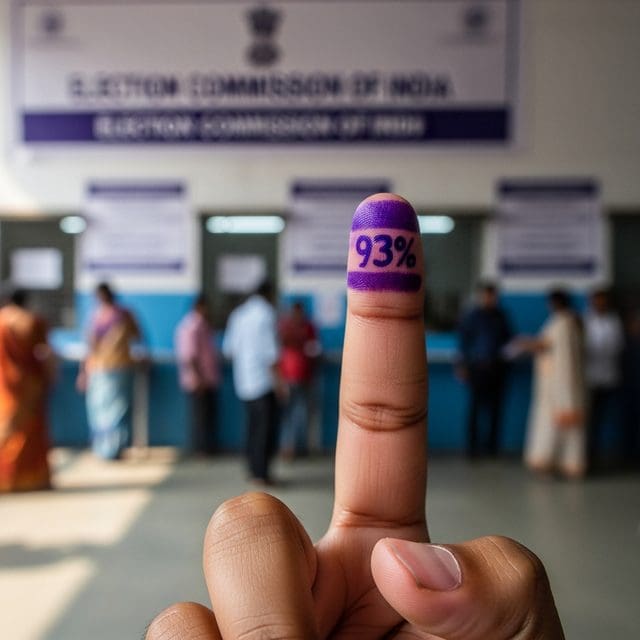
A historic 93 percent voter turnout in West Bengal’s first phase has triggered administrative disputes over data transparency and the security of digital voting records.
The first phase of the 2026 West Bengal assembly elections has concluded with a record-shattering voter turnout of 93.19 percent across 152 seats. This figure, confirmed by the Election Commission of India (ECI), represents the highest participation rate since Independence, driven largely by a surge in first-time voters and female participation. However, the sheer volume of the vote has immediately transitioned from a celebration of civic duty into a technical dispute over the mechanics of the count.
Following the April 23 polling, the ECI issued fresh post-poll guidelines specifically for the Bengal theater. The new protocols dictate that SD cards from booth cameras must remain under the direct supervision of sector officers until further notice. This administrative shift highlights the increasing reliance on digital surveillance to maintain the chain of custody in high-stakes contests, where the physical ballot’s journey is now mirrored by a digital trail that is equally subject to scrutiny.
Political leadership has already begun projecting outcomes based on these preliminary figures. Union Home Minister Amit Shah stated that the Bharatiya Janata Party (BJP) expects to secure over 110 of the 152 seats contested in the first phase. Defense Minister Rajnath Singh characterized the high turnout as a “clear message” from the electorate, suggesting that the volume of voters indicates a mandate for institutional change. The BJP delegation is scheduled to meet with the ECI on April 29 to discuss law and order requirements for the second phase, emphasizing a proactive approach to the administrative environment.
Conversely, Chief Minister Mamata Banerjee of the Trinamool Congress has raised procedural objections regarding the verification of voter rolls. Banerjee alleged the existence of a “logical discrepancy” in the rolls—a term she noted is not recognized under the standard ECI framework. She argued that the application of specific data-scrutiny exercises in Bengal, which are not utilized in other states, creates an uneven administrative playing field. This tension underscores a growing friction between state-level political entities and the centralized machinery of the ECI.
The rhetoric surrounding the election has also touched on the demographic integrity of the region. Assam Chief Minister Himanta Biswa Sarma recently described certain Bengal districts as an “extension of Bangladesh,” a comment that links the administrative act of voting to broader debates over national identity and border security. This occurs as a federal appeals court in the United States recently rejected efforts to ban asylum seekers at the U.S.-Mexico border, illustrating a global trend where judicial and electoral systems are increasingly tasked with defining the limits of the franchise.
As the state prepares for the second phase on April 29, the focus remains on the ECI’s ability to manage the logistics of a massive, highly energized electorate. With counting scheduled for May 4, the integrity of the process will depend on the transparent management of the “logical discrepancies” cited by the opposition and the secure handling of the digital records now mandated by the commission. In a high-turnout environment, the margin for administrative error narrows, placing the burden of proof on the infrastructure of the democracy itself.

Sophie Carter serves as a Staff Writer for Just Right News, where she anchors the outlet’s critical coverage of Elections, Influence, and Democracy Infrastructure. In an era where the mechanics of voting and the flow of political capital are under constant scrutiny, Sophie provides a steady, principled voice dedicated to the preservation of American institutional integrity and the rule of law.
Raised in Charlotte, North Carolina, Sophie’s perspective was forged in a community that balances rapid modern growth with a deep respect for tradition and civic duty. Growing up in the Queen City, she witnessed firsthand how a robust local culture depends on the trust between the citizen and the state. This upbringing instilled in her a foundational belief that the right to vote is a sacred trust—one that must be protected from both administrative overreach and the encroaching influence of special interest groups. Her reporting reflects these North Carolina roots, emphasizing the importance of community-led governance and the preservation of the individual’s voice in the face of nationalized political movements.
Now based in Atlanta, Georgia, Sophie operates from the heart of one of the nation’s most pivotal and contested political landscapes. Her location allows her to report from the front lines of the debate over election security, legislative reform, and the modernization of voting systems. For Sophie, the “infrastructure” of democracy is not merely a matter of machines and ballots; it is the collection of laws, people, and transparent processes required to maintain public confidence. Her work often highlights the necessity of clear, enforceable standards that ensure every legal vote is counted fairly and that the machinery of our republic remains accountable to the taxpayers who fund it.
Central to her work at Just Right News is her acclaimed feature series, “The Price of a Vote.” Through this ongoing project, Sophie explores the complex web of influence that shapes modern campaigns and policy decisions. She delves into how high-level lobbying, non-governmental organizations, and shifting bureaucratic regulations impact the weight of an individual citizen’s ballot. By examining the financial and structural pressures placed on the electoral process, she provides readers with a comprehensive look at the forces vying for control over the American political system.
Sophie’s approach to journalism is rooted in a commitment to the constitutional framework. She views her role as a watchdog for the voter, ensuring that the systems meant to serve the public remain transparent and free from corruption. Whether she is analyzing the implementation of new voting technologies or investigating the influence of outside money on state-level policy, her work is characterized by a rigorous adherence to facts and a refusal to succumb to the sensationalism that often plagues modern political reporting.
At Just Right News, Sophie Carter continues to be a vital resource for readers who value clarity, conviction, and a defense of traditional American values. Her deep ties to the Southeast and her specialized focus on the mechanics of our republic make her an essential voice in the ongoing conversation about the future of American self-governance. Through her reporting, she remains dedicated to the idea that a secure and honest electoral system is the bedrock of a free and prosperous society.