

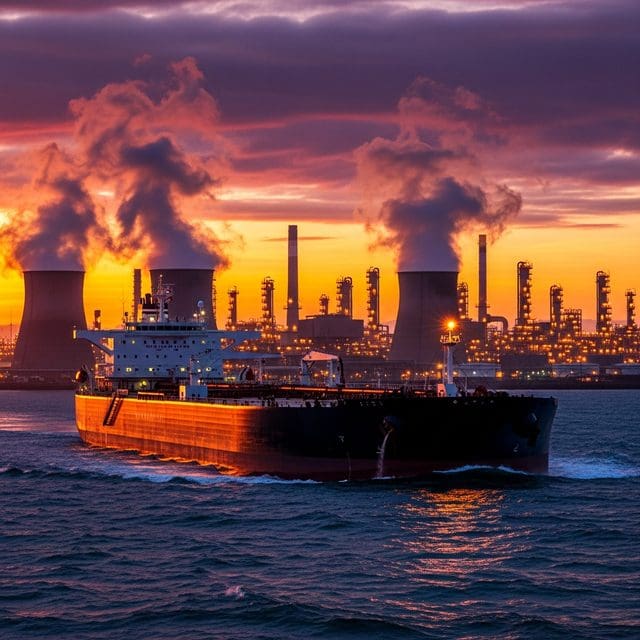
Crude oil remains above $100 per barrel as geopolitical instability in the Middle East forces a realignment of global supply chains and domestic energy investment strategies.
The global energy landscape is undergoing a forced transformation as the continued closure of the Strait of Hormuz enters a critical phase. Following Iranian attacks on tankers on April 22, 2026, crude oil prices have surged past the $100-per-barrel threshold. While President Trump extended a ceasefire deadline to allow Iranian factions to unify for peace talks, the physical disruption of the world’s most vital oil artery has fundamentally altered market expectations for the remainder of the year.
Major service providers SLB and Halliburton have signaled that elevated prices are likely to persist, a sentiment reflected in the performance of integrated majors. ExxonMobil has seen an 18% year-to-date gain as the market rewards reliable production in a volatile climate. To mitigate the loss of Middle Eastern supply, Chevron has ramped up exports from Venezuela, moving 500,000 barrels to the U.S. Gulf Coast to keep domestic refineries operational. This shift highlights a pragmatic, if uncomfortable, reliance on Western Hemisphere resources to stabilize the American economy during a period of extreme Eastern volatility.
The Treasury Department has simultaneously moved to tighten the screws on Tehran, imposing fresh sanctions on a Chinese refinery and dozens of shipping firms. This follows the U.S. military’s seizure of three Iranian tankers, including the M/T Majestic X in the Indian Ocean. While these actions aim to disrupt Iran’s revenue, they add layers of complexity to a global supply chain already reeling from the redirection of Russian energy under the EU’s 20th sanctions package. The resulting shift in global supply patterns has increased U.S. oil exports, granting Washington more geopolitical leverage while simultaneously exposing the domestic market to heightened price swings.
Domestic energy markets are responding to this volatility with a mix of innovation and consolidation. X-Energy’s successful upsized IPO on April 24 suggests a growing investor appetite for small modular nuclear reactors as a hedge against fossil fuel instability and grid fragility. In the renewables sector, SolarEdge Technologies saw a 7.1% mid-day jump on April 25, suggesting that some investors view the current oil spike as a catalyst for solar adoption. However, the sector remains uneven; smaller residential players like Zeo Energy are struggling with Nasdaq compliance issues following a minimum bid price deficiency notice on April 23.
The economic impact on the American taxpayer is becoming tangible as gasoline prices climb in response to the $100-plus crude environment. The focus on grid reliability and diverse generation has moved from policy white papers to the kitchen table, as consumers weigh the costs of traditional fuel against the long-term promise of nuclear and solar alternatives. While the solar sector shows pockets of resilience, the broader energy market is currently defined by a return to hard assets and traditional production to bridge the gap left by geopolitical conflict. For the American consumer, the immediate future holds a difficult balance between high fuel costs and the slow, capital-intensive transition to a more independent energy architecture.

Mark Davis serves as the Senior Correspondent for Energy, Climate, and Resource Economics at Just Right News. In an era where the conversation around the environment is often dominated by alarmism and top-down mandates, Mark provides a vital, market-oriented perspective on the complex forces shaping our world. As the lead voice behind the acclaimed feature series “Power and the Planet,” he explores the intersection of environmental policy, global energy markets, and the fundamental economic principles that sustain modern civilization.
Mark’s pragmatic approach to resource management was forged in the high desert of his hometown, Albuquerque, New Mexico. Growing up in a region defined by both its breathtaking natural beauty and its rugged, resource-dependent landscape, he developed an early appreciation for the delicate balance between conservation and utilization. New Mexico’s unique position as a hub for both traditional energy production and cutting-edge scientific research provided Mark with a front-row seat to the evolution of the American energy sector. This upbringing instilled in him a deep-seated belief that true environmental stewardship is inseparable from economic prosperity and technological innovation.
Now based in Boulder, Colorado, Mark operates from the heart of the nation’s climate research community. While Boulder is often seen as a bastion of environmental idealism, Mark utilizes his post to provide a necessary counterweight, grounded in the realities of resource economics. He understands that energy policy does not exist in a vacuum; it has tangible consequences for the American taxpayer, the stability of the national power grid, and the strength of the domestic manufacturing sector. By reporting from the front lines of the climate debate, he is able to challenge prevailing narratives with hard data and a commitment to the principles of the free market.
Throughout his tenure at Just Right News, Mark has distinguished himself by focusing on the “Resource Economics” aspect of his beat. He frequently highlights the hidden costs of rapid energy transitions and advocates for an “all-of-the-above” energy strategy that prioritizes American energy independence. His work often shines a light on the geopolitical implications of resource scarcity, arguing that a secure nation must first be an energy-secure nation. Whether he is analyzing the impact of federal land-use regulations or investigating the supply chains required for new technologies, Mark remains focused on how policy decisions affect the lives and livelihoods of everyday citizens.
In “Power and the Planet,” Mark continues to bridge the gap between complex scientific concepts and the economic realities facing the country. He rejects the false choice between a healthy environment and a thriving economy, instead seeking out solutions that leverage American ingenuity and private-sector competition. For Mark, reporting on the climate is not about following the latest trends, but about ensuring that the conversation remains tethered to the foundational values of liberty, property rights, and fiscal responsibility. His contributions ensure that Just Right News readers receive a comprehensive, clear-eyed view of the challenges and opportunities defining the future of our planet.