

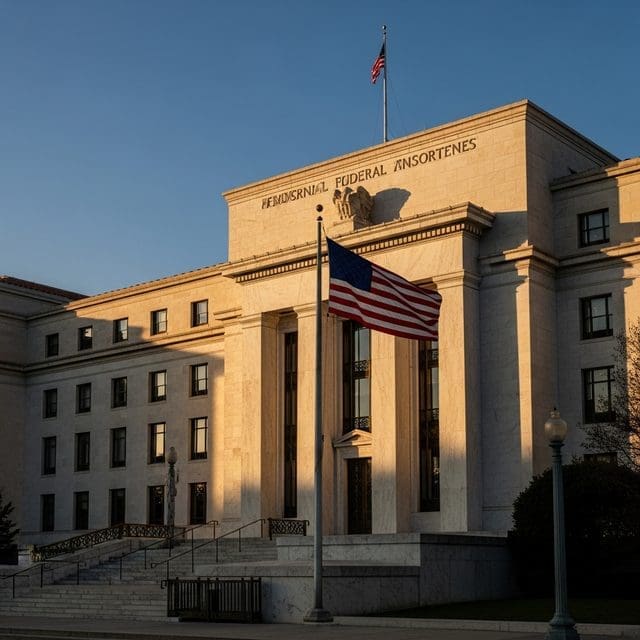
The Federal Reserve is expected to maintain current interest rates as Jerome Powell concludes his term, leaving households to grapple with high borrowing costs amid geopolitical instability and a pending leadership shift to Kevin Warsh.
The Federal Reserve is entering a period of significant structural transition as the Department of Justice concludes its criminal investigation into Chair Jerome Powell. This development, paired with Senator Thom Tillis’s announcement of support for nominee Kevin Warsh, removes the final political hurdles for a change in leadership at the nation’s central bank. Despite this looming ‘regime change,’ the immediate outlook for American households remains defined by the Fed’s commitment to holding interest rates at their current levels.
Central bankers are expected to keep the federal funds rate unchanged at next week’s policy meeting, which is likely to be Powell’s final act as chair. Market data from the CME Group’s FedWatch gauge suggests virtually no probability of a rate cut, a stance driven by an inflation shock and the ongoing conflict with Iran. Brent crude prices have surged over 55% since late February, driving up the cost of gasoline and jet fuel, while consumer confidence has plummeted to record lows.
For the American taxpayer, the Fed’s decision to maintain high rates serves as a double-edged sword. While it acts as a necessary brake on inflation, it continues to strain those carrying trillions of dollars in credit card, auto, and student loan debt. Because most credit cards utilize variable rates directly tied to the Fed’s benchmark, consumers should expect no relief on interest charges in the near term. Similarly, auto loan rates remain elevated, forcing many buyers into longer-term contracts to manage monthly payments.
In the housing market, 15- and 30-year fixed mortgage rates continue to exhibit volatility. These rates track long-term Treasury yields rather than the Fed’s overnight rate and are currently sensitive to shifting signals regarding the war with Iran. Conversely, the high-rate environment remains a benefit for savers, as yields on savings accounts continue to outpace inflation, offering a rare advantage for those with capital reserves.
President Donald Trump has remained a vocal critic of the current restrictive monetary policy, advocating for lower rates to enhance national competitiveness. During a recent appearance on CNBC, the President argued that the United States should possess the lowest interest rates globally to support domestic business and borrowing. While nominee Kevin Warsh has pledged to maintain the central bank’s independence, the tension between executive pressure for growth and the Fed’s mandate for price stability will likely define the next era of American monetary policy.
As the Senate prepares to finalize Warsh’s confirmation, the transition comes at a moment of heightened domestic tension. A recent shooting outside the White House Correspondents’ Dinner, which targeted administration officials, underscores the volatile backdrop against which these economic decisions are being made. For now, the Fed appears focused on stability, leaving the fundamental cost of capital high as the guard changes at the Eccles Building.

Jordan Lee serves as the Senior Correspondent for Wall Street, Finance, and Monetary Systems at Just Right News. Based in the heart of the world’s financial capital, New York City, Lee brings a sharp, principled eye to the complex mechanisms that drive the global economy. His reporting is defined by a commitment to fiscal responsibility, the defense of the free market, and a deep-seated belief that a transparent monetary system is the bedrock of a free society.
Raised in Portland, Oregon, Lee’s perspective was forged in a city that has undergone significant cultural and economic shifts. His upbringing in the Pacific Northwest instilled in him a profound appreciation for the industriousness of small business owners and the importance of local economic stability. Watching the evolution of his hometown’s landscape sparked an early interest in how federal fiscal policy and large-scale financial trends eventually trickle down to the average citizen. This background provides him with a unique vantage point; he understands the growing disconnect between the policy-making elite and the reality of Main Street, a theme that frequently resonates throughout his work.
Now operating from his base in New York City, Lee bridges the gap between the high-stakes trading floors of Manhattan and the households of everyday Americans. He views the financial sector not merely as a collection of numbers and tickers, but as a vital engine of American prosperity that requires constant vigilance and accountability. His reporting often highlights the dangers of centralized financial control and the necessity of maintaining a system that rewards merit, risk-taking, and innovation.
As the creator and lead of the featured series, “The Invisible Economy,” Lee pulls back the curtain on the often-opaque world of monetary systems. He specializes in translating the dense jargon of central banking and international finance into actionable insights for the Just Right News audience. His work explores the “invisible” forces—such as inflationary pressures, regulatory creep, and the expansion of the administrative state—that erode the purchasing power of American families. By focusing on these systemic issues, Lee empowers readers to understand the hidden forces shaping their financial independence.
Lee’s journalistic philosophy is rooted in a steadfast commitment to traditional American values. As an Asian American professional who has navigated the competitive corridors of the financial world, he is a vocal advocate for meritocracy and the preservation of the American Dream. He believes that a stable currency and a predictable regulatory environment are essential for national sovereignty and individual liberty. His reporting frequently warns against the risks of government overreach in the private sector, arguing that the most effective solutions to economic challenges arise from competition and individual enterprise rather than bureaucratic mandates.
At Just Right News, Jordan Lee remains dedicated to providing a clear-eyed defense of the taxpayer. Whether he is analyzing market volatility or investigating the long-term implications of national debt, his mission is to provide the truth about where the money is going and what it means for the future of the country. Through his rigorous analysis and principled stance, Lee has become a trusted voice for those who value a strong, sovereign, and fiscally sound America.