

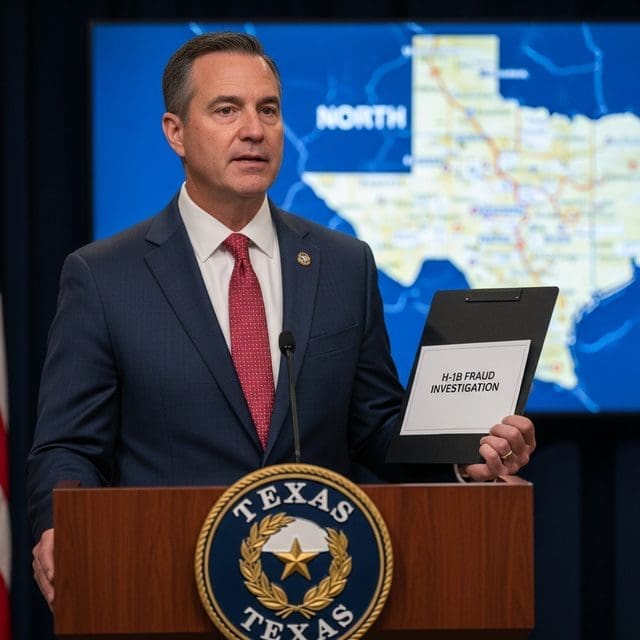
Texas Attorney General Ken Paxton launches a massive fraud investigation into H-1B visa abuse, signaling a growing trend of state leaders taking the lead on national security and labor integrity.
The laboratories of democracy are increasingly becoming the front lines of national security and labor integrity. In a bold assertion of state sovereignty, Texas Attorney General Ken Paxton has launched a sweeping investigation into thirty North Texas firms suspected of orchestrating H-1B visa fraud. The probe focuses on the use of ‘ghost offices’—physical locations that exist on paper to satisfy federal requirements but serve no actual business purpose.
This move by the Texas executive branch underscores a growing frustration with federal oversight. By targeting these bad actors, Paxton is signaling that if the federal government refuses to police the loopholes in its own immigration programs, the states will. The investigation identified companies such as Tekpro IT as part of a broader effort to ensure that foreign labor programs are not used to undercut the domestic workforce or bypass legal safeguards. This is federalism in its purest form: the state stepping in to protect its local economy when the central authority falters.
Complementing Paxton’s legal offensive, Governor Greg Abbott has implemented a freeze on state-level H-1B petitions for agencies and universities, effective through May 2027. This coordinated strategy between the Governor’s office and the Attorney General’s office demonstrates how a state can leverage its administrative and prosecutorial power to protect the integrity of its local economy. It serves as a blueprint for other states weary of federal inertia, proving that the Tenth Amendment remains a vital tool for regional self-determination.
While Texas focuses on labor and security, other states are grappling with the delicate balance between administrative mandates and individual liberties. In New York, the Department of Motor Vehicles has come under fire for forcing an ultra-Orthodox Jewish woman to remove her head covering for a license photo. Critics argue this bureaucratic overreach violates the fundamental right to religious expression, likening the act to a forced public shaming. This tension highlights the ongoing struggle within state agencies to respect the constitutional rights of the citizens they serve while maintaining standardized procedures.
The importance of state-level leadership is further emphasized by the recent downfall of Sinaloa Governor Ruben Rocha Moya, who stepped down following a U.S. indictment for drug smuggling and bribery. This serves as a stark reminder that the integrity of local governance is paramount to regional stability. When state leaders fail, the consequences ripple across borders, making the principled governance seen in domestic statehouses all the more vital to the American experiment.
From the Texas crackdown on visa fraud to the legislative debates over religious accommodations in New York, the message is clear: the states are not merely subdivisions of the federal government. They are independent entities capable of taking decisive action to protect their citizens, their economies, and their values. As the federal government remains mired in gridlock, the ‘Fifty Laboratories of Power’ remain the most effective vehicles for meaningful policy reform and the protection of individual liberty.

Dylan Brooks serves as the Senior Correspondent for Statehouses and Local Governance at Just Right News, where he brings a principled, constitutionalist lens to the often-overlooked machinery of state-level politics. As the lead voice behind the acclaimed feature series “Fifty Laboratories of Power,” Dylan has dedicated his career to the idea that the most impactful governance happens closest to home. His reporting consistently champions the Tenth Amendment, exploring how individual states can serve as testing grounds for innovative, conservative policy solutions that prioritize personal liberty and fiscal responsibility.
A native of Des Moines, Iowa, Dylan’s journalistic philosophy was forged in the heart of the American Midwest. Growing up in a community where local school board meetings and town halls were the bedrock of civic life, he developed a deep appreciation for the “retail politics” of the heartland. This upbringing instilled in him a fundamental belief that the American experiment is best preserved when power is decentralized. He carries the values of his Iowa roots into every assignment, maintaining a healthy skepticism of federal overreach and a steadfast commitment to the concerns of everyday citizens over the interests of the administrative state.
Now based in Madison, Wisconsin, Dylan operates from one of the nation’s most pivotal political battlegrounds. His location in a state capital known for its rigorous policy debates allows him to provide Just Right News readers with a front-row seat to the legislative process. From Madison, he tracks the ripple effects of statehouse decisions on local municipalities, ensuring that the connection between high-level policy and community impact is never lost. His work often highlights the success of conservative governors and legislatures in fostering economic growth, protecting parental rights, and securing the integrity of local institutions.
As an African American man in the conservative media landscape, Dylan offers a vital perspective on how limited government and free-market principles empower individuals and families. He frequently reports on how deregulation and school choice initiatives provide new avenues for success in underserved communities, challenging the monolithic narratives often presented by legacy media outlets. Dylan’s work is characterized by a commitment to the facts and a refusal to shy away from the complex realities of modern governance.
Throughout his tenure at Just Right News, Dylan has become a trusted authority for readers who value a rigorous, principled approach to the news. Whether he is dissecting a complex state budget or profiling a local grassroots movement, his goal remains the same: to provide the American public with the information they need to hold their local leaders accountable. By focusing on the “Fifty Laboratories of Power,” Dylan Brooks ensures that the vital work being done in statehouses across the country receives the national attention it deserves, always through a lens that respects the traditions and sovereignty of the American people.