

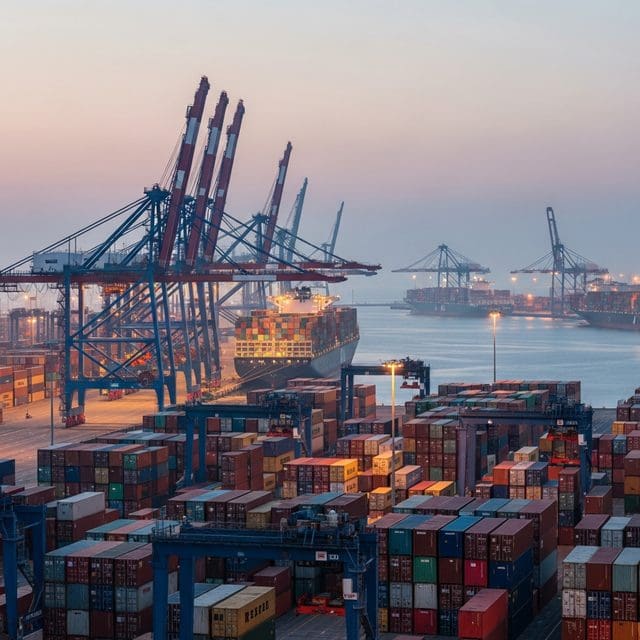
American importers are racing to beat a new wave of protectionist measures, driving record volumes at West Coast ports despite ongoing global shipping congestion.
The journey of a consumer product from a foreign factory to an American storefront is becoming an increasingly complex gauntlet of shifting regulations and logistical hurdles. Despite recent diplomatic breakthroughs in the Middle East, the American blue-collar workforce and domestic manufacturers face a trade landscape defined by renewed protectionism and a strategic pivot toward national sovereignty. The current climate is one of high-stakes trade diplomacy where the cost of a shipping container is dictated as much by a courtroom in Washington as by the fuel in a vessel’s tanks.
At the Port of Los Angeles, the heartbeat of trans-Pacific trade, import volumes surged 17% year-on-year in May. Shippers are currently front-loading cargo to secure inventory before a projected second wave of U.S. tariffs takes hold. This rush comes as a June 11 Federal Circuit stay ensures that broad Section 122 import tariffs remain in effect, overriding previous lower-court rulings that had offered temporary hope for reduced costs. For the American importer, the primary challenge is no longer just moving the goods, but navigating a regulatory environment where tariff volatility is now the top concern for 72% of trade professionals, a massive jump from 41% just one year ago.
The geopolitical map is also being redrawn in ways that impact the shelf price of everyday goods. The reopening of the Strait of Hormuz, following a memorandum of understanding between the U.S. and Iran, has led to a 10% drop in oil prices and the removal of transit tolls. While this should theoretically ease global shipping costs, the reality on the ground remains stubborn. Average global vessel waiting times hover near 4.8 days, with severe congestion reported at 60% to 70% of major ports. These delays, driven by yard utilization issues in India and labor strikes in Antwerp, continue to inflate inventory-holding costs for domestic businesses that are already grappling with memory chip shortages that outpace new manufacturing capacity.
Sourcing incentives are shifting away from traditional hubs as the administration adjusts its toolkit to favor domestic enterprise. While additional tariffs on Indian imports were removed effective February 7, 2026, the White House is signaling a potential 10-percentage-point hike on European Union autos, which could bring duties to 25%. Furthermore, a 50% tariff remains firmly in place for goods manufactured primarily from specific metals, while many derivatives sit at 25%. These measures are designed to protect the integrity of the American industrial base from subsidized foreign competition and ensure that the dignity of the individual worker is not sacrificed for corporate efficiency.
This environment of protective levies is forcing a reckoning for globalist supply chains that once prioritized penny-pinching efficiency over national resilience. Companies are increasingly turning to real-time classification tools and internal trade risk councils to manage the constant rerouting of goods. As the U.S. moves toward a 10% Section 301 universal levy to replace temporary measures, the message to the market is clear: the era of unfettered, low-tariff globalism is receding. The focus has returned to where things are actually made and the security of the routes they take to get here.
Ultimately, the resilience of the American economy depends on a transparent trade system that prioritizes local prosperity. Whether it is the expansion of herbicide technology through strategic licensing or the massive $75 billion IPO of SpaceX signaling a new era of domestic aerospace dominance, the underlying theme is the same: a return to American-led industry. As the Port of Los Angeles prepares for over 900,000 container units this July, the race to adapt to this new protectionist reality is well underway, ensuring that the journey of things remains a central pillar of national sovereignty.

Sean Bradley serves as the Senior Correspondent for Trade, Supply Chains, and Global Labor at Just Right News, where he brings a principled, clear-eyed perspective to the complex systems that power the modern world. With a focus on the economic forces that impact the American household, Bradley has distinguished himself as a leading voice in explaining how global shifts in manufacturing and logistics translate to the kitchen table.
Growing up in Long Beach, California, Bradley’s interest in the movement of goods was forged against the backdrop of one of the nation’s most vital maritime gateways. Raised in a community where the towering cranes of the port were a constant fixture on the horizon, he developed an early appreciation for the blue-collar industries that form the backbone of the American economy. This upbringing instilled in him a profound respect for the dockworkers, truckers, and laborers who keep the country moving, a sentiment that remains a cornerstone of his reporting today. For Bradley, trade is not merely a series of abstract figures on a spreadsheet; it is a human endeavor that sustains families and defines the strength of a nation.
Now based in Seattle, Washington, Bradley occupies a strategic vantage point in another of the country’s most significant trade hubs. His location allows him to witness firsthand the intersection of traditional industry and the evolving technological landscape of global logistics. From the Pacific Northwest, he monitors the flow of goods across the ocean, providing Just Right News readers with timely insights into how international tensions, regulatory hurdles, and labor disputes affect the availability and cost of essential goods.
His signature feature series, “The Journey of Things,” has become a staple for readers seeking to understand the intricate path products take from raw materials to the retail shelf. Through this series, Bradley pulls back the curtain on the global marketplace, often highlighting the risks of over-reliance on foreign adversaries and the importance of domestic manufacturing resilience. His reporting consistently emphasizes the conservative values of national sovereignty, free-market competition, and the protection of the American worker from unfair global practices.
As a journalist of Irish heritage, Bradley maintains a deep-seated respect for the dignity of the individual worker and the importance of community stability. He approaches his beat with a commitment to transparency, often questioning the status quo of globalist policies that prioritize corporate efficiency over local prosperity. Whether he is reporting from a warehouse floor or analyzing a new international trade agreement, his goal remains the same: to provide the American public with the truth about where their products come from and what it costs to get them there.
Throughout his tenure at Just Right News, Bradley has remained a steadfast advocate for economic common sense. His work serves as a vital resource for those who believe that a strong nation is built on secure borders, robust trade, and a respected workforce. By combining his local roots in Long Beach with his professional experience in Seattle, Bradley continues to offer a unique and necessary perspective on the forces that shape the American way of life.