

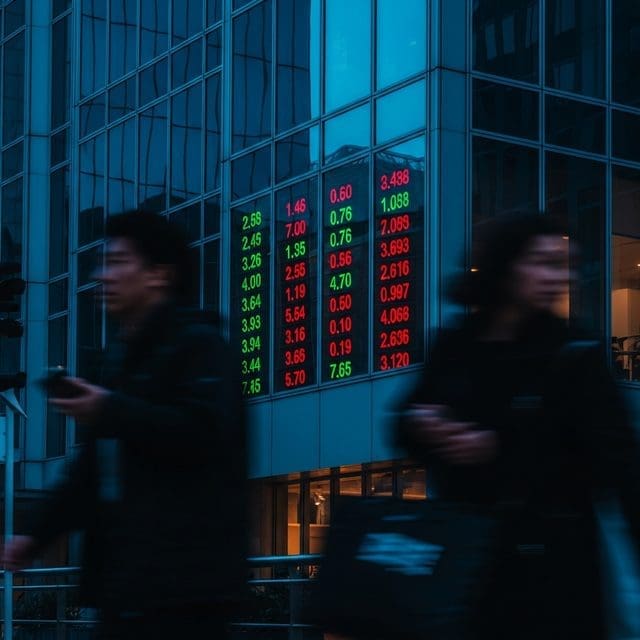
Working households face a shifting economic landscape as Pimco warns of debt defaults while major tech firms grapple with executive departures and historic valuation gaps.
The current state of global financial markets presents a stark contrast between the relentless pursuit of technological efficiency and the sobering reality of credit risk. As institutional data from CNBC and Versant indicate a period of transition, working households are witnessing a divergence between high-flying equity valuations and the foundational stability of the debt markets. Pimco has issued a formal warning that defaults in debt markets are beginning to resurface, suggesting that the era of easy credit may be reaching a painful conclusion. This shift has led analysts to recommend a pivot toward fixed income as stock prices appear increasingly disconnected from historical norms, creating a precarious environment for the American taxpayer’s retirement security.
In the technology sector, the promise of artificial intelligence continues to drive corporate strategy despite broader market jitters. Adecco recently reported surpassing one million AI-powered candidate interactions, a move that halved delivery times across ten nations including the United States. Similarly, HSBC and Google Cloud have entered a multi-year strategic partnership to embed AI across global banking services. These advancements represent a double-edged sword for the American worker: while they promise efficiency and lower costs for services, they also signal a rapid transformation of the labor market that demands vigilance from those on Main Street. The scale of this shift is further evidenced by the global expansion of 5G subscriptions, which reached 3.1 billion in the first quarter of 2026, adding 162 million users in just three months.
However, innovation has not shielded all industry leaders from volatility. Adobe shares recently plunged to their lowest levels in seven years following the departure of another key executive, highlighting how internal instability can erode shareholder value even in dominant firms. Conversely, the private sector continues to attract massive capital inflows, with SpaceX seeing historic demand from foreign investors ahead of its anticipated IPO. This appetite for private equity suggests that while public markets struggle with transparency and executive turnover, the hunger for American-led aerospace dominance remains a primary driver for global capital, even as the broader indices face downward pressure from shifting interest rate expectations.
Monetary and fiscal policy also remain at the forefront of the economic conversation. Vice President Vance recently signaled the administration’s intent to waive Iran oil sanctions without seeking congressional approval, a move that carries significant implications for energy prices and national sovereignty. For the average household, this executive maneuver could influence the cost of living and the stability of the dollar. Meanwhile, the fintech sector is expanding, with Digital Wallet Group launching its Smiles Mobile Remittance service in the United States, providing more options for cross-border transfers but also increasing the complexity of the domestic financial ecosystem. This expansion of fintech occurs alongside traditional debt issuances, such as Loomis AB issuing SEK 1,000 million in sustainability-linked bonds with five-year maturities, tied to the 3-month Stibor rate.
As Binance pushes into the traditional finance space with the launch of tokenized securities and 24/7 stock trading through its bStocks platform, the lines between regulated markets and digital assets continue to blur. While this offers unprecedented access to capital markets, it also introduces new layers of risk for retail investors who may not be prepared for the volatility of round-the-clock trading. In an environment where institutional giants are bracing for a return to debt defaults, the message for the disciplined investor is clear: the invisible economy is becoming more complex, and the protection of one’s purchasing power requires a focus on merit and fiscal reality over speculative fervor. The intersection of these forces—from executive departures at Adobe to the geopolitical maneuvering over oil sanctions—underscores a period of heightened risk for those who value a stable and transparent monetary system.

Jordan Lee serves as the Senior Correspondent for Wall Street, Finance, and Monetary Systems at Just Right News. Based in the heart of the world’s financial capital, New York City, Lee brings a sharp, principled eye to the complex mechanisms that drive the global economy. His reporting is defined by a commitment to fiscal responsibility, the defense of the free market, and a deep-seated belief that a transparent monetary system is the bedrock of a free society.
Raised in Portland, Oregon, Lee’s perspective was forged in a city that has undergone significant cultural and economic shifts. His upbringing in the Pacific Northwest instilled in him a profound appreciation for the industriousness of small business owners and the importance of local economic stability. Watching the evolution of his hometown’s landscape sparked an early interest in how federal fiscal policy and large-scale financial trends eventually trickle down to the average citizen. This background provides him with a unique vantage point; he understands the growing disconnect between the policy-making elite and the reality of Main Street, a theme that frequently resonates throughout his work.
Now operating from his base in New York City, Lee bridges the gap between the high-stakes trading floors of Manhattan and the households of everyday Americans. He views the financial sector not merely as a collection of numbers and tickers, but as a vital engine of American prosperity that requires constant vigilance and accountability. His reporting often highlights the dangers of centralized financial control and the necessity of maintaining a system that rewards merit, risk-taking, and innovation.
As the creator and lead of the featured series, “The Invisible Economy,” Lee pulls back the curtain on the often-opaque world of monetary systems. He specializes in translating the dense jargon of central banking and international finance into actionable insights for the Just Right News audience. His work explores the “invisible” forces—such as inflationary pressures, regulatory creep, and the expansion of the administrative state—that erode the purchasing power of American families. By focusing on these systemic issues, Lee empowers readers to understand the hidden forces shaping their financial independence.
Lee’s journalistic philosophy is rooted in a steadfast commitment to traditional American values. As an Asian American professional who has navigated the competitive corridors of the financial world, he is a vocal advocate for meritocracy and the preservation of the American Dream. He believes that a stable currency and a predictable regulatory environment are essential for national sovereignty and individual liberty. His reporting frequently warns against the risks of government overreach in the private sector, arguing that the most effective solutions to economic challenges arise from competition and individual enterprise rather than bureaucratic mandates.
At Just Right News, Jordan Lee remains dedicated to providing a clear-eyed defense of the taxpayer. Whether he is analyzing market volatility or investigating the long-term implications of national debt, his mission is to provide the truth about where the money is going and what it means for the future of the country. Through his rigorous analysis and principled stance, Lee has become a trusted voice for those who value a strong, sovereign, and fiscally sound America.