

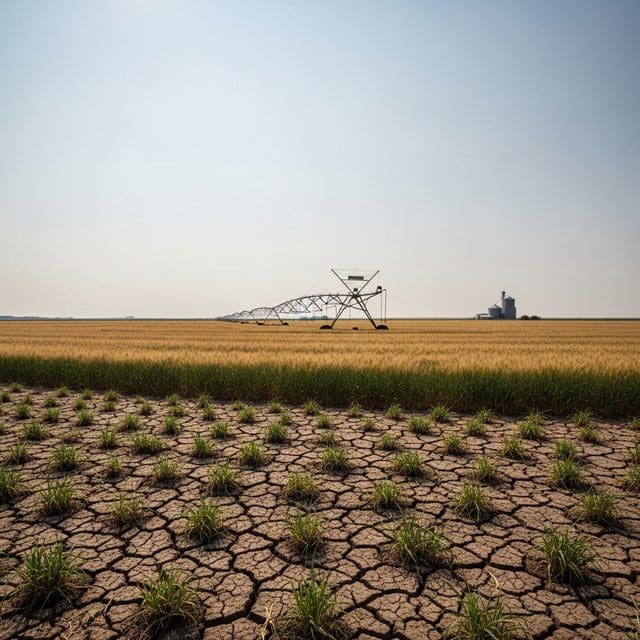
Expanding spring droughts and surging fertilizer prices are threatening the Great Plains wheat harvest while new EPA pesticide rules and nitrate contamination reports pressure local water systems.
The American agricultural heartland is currently facing a dual-front crisis as extreme weather patterns collide with volatile input markets. In Nebraska and Oklahoma, a relentless spring drought has expanded to cover nearly 90% of the landscape. According to recent data, more than half of Nebraska is currently categorized under extreme drought conditions, a development that poses a direct threat to the Great Plains winter wheat harvest and is forcing ranchers to make difficult decisions regarding cattle herd reductions.
This lack of moisture is not isolated to the plains. In Arkansas, farmers have been forced to activate irrigation systems a full month earlier than usual after the region skipped its typical spring rains. Agriculture experts warn that this early reliance on groundwater could lead to a significant reduction in rice acreage as growers struggle to manage costs and water availability. In Kentucky, the situation is similarly grim, with nearly 100% of the state reporting abnormally dry conditions and unusually low soil moisture levels for late April.
Compounding these environmental challenges is a sudden and sharp increase in the cost of essential nutrients. Fertilizer prices have spiked over the last thirty days, with urea increasing by 50% and ammonia by 30%. The rapid escalation has caught the attention of federal officials, with USDA Secretary Rollins designating the price surge a national security issue. These costs, combined with the energy requirements for early-season irrigation, are tightening the profit margins for family-owned farms that are already operating on the edge.
On the regulatory front, the Environmental Protection Agency (EPA) finalized new pesticide tolerances on April 22 for six specific ingredients, including hydrogen cyanide and ethofumate. While these federal standards are intended to provide a framework for safe application, they arrive at a time when public scrutiny of agricultural runoff is intensifying. New data indicates that farm runoff has elevated nitrate levels in the drinking water of approximately 62.1 million Americans, with over 6,114 water systems reporting concentrations exceeding 3 mg/L between 2021 and 2023.
While federal agencies focus on chemical tolerances, local producers are left to navigate the practical realities of a changing climate and a global economy. The shift toward value-added portfolios, such as Hormel Foods’ recent sale of its whole-bird turkey business to focus on processed goods, suggests a broader industry trend toward risk mitigation. For the independent farmer in the San Joaquin Valley or the Great Plains, however, the immediate priority remains securing the water and affordable inputs necessary to keep the nation’s food supply stable.
In the broader geopolitical context, recent stabilization in the Middle East has provided some relief to global energy markets, with oil prices dropping 10% following news that the Strait of Hormuz remains open. However, these macro-economic shifts have yet to trickle down to the local level where farmers face immediate bills for diesel and urea. As the spring planting season progresses, the tension between federal environmental goals and the survival of the American family farm continues to define the landscape of the domestic food sector.

Eric Nolan serves as the Senior Correspondent for Food, Water, and Environmental Health at Just Right News, where he brings a principled, common-sense perspective to the most fundamental issues facing the American public. With a career dedicated to uncovering the truth behind the policies that govern our natural resources, Eric has become a trusted voice for readers who value traditional stewardship over bureaucratic overreach. His reporting is defined by a commitment to the idea that true environmentalism is rooted in the protection of the American family and the preservation of the nation’s agricultural heritage.
Raised in Fresno, California, Eric’s worldview was shaped in the heart of the San Joaquin Valley. Growing up in one of the world’s most productive agricultural hubs, he witnessed firsthand the vital connection between the land, the water, and the dinner table. In Fresno, he saw the resilience of farmers and the devastating impact that distant, top-down regulations can have on local communities. This upbringing instilled in him a deep respect for the producers who feed the country and a lifelong skepticism toward the alarmist narratives often pushed by mainstream media. For Eric, environmental health is not an abstract political talking point; it is a matter of ensuring that the people who work the land have the freedom and the resources to do so effectively.
Now based in Eugene, Oregon, Eric operates from a unique vantage point in the Pacific Northwest. Living in a region often defined by intense environmental debate, he provides a necessary counter-narrative to the prevailing trends of the area. From his base in Eugene, he monitors the shifting tides of federal and state policies, ensuring that the voices of rural citizens and property owners are not drowned out by urban activism. His reporting often bridges the gap between the rugged realities of the outdoors and the legislative halls where decisions are made, offering a grounded perspective that prioritizes local sovereignty and practical solutions.
As the lead for the acclaimed feature series “Earth on the Table,” Eric explores the intricate journey of the American food supply. He tackles critical issues such as water rights, soil health, and food security through a lens of national stability and individual liberty. He believes that a healthy environment and a thriving economy are not mutually exclusive, but rather two sides of the same coin of national prosperity. His work consistently highlights how innovation and private-sector ingenuity are the most effective tools for ensuring clean water and a safe food supply, rather than the expansion of the administrative state.
At Just Right News, Eric’s reporting serves as a vital resource for those who seek accountability and transparency. Whether he is investigating the impact of federal land management on local economies or examining the safety of the national food infrastructure, his work remains anchored in the values of heritage and hard work. Eric Nolan continues to be a leading voice in environmental journalism, championing the belief that the best way to protect our natural resources is to empower the people who live and work closest to them.