

Rising fuel costs and healthcare anxieties are forcing middle-class Americans to rethink their budgets despite local efforts to maintain normalcy and community traditions.
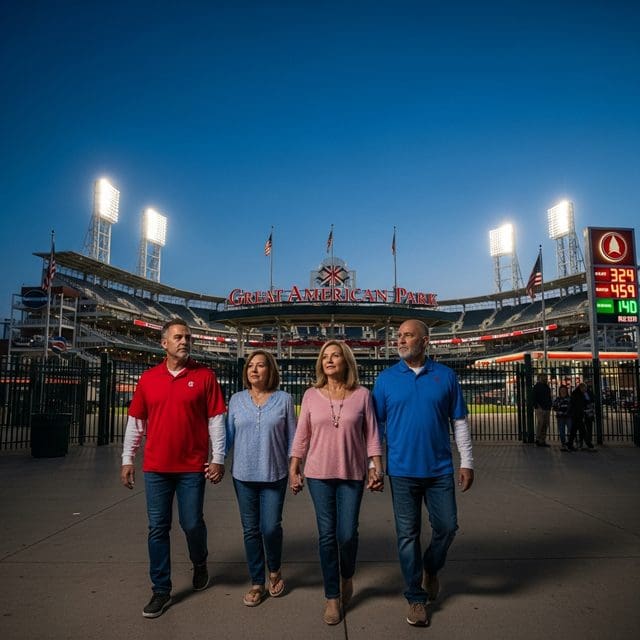
The lights at Great American Ball Park still shine bright over the Ohio River, drawing crowds of over 42,000 for recent Reds games. But beneath the roar of the stadium, the conversation in the parking lots and local diners has shifted from the box score to the balance sheet. For the families of Cincinnati, the distance between the geopolitical tensions in the Strait of Hormuz and the cost of a gallon of milk is shrinking by the day.
On April 28, Brent crude futures climbed toward $111 per barrel following the rejection of a proposal to reopen the Strait of Hormuz. For many Americans, these high-level diplomatic stalemates translate directly into a loss of personal agency. A recent KFF poll reveals that 64% of U.S. adults are now worried about affording healthcare, while an equal percentage expresses concern over the rising cost of gas and transportation. This is not merely a statistic; it is the quiet anxiety of a father wondering if he can afford both the drive to work and the co-pay for his daughter’s check-up.
The strain is visible in the housing market as well. In the Cincinnati area, where the BuildReady initiative has utilized a $2 million HUD grant to streamline multi-family housing, local efforts are battling a fierce national headwind. The NAHB/Wells Fargo Housing Market Index recently fell to 34, its lowest level since September 2025. Homebuilders cite high interest rates and oil-driven material costs as primary hurdles. When the cost of asphalt and insulation rises alongside the price of a mortgage, the dream of homeownership moves further out of reach for the working class.
This economic pressure is creating a sense of financial discomfort for 56% of Americans, according to recent survey data. The burden is felt most acutely by those who value self-reliance but find their thriftiness outpaced by inflation. In response to these pressures, institutions like the OPEC Fund have launched billion-dollar stability initiatives, and local firms like KTS Energy are launching awareness campaigns at the ballpark to promote sustainability. Yet, for the individual citizen, these top-down solutions often feel disconnected from the immediate reality of monthly bills.
As the midterm elections approach, 55% of voters say these rising costs will be a major factor in their decision. The American spirit remains resilient, found in the persistence of community traditions and the local nonprofits supported by grants like those from the American Water Charitable Foundation. However, the preservation of the American middle-class lifestyle now depends on a return to economic stability that respects the limits of the household budget. For the people of Cincinnati, the hope is that the resilience shown in the stands of the ballpark will eventually be mirrored in a national policy that prioritizes the pocketbook over the power play.

Ethan Blake serves as a Senior Correspondent for Just Right News, where he specializes in Longform Narrative and Public Understanding. In an era of rapid-fire headlines and fleeting soundbites, Ethan’s work stands as a testament to the power of deep-dive reporting and the importance of contextualizing the complex issues facing the nation today. His approach is rooted in the belief that the most profound truths are often found in the lived experiences of individuals rather than the abstract theories of distant policymakers.
Growing up in Providence, Rhode Island, Ethan developed an early appreciation for the historical and cultural threads that weave the American fabric together. Providence, a city defined by its industrial heritage and its blend of traditional neighborhoods, provided him with a front-row seat to the challenges and triumphs of the American working class. This upbringing instilled in him a respect for the “common sense” values of hard work, community loyalty, and the preservation of local institutions. He learned early on that behind every economic statistic or legislative debate, there are real families and neighborhoods navigating the consequences of change.
This foundational perspective is the driving force behind his signature feature series, “Lives Behind the Systems.” Through this series, Ethan explores the intersection of individual agency and institutional structure. Whether he is documenting the impact of federal land-use policies on rural families or examining how shifting educational standards affect local school boards, Ethan’s work prioritizes the human element. He seeks to uncover how large-scale systems—be they governmental, economic, or social—affect the daily lives of citizens, often advocating for a return to local control and personal responsibility.
Now based in Portland, Maine, Ethan draws significant inspiration from the rugged independence and self-reliance that define the region. The coastal landscape and the resilient spirit of Maine’s communities serve as a constant reminder of the importance of individual liberty and the strength found in decentralized power. Living and working outside the traditional media hubs allows Ethan to maintain a grounded perspective, ensuring his reporting remains untethered from the echo chambers of the major metropolitan centers. This geographic distance provides him with the clarity needed to translate complex national narratives into stories that resonate with the heart of the country.
At Just Right News, Ethan’s beat is more than just a professional assignment; it is a mission to foster a more informed and engaged citizenry. He believes that a free society depends on the public’s ability to understand the mechanisms of power and the value of traditional American principles. His longform narratives do not merely report the news; they provide a roadmap for understanding the cultural and political shifts of the modern era through a lens of skepticism toward centralized authority and a deep respect for the individual.
Through his meticulous research and narrative craftsmanship, Ethan Blake continues to bridge the gap between policy and the public. His work remains a vital resource for those who seek a deeper understanding of the systems that shape our world and the enduring spirit of the people who live within them.