

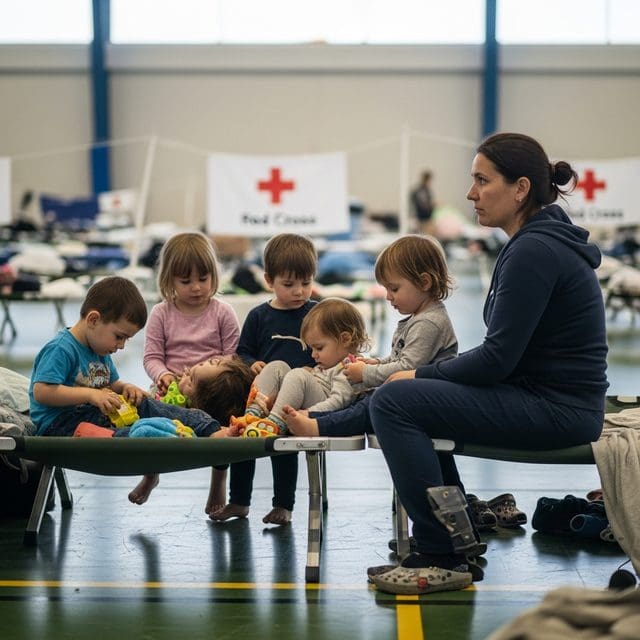
Ruth Nolasco and her five children seek refuge in a Georgia shelter as wildfires and environmental shifts test the limits of community-based disaster response.
In the quiet coastal city of Brunswick, Georgia, the air usually carries the scent of salt marsh and pine. This week, however, it is thick with the acrid smell of smoke. For Ruth Nolasco, that smell was the signal to gather her five children and leave behind the life they had built. Now, the family is living out of the American Red Cross shelter at the Selden Park Complex, a stark reminder of how quickly the comforts of home can be replaced by the cold efficiency of a disaster relief center.
Nolasco’s story is not just one of personal misfortune; it is a window into the increasing fragility of the American domestic landscape. While the headlines in Washington D.C. are dominated by a shooting at the White House Correspondents’ Dinner and high-stakes negotiations over a peace plan with Iran, families like the Nolascos are navigating a more immediate, visceral reality. For them, the success of a ten-day ceasefire in Lebanon or the fluctuation of oil prices matters far less than the availability of a clean cot and the safety of their neighborhood.
The wildfires that displaced Nolasco are part of a broader pattern of environmental instability hitting close to home for many Americans. In Irondequoit, New York, a massive landslide recently decimated a couple’s yard, and across the country, the Centers for Disease Control and Prevention (CDC) report that emergency room visits for tick bites are significantly higher than usual for this time of year. These are the quiet crises—the ones that don’t always make the evening news but fundamentally alter the way families interact with their environment and their local institutions.
In Brunswick, the response has been characteristically local. The Selden Park Complex has become a temporary hub of community resilience, where neighbors help neighbors under the banner of the Red Cross. This spirit of self-reliance and local cooperation remains the backbone of the American response to crisis, even as federal resources are often tied up in bureaucratic disputes or international posturing. For Nolasco, the immediate need is simple: a way to provide for her five children while their future remains clouded by smoke.
As the nation watches the fallout from a violent disruption in the capital, where a California computer engineer allegedly targeted the media elite, the contrast with the Selden Park shelter is sharp. In Washington, the focus is on political motives and federal indictments; in Brunswick, the focus is on the basic human necessity of shelter. The Nolasco family’s displacement serves as a quiet call to remember the importance of local stability and the preservation of the institutions that catch us when the ground, quite literally, begins to shift.

Ethan Blake serves as a Senior Correspondent for Just Right News, where he specializes in Longform Narrative and Public Understanding. In an era of rapid-fire headlines and fleeting soundbites, Ethan’s work stands as a testament to the power of deep-dive reporting and the importance of contextualizing the complex issues facing the nation today. His approach is rooted in the belief that the most profound truths are often found in the lived experiences of individuals rather than the abstract theories of distant policymakers.
Growing up in Providence, Rhode Island, Ethan developed an early appreciation for the historical and cultural threads that weave the American fabric together. Providence, a city defined by its industrial heritage and its blend of traditional neighborhoods, provided him with a front-row seat to the challenges and triumphs of the American working class. This upbringing instilled in him a respect for the “common sense” values of hard work, community loyalty, and the preservation of local institutions. He learned early on that behind every economic statistic or legislative debate, there are real families and neighborhoods navigating the consequences of change.
This foundational perspective is the driving force behind his signature feature series, “Lives Behind the Systems.” Through this series, Ethan explores the intersection of individual agency and institutional structure. Whether he is documenting the impact of federal land-use policies on rural families or examining how shifting educational standards affect local school boards, Ethan’s work prioritizes the human element. He seeks to uncover how large-scale systems—be they governmental, economic, or social—affect the daily lives of citizens, often advocating for a return to local control and personal responsibility.
Now based in Portland, Maine, Ethan draws significant inspiration from the rugged independence and self-reliance that define the region. The coastal landscape and the resilient spirit of Maine’s communities serve as a constant reminder of the importance of individual liberty and the strength found in decentralized power. Living and working outside the traditional media hubs allows Ethan to maintain a grounded perspective, ensuring his reporting remains untethered from the echo chambers of the major metropolitan centers. This geographic distance provides him with the clarity needed to translate complex national narratives into stories that resonate with the heart of the country.
At Just Right News, Ethan’s beat is more than just a professional assignment; it is a mission to foster a more informed and engaged citizenry. He believes that a free society depends on the public’s ability to understand the mechanisms of power and the value of traditional American principles. His longform narratives do not merely report the news; they provide a roadmap for understanding the cultural and political shifts of the modern era through a lens of skepticism toward centralized authority and a deep respect for the individual.
Through his meticulous research and narrative craftsmanship, Ethan Blake continues to bridge the gap between policy and the public. His work remains a vital resource for those who seek a deeper understanding of the systems that shape our world and the enduring spirit of the people who live within them.