

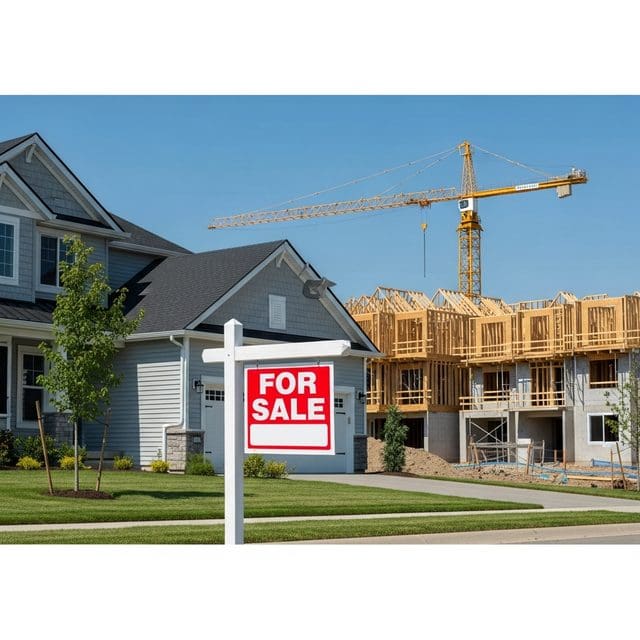
Rising mortgage rates and war-driven material costs push homebuilder sentiment to a seven-month low despite a temporary ceasefire in the Middle East.
The American housing market is currently caught in a vice between volatile international relations and stubborn domestic inflation. As of April 25, 2026, the 30-year fixed mortgage rate has ticked up to 6.09 percent, a seven-basis-point increase from the previous week. This incremental rise, while seemingly small, represents a significant barrier for families already stretched thin by a high cost of living.
Market stability remains elusive despite a recent diplomatic breakthrough. President Trump’s announcement of a 10-day ceasefire between Israel and Lebanon, effective April 17, alongside the reopening of the Strait of Hormuz, led to a 10 percent drop in oil prices. However, the relief has yet to reach the construction sector. U.S. homebuilder sentiment hit a seven-month low this April, as the trailing costs of conflict-driven material shortages continue to weigh heavily on new projects. For the American taxpayer, this translates to a persistent shortage of new inventory and higher price tags on what little is available.
In the existing home market, the situation is equally stagnant. March data shows existing home sales at an annualized rate of 3.98 million units, with the median price creeping up to $408,800. While inventory sits at roughly 1.36 million units, the lack of affordable “missing-middle” housing remains a primary concern for those advocating for property rights and local sovereignty. Bureaucratic hurdles often prevent the market from responding to demand, though some regions are beginning to see the light. Zoning reforms are accelerating in certain jurisdictions, with British Columbia notably mandating multi-unit zoning by the end of June to address similar supply constraints.
Renters are seeing the only glimmer of hope in an otherwise bleak landscape. The typical U.S. rent stood at $1,910 in March, representing a 1.8 percent year-over-year increase. This is the slowest growth rate recorded since December 2020, suggesting that the rental market may finally be cooling after years of unsustainable hikes. Nevertheless, for those in urban centers like Philadelphia, the crisis of affordability is often overshadowed by the visible failure of public policy. The ongoing homelessness crisis along Kensington Avenue serves as a stark reminder that federal spending—including the $20.6 billion recently designated by the FTA for public transit—often fails to address the root causes of community instability.
As the U.S. and Iran negotiate a complex peace plan involving the release of $20 billion in frozen funds, the domestic focus must return to the levers that affect the daily lives of citizens. Infrastructure and housing are not merely line items in a federal budget; they are the foundations of individual liberty. Without a concerted effort to reduce the regulatory burden on builders and stabilize the currency to lower interest rates, the American dream of property ownership will remain a casualty of global and domestic mismanagement.

Deborah Cole serves as a Senior Correspondent for Just Right News, where she spearheads the network’s coverage of Housing, Infrastructure, and Mobility. With a career defined by a commitment to rigorous reporting and a focus on the fundamental pillars of American community life, Deborah brings a principled perspective to the complex issues that dictate how and where we live. Her work is grounded in the belief that sound policy, fiscal responsibility, and respect for private property are the essential foundations of a prosperous society.
Originally from Boston, Massachusetts, Deborah’s upbringing in one of the nation’s oldest and most historically significant cities deeply influenced her professional trajectory. Growing up amidst the architectural legacy and dense urban planning of New England, she developed an early appreciation for the importance of durable infrastructure and the role of local tradition in shaping neighborhoods. Her perspective is informed by the classic American values of her hometown—hard work, community cohesion, and a healthy skepticism of top-down bureaucratic mandates that often overlook the unique needs of individual citizens.
Today, Deborah operates from her base in Austin, Texas, a city that serves as a primary laboratory for her reporting. Austin’s rapid expansion and its status as a hub for innovation and migration provide her with a front-row seat to the most pressing challenges in modern infrastructure and housing. From the Lone Star State, she chronicles the tensions between rapid growth and the preservation of the American Dream, often highlighting how market-driven solutions and deregulation can address the housing shortages that plague many of the country’s metropolitan areas.
At Just Right News, Deborah is perhaps best known for her signature feature series, “Where We Live.” Through this platform, she explores the intersection of public policy and private life, moving beyond mere statistics to tell the stories of families, small business owners, and local developers. Her reporting frequently highlights the importance of mobility—not just in terms of transportation and transit, but as a vehicle for economic opportunity and social stability. She remains a staunch advocate for the taxpayer, consistently scrutinizing government spending on large-scale projects and advocating for transparency in how infrastructure dollars are allocated.
Deborah’s beat is more than just a collection of policy topics; it is an investigation into the physical and legal structures that allow families to flourish. Whether she is reporting on the impact of zoning laws on suburban development or the necessity of maintaining the nation’s highway systems, her work is characterized by a dedication to the facts and a respect for the constitutional principles that protect the rights of homeowners.
As a Senior Correspondent, Deborah Cole continues to be a vital voice for Just Right News, providing the audience with the clarity and context needed to navigate an ever-changing landscape. Her reporting ensures that the values of individual liberty and local sovereignty remain at the forefront of the national conversation regarding the future of our cities and towns. Through her tireless efforts, she remains committed to informing the public on the issues that hit closest to home.