

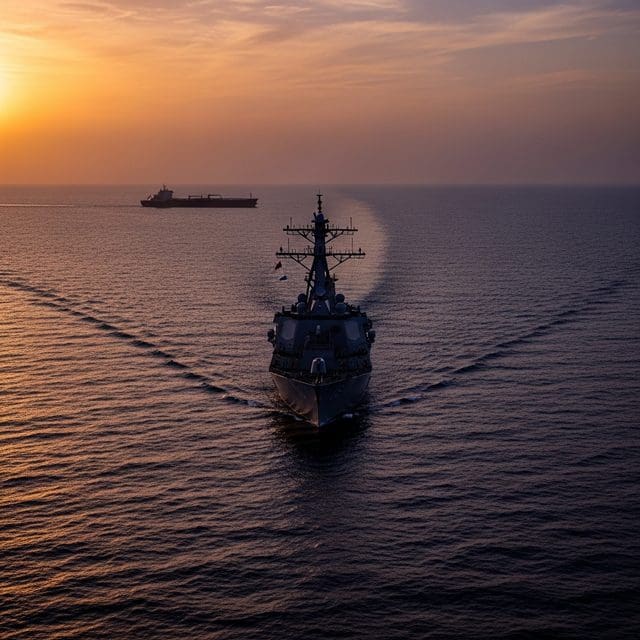
President Trump halted high-level negotiations in Islamabad, citing an insufficient Iranian proposal while the U.S. Navy intercepted a sanctioned tanker, signaling a return to maximum pressure over diplomatic concessions.
The White House abruptly canceled a high-stakes diplomatic mission to Islamabad on Sunday, signaling a pivot back to aggressive containment as a fragile U.S.-Iran ceasefire nears expiration. President Trump recalled envoys Steven Witkoff and Jared Kushner just as they were set to engage in a new round of talks mediated by Pakistan, stating that the United States currently holds “all the cards” and found the initial Iranian proposal lacking.
This diplomatic withdrawal coincided with a direct military intervention in the Arabian Sea. The U.S. Navy intercepted the M/V Sevan, a sanctioned tanker belonging to Iran’s “shadow fleet,” carrying approximately 750,000 barrels of propane and butane. The seizure underscores the administration’s commitment to a port blockade that Iranian President Masoud Pezeshkian previously identified as a non-starter for formal negotiations. Teheran’s Foreign Minister, Abbas Araghchi, returned to Islamabad on April 26 to relay the regime’s war-end positions through Pakistani intermediaries, though no direct contact with American officials occurred.
On the periphery of the U.S.-Iran standoff, regional proxies continue to test the limits of existing truces. Israel issued urgent evacuation warnings for seven villages in southern Lebanon before launching targeted strikes on Kfar Tebnit and Nabatiye. Prime Minister Benjamin Netanyahu reportedly ordered forceful responses to Hezbollah movements, resulting in at least six deaths in Lebanon over the weekend. Hezbollah retaliated by targeting an Israeli military vehicle, further straining the stability of the northern border.
The geopolitical volatility extends to Eastern Europe, where Russian forces launched a series of drone and missile barrages across Ukraine. These strikes killed five civilians and damaged critical infrastructure at the Odesa port, including a commercial vessel. The ongoing attrition in Ukraine remains a primary concern for the Pentagon as it balances resource allocation between the European theater and the escalating maritime confrontation in the Middle East.
Domestically, the administration faces legal and security distractions. A federal appeals court recently ruled on April 24 that an executive order banning asylum claims at the southern border is illegal, while security protocols are under review following a shooting incident at the White House Correspondents’ Dinner. Despite these internal pressures, the White House appears focused on leveraging its naval superiority to force a more favorable settlement from Teheran, prioritizing the ‘peace through strength’ doctrine over immediate de-escalation.
As the ceasefire deadline looms, the stakes for American power in the region are tethered to the success of this economic strangulation. While Pakistan continues to offer a neutral ground for dialogue, the Trump administration’s refusal to meet without significant Iranian concessions suggests a long-term commitment to the blockade. For the American heartland, the primary concern remains whether this pressure will yield a more stable Middle East or if the rising costs of global shipping and energy will eventually hit the domestic economy.

Olivia Kendall serves as the Senior Correspondent for Geopolitics, Defense, and Foreign Policy at Just Right News, where she provides a principled, conservative perspective on the complex forces shaping the global stage. With a career dedicated to deconstructing the intricacies of international relations, Kendall has become a trusted voice for readers who value national sovereignty, a robust military, and a foreign policy that prioritizes American interests above all else.
A native of Washington, D.C., Kendall’s professional journey is deeply rooted in her upbringing within the nation’s capital. Growing up in the epicenter of American political life, she developed an early and profound understanding of how policy is crafted and, more importantly, how it often fails to account for the values of the American heartland. This unique vantage point allowed her to witness firsthand the rise of globalist bureaucracies, fueling her commitment to reporting that champions the constitutional foundations of the United States. Her background as a British White American further informs her worldview, providing her with a keen appreciation for the Western tradition and the enduring importance of the “Special Relationship” in maintaining global stability.
Now based in Arlington, Virginia, Kendall operates from the doorstep of the Pentagon and the heart of the nation’s defense establishment. Her proximity to the decision-makers in the military and intelligence communities allows her to provide boots-on-the-ground reporting that is both timely and deeply informed. For Kendall, Arlington is more than just a base of operations; it is a daily reminder of the sacrifices made by the men and women in uniform. This connection to the defense community drives her rigorous coverage of military readiness and her advocacy for a “peace through strength” approach to diplomacy.
At Just Right News, Kendall is perhaps best known for her acclaimed feature series, “The World’s Shadow on America.” In this ongoing project, she explores the direct correlation between international developments and the daily lives of American citizens. Whether she is analyzing the encroachment of foreign adversaries in domestic supply chains or the impact of international treaties on local economies, Kendall’s work serves as a vital bridge between distant geopolitical shifts and their consequences at home. She rejects the notion that foreign policy is an abstract concern for elites, instead proving that what happens in the corridors of power in Brussels or Beijing has a tangible “shadow” that falls across every American doorstep.
Throughout her tenure, Kendall has remained a steadfast critic of international overreach and a vocal proponent of a clear-eyed, realistic foreign policy. She brings a sharp analytical mind to her beat, often challenging the prevailing narratives of the mainstream media to uncover the underlying truths that affect national security. Her reporting is characterized by a refusal to compromise on the truth and a dedication to the idea that a strong, secure America is the world’s best hope for liberty. As a Senior Correspondent, Olivia Kendall continues to lead the charge in providing the essential context and conservative insight necessary to navigate an increasingly volatile world.