

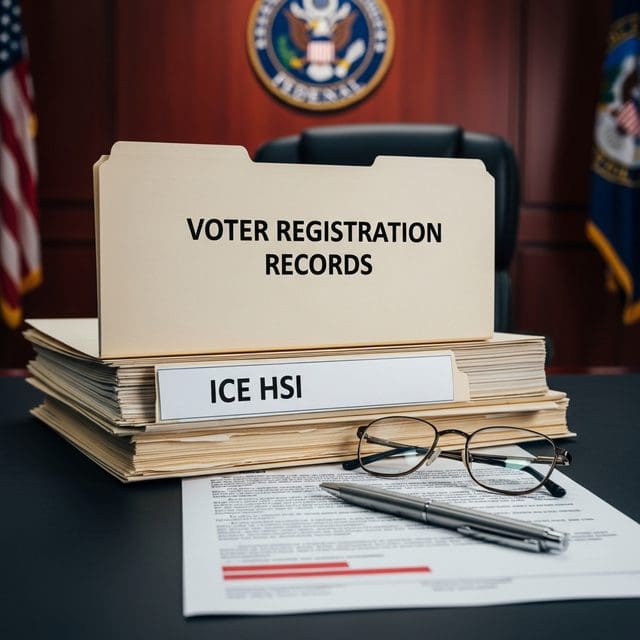
Internal emails and public records show federal immigration investigators obtained comprehensive voter data from North Carolina and Texas counties as part of a White House election integrity initiative.
Internal government records obtained through public-records requests confirm that Immigration and Customs Enforcement (ICE) secured comprehensive voter files from local jurisdictions in North Carolina and Texas. The documents, surfaced by the watchdog group Democracy Forward, show that the agency’s Homeland Security Investigations unit acquired sensitive data from Forsyth County and Webb County during 2025–26. This acquisition is a central component of a broader “election integrity” push coordinated between the White House and the Department of Justice to identify non-citizens on voter rolls.
The records indicate that the files provided to federal investigators contained more than just public registration lists. The data included names, residential addresses, dates of birth, driver’s license numbers, and detailed voting histories. This level of access has sparked concern among election officials, as these identifiers are typically shielded from public disclosure to prevent identity theft. While some jurisdictions complied, others characterized the federal pressure as an infringement on state-managed systems. Arizona Secretary of State Adrian Fontes previously alleged that federal authorities attempted to leverage the removal of ICE presence in certain areas to compel the surrender of voter rolls.
The transparency of these federal efforts remains a point of contention in the courts. American Oversight has filed lawsuits against both ICE and the DOJ under the Freedom of Information Act (FOIA), seeking to uncover the full extent of how federal officials are sharing and utilizing this sensitive voter data. The litigation seeks to establish whether these requests represent a standardized new protocol for federal-state data sharing or an isolated investigative tactic. This push for document access highlights a broader trend of using the legal system to force the disclosure of primary source materials the administrative state seeks to keep confidential.
In a parallel legal battle, the Heritage Foundation is seeking materials from Special Counsel Robert Hur’s investigation into Joe Biden’s handling of classified documents. While Judge Dabney Friedrich initially ordered the Department of Justice to release redacted transcripts and audio of interviews between Biden and his ghostwriter, Mark Zwonitzer, a temporary injunction issued on June 20, 2026, has paused the release. The three-week injunction allows for a potential appeal as Biden’s legal team argues that the public disclosure of the audio recordings would cause irreparable harm and infringe upon presidential privacy. The DOJ had previously agreed to a narrow window for production, but the court’s latest move ensures the records remain shielded.
These developments occur as the 60-day negotiation period for a comprehensive U.S.-Iran nuclear and sanctions relief deal began on June 19, 2026, following President Trump’s signature on a memorandum of understanding in Versailles. While the administration manages these foreign policy maneuvers, the domestic focus remains fixed on the integrity of federal data collection practices. The contrast between the administration’s pursuit of transparency in voter rolls and its defense of privacy regarding special counsel recordings has become a central theme for accountability journalists.
Ultimately, these developments underscore an intensifying reliance on the court system to mediate the boundaries of government transparency. Whether through ICE’s collection of local voter data or the pursuit of special counsel interview tapes, the struggle over the public’s right to see primary source documents continues to define the relationship between the administrative state and the citizens it serves. The goal remains holding the federal government answerable through the very records it generates.
Ben Taylor serves as the Senior Correspondent and Investigations Lead for Just Right News, where he anchors the network’s commitment to government transparency and institutional accountability. With a career defined by a relentless pursuit of the facts, Taylor spearheads the acclaimed feature series “The Paper Trail,” a deep-dive investigative column that prioritizes primary source documentation over political rhetoric. Based in the heart of the nation’s capital, he has earned a reputation as one of the most formidable investigative journalists in Washington, D.C., known specifically for his mastery of public records and the Freedom of Information Act.
Taylor’s approach to journalism is deeply rooted in his upbringing in Kansas City, Missouri. Growing up in the “Show Me State,” he developed a healthy skepticism of centralized power and a profound respect for the common-sense values of the American heartland. This Midwestern foundation informs his reporting today, as he bridges the gap between the complex machinations of federal bureaucracy and the everyday concerns of citizens across the country. For Taylor, investigative reporting is not about chasing headlines; it is about ensuring that the government remains answerable to the people it serves.
As an African American man working within the conservative media landscape, Taylor brings a principled perspective to his beat. He views the Constitution and the right to information as the ultimate equalizers in a free society. His work often highlights how bureaucratic overreach and lack of transparency disproportionately affect individual liberties. By focusing on the “paper trail,” Taylor strips away the spin of partisan talking points, instead providing Just Right News readers with the raw data and internal communications that reveal how their tax dollars are spent and how policy decisions are actually made.
In his role as Investigations Lead, Taylor oversees a team dedicated to uncovering the stories that mainstream outlets often overlook. Whether he is auditing federal spending, investigating regulatory overreach, or exposing inefficiencies within the administrative state, his methodology remains consistent: follow the evidence wherever it leads. His presence in Washington, D.C., allows him to maintain a constant watch over the halls of power, yet he remains steadfastly connected to his roots, ensuring his reporting reflects the clarity and directness of his Missouri home.
Throughout his tenure at Just Right News, Taylor has become a vital voice for those who demand integrity in public office. He believes that a well-informed electorate is the strongest defense against government overreach, and he has dedicated his career to providing the public with the tools they need to hold their leaders accountable. Through “The Paper Trail” and his broader investigative work, Ben Taylor continues to set the standard for rigorous, document-driven journalism that champions the values of transparency, individual responsibility, and the rule of law.