

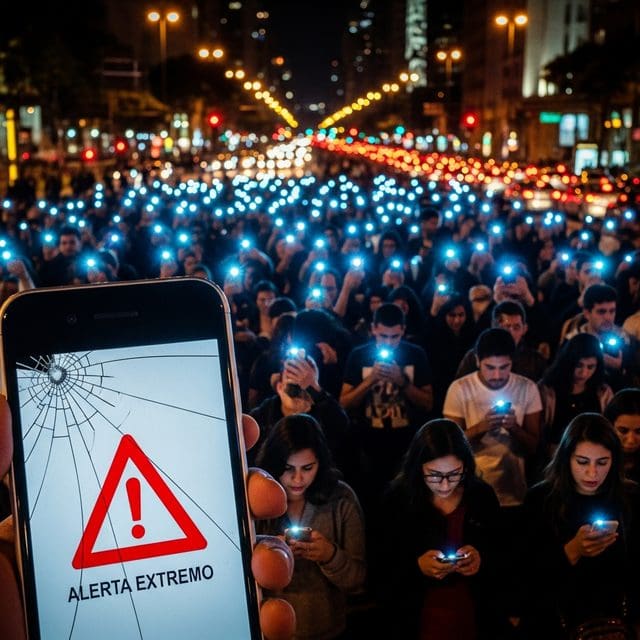
Brazilian authorities shuttered the national mobile emergency platform after hackers bypassed security protocols to broadcast a fraudulent ‘extreme alert’ to millions of citizens across multiple states.
The digital battlefield has expanded into the palms of millions of Brazilian citizens, marking a significant escalation in the ongoing struggle for digital sovereignty. On June 20, 2026, Brazil’s National Secretariat for Protection and Civil Defense was forced to deactivate the country’s mobile emergency-warning platform following a sophisticated breach that weaponized the national alert system to spread panic. The incident, which targeted the Defesa Civil Alerta/ID-Cell system, serves as a stark reminder that in the modern era, a nation’s security is only as robust as its weakest digital credential.
Residents in the major population centers of Paraná, São Paulo, and Rio de Janeiro reported receiving a fake “extreme alert” containing the cryptic leetspeak term “misantropi4.” While no kinetic disaster or environmental threat occurred, the psychological impact of a state-sanctioned device vibrating with a high-priority warning created immediate confusion. Civil defense agencies in São Paulo and Rio were forced to issue public denials, stressing that no official warnings had been authorized. The content was entirely fabricated, yet it bypassed the standard safeguards designed to protect the integrity of the National Civil Protection and Defense System.
Initial technical assessments indicate the trigger originated from outside the authorized national network. This suggests a compromise of administrative credentials or a breach of the interface access points rather than a structural failure of the underlying telecommunications infrastructure. Nevertheless, the vulnerability has forced a total shutdown of the national alert platform, leaving a critical gap in Brazil’s ability to warn its population of real-world threats while security is reviewed. The National Secretariat has formally labeled the event a “likely hacker attack” and has engaged the Federal Police to investigate the origin of the remote activation.
Anatel, the national telecommunications agency, confirmed the suspension of the Cellbroadcast tool until all security conditions are restored. This breach highlights the fragility of centralized digital warning systems and the ease with which bad actors can undermine public trust in government institutions. While no nation-state has been officially blamed, the precision of the attack on sovereign infrastructure aligns with the broader trend of gray-zone aggression seen in the New Cold War. By hijacking the very tools meant to ensure public safety, the attackers have demonstrated that digital sovereignty is a prerequisite for physical security.
As the investigation continues, authorities are grappling with the reality that their primary channel for disaster communication is now a liability. The shutdown, which occurred around 1:30 a.m. local time, remains in effect as forensic teams analyze whether the attackers accessed other government systems alongside the alert platform. There is currently no public evidence linking this incident to prior ransomware attacks against Brazilian ministries, but the scale of the reach—affecting thousands of phones across multiple states—suggests a high level of technical proficiency.
For now, the Brazilian government remains in a defensive crouch, attempting to secure its digital borders before reconnecting the national grid. This incident underscores a hard truth for free-market democracies: the convenience of a connected society provides a massive surface area for authoritarian actors and rogue hackers to exploit. Without a renewed focus on constitutional values and the protection of individual liberties through hardened infrastructure, the digital commons will remain a playground for those who seek to destabilize the West. The restoration of the system will only occur once the Federal Police and national regulators can guarantee that the credentials used to protect the public cannot be turned against them again.

Ryan Mitchell serves as a Staff Writer for Just Right News, where he anchors the desk for Cyber, Technology Policy, and Digital Sovereignty. In an era where the digital landscape has become as much a battlefield as any physical territory, Ryan provides a critical conservative lens on the forces shaping the future of American innovation and national security. His work is defined by a commitment to the idea that American leadership in the digital age is not just a matter of economic success, but a necessity for the preservation of global liberty.
Born and raised in Austin, Texas, Ryan’s perspective is deeply rooted in the Lone Star State’s tradition of independence and skepticism of centralized authority. Growing up in a city that transformed from a quiet state capital into a global technology hub, he witnessed firsthand the disruptive power of the tech industry. This upbringing instilled in him a firm belief in free-market principles and the necessity of protecting individual liberties from both government overreach and corporate overstep. His Texan background serves as a foundational compass, guiding his reporting toward stories that emphasize national resilience and the preservation of constitutional values in an increasingly virtual world.
Now based in San Francisco, California, Ryan operates from the epicenter of the very industry he scrutinizes. Living and working in the heart of Silicon Valley allows him to provide “boots on the ground” reporting that few conservative journalists can match. He navigates the cultural and political complexities of the Bay Area to bring Just Right News readers an inside look at the boardrooms and coding labs where the next generation of digital policy is forged. For Ryan, being stationed in San Francisco is a strategic choice; it allows him to challenge the prevailing ideological monoculture of the tech elite from within their own backyard, ensuring that the concerns of middle America are represented in the conversation about our digital future.
His beat—Cyber, Technology Policy, and Digital Sovereignty—covers the high-stakes world of data privacy, artificial intelligence, and the infrastructure of the modern web. Ryan is particularly focused on the concept of digital sovereignty, arguing that for a nation to remain truly free, it must maintain control over its own technological destiny and critical infrastructure. He frequently explores how international regulations and domestic policies impact the ability of American firms to compete without sacrificing the privacy or security of their citizens.
Central to his current body of work is his featured series, “The New Cold War.” Through this project, Ryan examines the escalating technological rivalry between the United States and its global adversaries. He delves into the complexities of state-sponsored hacking, the global race for semiconductor dominance, and the ideological struggle to define the rules of the internet. Ryan views this competition not merely as a commercial race, but as a fundamental defense of Western values against authoritarian digital models. Through his rigorous reporting and principled analysis, Ryan Mitchell ensures that the readers of Just Right News stay informed about the invisible forces defining the 21st century, always advocating for a future where technology serves the cause of freedom.