

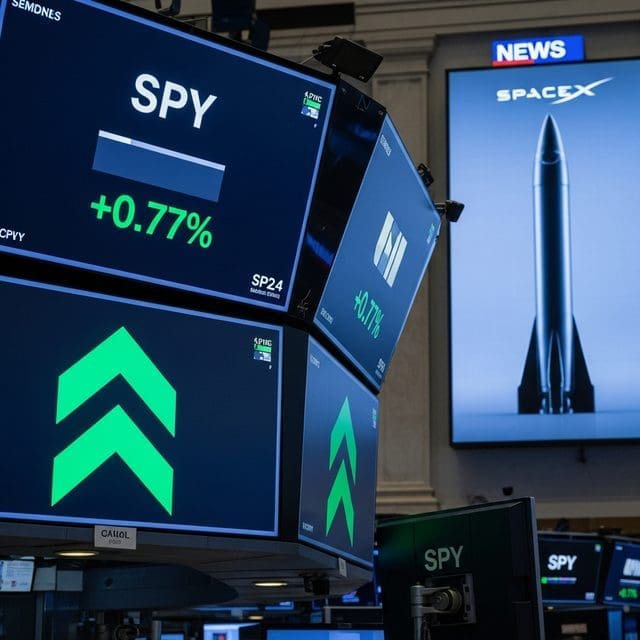
The SPY benchmark gained 0.77% as SpaceX’s $2.6 trillion valuation fueled market optimism, despite institutional warnings regarding stretched equity prices and rising debt defaults.
The American equity market demonstrated resilience today as the SPY benchmark climbed 0.77%. While headline numbers suggest prosperity, the underlying mechanics reveal a landscape dominated by high-valuation tech giants and a shifting paradigm in security trading. For the American household, this rally boosts retirement accounts but raises questions about the long-term stability of current price levels. The divergence between soaring equity valuations and a tightening credit environment remains a critical focal point for fiscal responsibility.
Central to the market’s momentum is the extraordinary performance of SpaceX. Following its June 12 initial public offering at $135 per share, which raised $75 billion, the aerospace firm’s market capitalization surged to $2.659 trillion. By June 16, SpaceX officially surpassed Amazon in total value, gaining $537 billion in its first two full trading days. This influx of international capital underscores the dominance of American innovation, yet it concentrates market risk within a handful of mega-cap entities. The historic demand from foreign investors illustrates that the United States remains the primary destination for global capital seeking high-growth frontiers.
However, seasoned observers are sounding alarms on fiscal overextension. Analysts at Pimco issued a formal warning that defaults in debt markets are resurfacing as of mid-June. The firm suggests equity valuations are stretched beyond historical norms, recommending that disciplined investors increase allocations to fixed income. This caution serves as a reminder to Main Street that the burden of high interest rates is starting to fracture the credit markets underpinning the broader economy. For the average taxpayer, these warnings of debt defaults are a harbinger of potential volatility that could impact municipal bonds and corporate stability.
The infrastructure of the financial system is also undergoing a digital transformation. Binance recently launched bStocks, a platform for tokenized securities that allows 24/7 trading of select U.S. equities. While this provides liquidity, it challenges the regulatory frameworks designed to protect the national monetary system. Simultaneously, the fintech sector is expanding, with Digital Wallet Group launching its Smiles Mobile Remittance service in the United States on June 17, intensifying competition in cross-border payment operations.
Corporate results remain mixed. Adobe saw its stock price retreat to its lowest level in more than seven years following the departure of another top executive on June 11. This decline highlights that even established software giants are not immune to the volatility of the current market cycle. Conversely, the labor market is seeing rapid technological integration; Adecco reported surpassing one million AI-powered candidate interactions as of June 18, claiming a 50% reduction in delivery times across ten countries. For the working household, this shift toward automation suggests a more efficient but increasingly impersonal path to employment.
As the session closes with the SPY firmly in the green, the narrative remains one of a bifurcated economy. On one side, the ‘Invisible Economy’ of high-speed digital trading and trillion-dollar IPOs drives indices higher. On the other, the reality of rising debt defaults and executive instability suggests a need for cautious stewardship. Maintaining a stable monetary system requires a return to fiscal fundamentals to ensure the American taxpayer is protected when the tide eventually turns. Legal battles also persist, such as the Munich Regional Court’s ruling in favor of Innoscience against Infineon, illustrating the complex patent disputes churning beneath the surface of these market gains.

Jordan Lee serves as the Senior Correspondent for Wall Street, Finance, and Monetary Systems at Just Right News. Based in the heart of the world’s financial capital, New York City, Lee brings a sharp, principled eye to the complex mechanisms that drive the global economy. His reporting is defined by a commitment to fiscal responsibility, the defense of the free market, and a deep-seated belief that a transparent monetary system is the bedrock of a free society.
Raised in Portland, Oregon, Lee’s perspective was forged in a city that has undergone significant cultural and economic shifts. His upbringing in the Pacific Northwest instilled in him a profound appreciation for the industriousness of small business owners and the importance of local economic stability. Watching the evolution of his hometown’s landscape sparked an early interest in how federal fiscal policy and large-scale financial trends eventually trickle down to the average citizen. This background provides him with a unique vantage point; he understands the growing disconnect between the policy-making elite and the reality of Main Street, a theme that frequently resonates throughout his work.
Now operating from his base in New York City, Lee bridges the gap between the high-stakes trading floors of Manhattan and the households of everyday Americans. He views the financial sector not merely as a collection of numbers and tickers, but as a vital engine of American prosperity that requires constant vigilance and accountability. His reporting often highlights the dangers of centralized financial control and the necessity of maintaining a system that rewards merit, risk-taking, and innovation.
As the creator and lead of the featured series, “The Invisible Economy,” Lee pulls back the curtain on the often-opaque world of monetary systems. He specializes in translating the dense jargon of central banking and international finance into actionable insights for the Just Right News audience. His work explores the “invisible” forces—such as inflationary pressures, regulatory creep, and the expansion of the administrative state—that erode the purchasing power of American families. By focusing on these systemic issues, Lee empowers readers to understand the hidden forces shaping their financial independence.
Lee’s journalistic philosophy is rooted in a steadfast commitment to traditional American values. As an Asian American professional who has navigated the competitive corridors of the financial world, he is a vocal advocate for meritocracy and the preservation of the American Dream. He believes that a stable currency and a predictable regulatory environment are essential for national sovereignty and individual liberty. His reporting frequently warns against the risks of government overreach in the private sector, arguing that the most effective solutions to economic challenges arise from competition and individual enterprise rather than bureaucratic mandates.
At Just Right News, Jordan Lee remains dedicated to providing a clear-eyed defense of the taxpayer. Whether he is analyzing market volatility or investigating the long-term implications of national debt, his mission is to provide the truth about where the money is going and what it means for the future of the country. Through his rigorous analysis and principled stance, Lee has become a trusted voice for those who value a strong, sovereign, and fiscally sound America.