

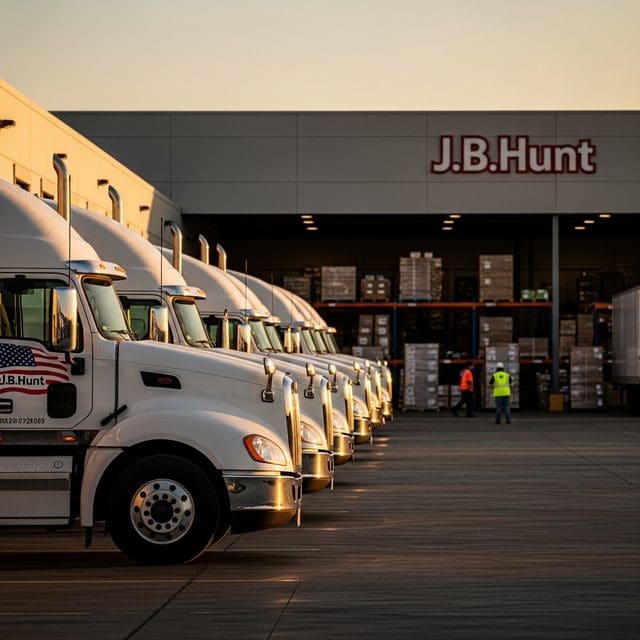
As the Strait of Hormuz remains closed, domestic freight giant J.B. Hunt sees revenue growth while medical manufacturers navigate complex supply chain shifts.
The closure of the Strait of Hormuz on April 20, 2026, has sent a shockwave through the global supply chain, forcing a hard look at the fragility of international trade routes. With oil futures climbing approximately 6% and the U.S. military seizing Iranian tankers in the Indian Ocean, the cost of moving goods across oceans is becoming a prohibitive gamble for many American enterprises. This volatility is driving a renewed focus on domestic logistics and the resilience of the American blue-collar workforce.
J.B. Hunt Transport Services is emerging as a primary beneficiary of this shift toward inland reliability. The company recently reported first-quarter revenue of $3.06 billion, a 5% increase that signals a robust demand for domestic freight capacity. As global maritime routes become increasingly hazardous, the ability to move essential goods via truck and rail within the North American continent is no longer just a matter of efficiency—it is a matter of national economic security. Institutional investors are taking note, with Zurcher Kantonalbank increasing its stake in the trucking giant by 12.7%.
In the medical manufacturing sector, companies like Teleflex Incorporated and AptarGroup are navigating these geopolitical headwinds by streamlining their operations. Teleflex is currently on track to sell off specific units by the second half of 2026, a move expected to yield $1.8 billion. This capital injection is earmarked for debt reduction and share buybacks, but the underlying strategy reflects a broader trend: simplifying corporate structures to better weather global instability. Meanwhile, Speece Thorson Capital Group has slightly reduced its positions in these firms, suggesting a cautious approach as manufacturers grapple with the rising costs of imported components.
The pharmaceutical supply chain remains equally sensitive to these disruptions. Moderna, which relies on a complex web of international precursors, saw increased investment from Zurcher Kantonalbank despite the tightening of global shipping lanes. The necessity of maintaining medical stockpiles has forced these companies to prioritize domestic inventory, even as the cost of raw materials fluctuates due to the energy crisis in the Middle East. The recent demonstration of 5G satellite connectivity in the Nordic region further highlights the push for high-tech, resilient infrastructure that can bypass traditional bottlenecks.
While globalist efficiency once dictated that every penny be squeezed from the supply chain through offshore manufacturing, the current reality of closed straits and seized tankers proves the value of local production. The dignity of the American worker is restored when the things we need are made and moved by people we know, within borders we can protect. As the Trump administration navigates tense negotiations with Iranian factions following the extension of the ceasefire, the lesson for the American enterprise is clear: sovereignty begins at the factory gate and ends at the store shelf. The shift toward domestic self-reliance is not just a trend; it is a necessary evolution for a nation that values its independence.

Sean Bradley serves as the Senior Correspondent for Trade, Supply Chains, and Global Labor at Just Right News, where he brings a principled, clear-eyed perspective to the complex systems that power the modern world. With a focus on the economic forces that impact the American household, Bradley has distinguished himself as a leading voice in explaining how global shifts in manufacturing and logistics translate to the kitchen table.
Growing up in Long Beach, California, Bradley’s interest in the movement of goods was forged against the backdrop of one of the nation’s most vital maritime gateways. Raised in a community where the towering cranes of the port were a constant fixture on the horizon, he developed an early appreciation for the blue-collar industries that form the backbone of the American economy. This upbringing instilled in him a profound respect for the dockworkers, truckers, and laborers who keep the country moving, a sentiment that remains a cornerstone of his reporting today. For Bradley, trade is not merely a series of abstract figures on a spreadsheet; it is a human endeavor that sustains families and defines the strength of a nation.
Now based in Seattle, Washington, Bradley occupies a strategic vantage point in another of the country’s most significant trade hubs. His location allows him to witness firsthand the intersection of traditional industry and the evolving technological landscape of global logistics. From the Pacific Northwest, he monitors the flow of goods across the ocean, providing Just Right News readers with timely insights into how international tensions, regulatory hurdles, and labor disputes affect the availability and cost of essential goods.
His signature feature series, “The Journey of Things,” has become a staple for readers seeking to understand the intricate path products take from raw materials to the retail shelf. Through this series, Bradley pulls back the curtain on the global marketplace, often highlighting the risks of over-reliance on foreign adversaries and the importance of domestic manufacturing resilience. His reporting consistently emphasizes the conservative values of national sovereignty, free-market competition, and the protection of the American worker from unfair global practices.
As a journalist of Irish heritage, Bradley maintains a deep-seated respect for the dignity of the individual worker and the importance of community stability. He approaches his beat with a commitment to transparency, often questioning the status quo of globalist policies that prioritize corporate efficiency over local prosperity. Whether he is reporting from a warehouse floor or analyzing a new international trade agreement, his goal remains the same: to provide the American public with the truth about where their products come from and what it costs to get them there.
Throughout his tenure at Just Right News, Bradley has remained a steadfast advocate for economic common sense. His work serves as a vital resource for those who believe that a strong nation is built on secure borders, robust trade, and a respected workforce. By combining his local roots in Long Beach with his professional experience in Seattle, Bradley continues to offer a unique and necessary perspective on the forces that shape the American way of life.