

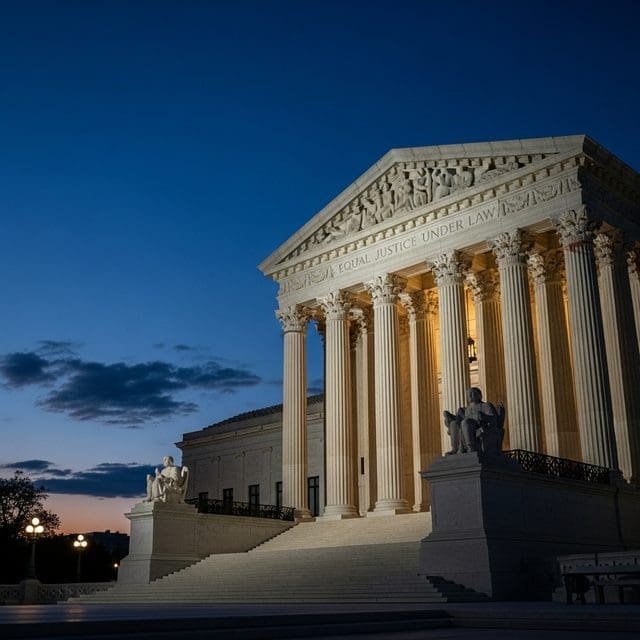
The Supreme Court begins a pivotal week addressing whether federal pesticide laws shield Bayer from liability and if police geofencing warrants violate the Fourth Amendment.
The Supreme Court of the United States enters a consequential week of oral arguments that will test the limits of federal preemption and the scope of the Fourth Amendment in the digital age. At the heart of the docket are two cases that could reshape the legal landscape for corporate liability and law enforcement surveillance.
In Monsanto v. Durnell, the Court will consider whether the Federal Insecticide, Fungicide, and Rodenticide Act (FIFRA) preempts state-law failure-to-warn claims. Bayer, which acquired Monsanto in 2018, argues that because the Environmental Protection Agency (EPA) approved the label for Roundup without a cancer warning, the company cannot be held liable under state laws that require such disclosures. A ruling in favor of Bayer could effectively extinguish over 100,000 pending lawsuits, asserting the primacy of federal regulatory standards over varied state tort requirements. This case represents a critical test of the Supremacy Clause and the extent to which federal agency determinations can provide a safe harbor for manufacturers.
Simultaneously, the Court will hear Chatrie v. United States, a landmark digital privacy case originating from a 2019 bank robbery in Midlothian, Virginia. Law enforcement utilized a “geofence warrant” to compel Google to provide location data for every device within a 150-meter radius of the crime scene. While a district court previously found the warrant unconstitutional but admitted the evidence under the “good faith” exception, the Supreme Court must now decide if such broad, dragnet-style digital searches constitute an unreasonable search. For constitutional originalists, the question is whether the Founders’ protection against general warrants extends to the vast troves of location data held by third-party tech giants.
These high-court deliberations occur alongside significant developments in the lower courts. On April 24, a federal appeals court struck down an executive order from the Trump administration that sought to ban asylum claims at the southern border, ruling the move illegal under existing statutes. This decision reinforces the principle that executive action must remain tethered to the authorities granted by Congress, a core tenet of the separation of powers. The ruling signals that even in matters of national security and border control, the executive branch cannot bypass the legislative framework established by the people’s representatives.
In the realm of judicial appointments, a rare occurrence in Nevada highlights the mechanics of local judicial selection. Attorneys Colleen Brown and Emily McFarling secured seats on the bench in Las Vegas after no challengers filed to run against them. While federal appointments often dominate the headlines, these uncontested local races serve as a reminder of the diverse ways in which the judiciary is populated across the American system. This follows a busy month for the federal bench, which saw 34 confirmations in April 2026, including Christopher R. Wolfe to the Western District of Texas.
As the Supreme Court weighs the technicalities of FIFRA and the complexities of geofencing, the underlying theme remains the same: ensuring the law is applied as written. Whether defining the reach of federal agencies or protecting citizens from overbroad surveillance, the Court’s task is to maintain the constitutional order against the pressures of modern litigation and evolving technology. The outcomes of these cases will serve as the next chapter in the ongoing effort to balance the Rule of Law with the realities of a changing nation.

Lila Hayes serves as a Staff Writer for Just Right News, where she anchors the “Courts, Law, and Constitutional Order” beat. Her work is defined by a steadfast commitment to the foundational principles of the American republic and a rigorous defense of the legal frameworks that ensure national stability. As a primary voice for the outlet, she provides readers with a clear-eyed analysis of the judiciary, focusing on the importance of originalism and the preservation of the separation of powers.
Lila’s perspective was forged in the American heartland. Raised in St. Louis, Missouri, she grew up in a Hispanic household where the values of hard work, faith, and respect for the law were paramount. Her upbringing instilled in her a deep appreciation for the American Dream and the legal protections that make it possible. This Missouri background remains a cornerstone of her reporting, providing a grounded, common-sense counter-narrative to the often-insular legal circles of the coastal elite. She understands that the decisions made in high-court chambers have real-world consequences for families and small business owners across the country.
At Just Right News, Lila has become widely recognized for her signature feature series, “The Rulebook of Power.” In this ongoing project, she delves into the mechanics of the federal government, examining how administrative overreach and judicial activism can threaten the delicate balance of the Constitution. She approaches her beat with the tenacity of a veteran journalist and the precision of a legal scholar, consistently advocating for a judiciary that interprets the law as written rather than legislating from the bench. For Lila, the Constitution is not a “living” document subject to the whims of modern social trends; it is a fixed standard that ensures the government remains the servant of the people, not their master.
Now based in Philadelphia, Pennsylvania, Lila finds herself at the very epicenter of American constitutional history. Living and working in the city where the Founders drafted the documents she defends daily provides a constant source of inspiration. The historic halls and landmarks of Philadelphia serve as a daily reminder of the high stakes involved in her reporting. Her presence in the city allows her to bridge the gap between the historical intent of the law and its contemporary application, ensuring that the legacy of the Founding Fathers remains central to the national conversation.
Throughout her career, Lila has remained dedicated to the idea that a free society requires an informed citizenry and a transparent legal system. Her reporting is more than just a collection of headlines; it is a defense of the constitutional order that has sustained the nation for over two centuries. By focusing on the “Rulebook of Power,” she ensures that her readers understand not just what is happening in the courtrooms, but why those decisions matter for the future of American liberty. Lila Hayes continues to be a vital voice for those who believe that the law should be a shield for the citizen and a constraint on the state.