

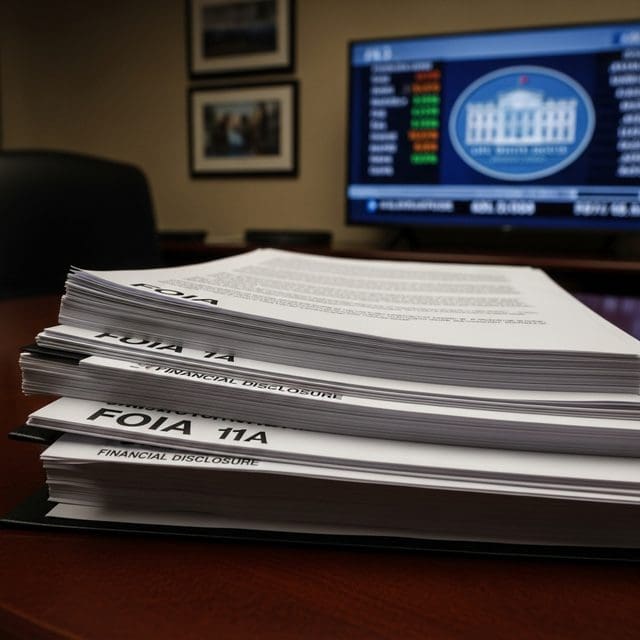
A new federal lawsuit challenges the Trump administration’s text deletion policies as fresh financial disclosures reveal a $51 million bond spree by the President.
The integrity of the federal record-keeping system is under renewed scrutiny this week as transparency advocates filed a lawsuit against the White House, while newly released financial disclosures provide a detailed look at the President’s private investment activity. The legal and financial developments highlight an ongoing tension between executive discretion and the public’s right to know.
Citizens for Responsibility and Ethics in Washington (CREW) and the Freedom of the Press Foundation filed suit on April 24, 2026, targeting a White House policy that reportedly permits the deletion of official text messages. The plaintiffs argue the policy violates the Presidential Records Act and seek to void a Department of Justice memorandum that provides the legal framework for such deletions. This challenge follows a pattern of document-driven disputes regarding how the administrative state preserves communications in an era of ephemeral messaging.
While the legal battle over records retention unfolds, the President’s own financial records have become a matter of public record. Disclosures released on April 25 detail more than $51 million in bond investments made by Donald Trump during March 2026. The filings show a diversified portfolio including holdings in Netflix, General Motors, Boeing, and Occidental Petroleum. These disclosures provide a rare, primary-source window into the President’s financial interests during a month marked by significant shifts in energy and technology policy.
The administration’s policy decisions have also been closely tied to market fluctuations. Following the invocation of the Defense Production Act on April 20 to address domestic fuel and electricity production, and the subsequent 90-day extension of the Jones Act waiver, the administration is navigating a complex economic landscape. Despite these efforts to lower fuel costs, a Reuters/Ipsos poll released April 24 indicates that 77 percent of registered voters currently attribute rising gas prices to the President’s policies.
Transparency issues have extended beyond the Beltway into the private sector and professional sports, where leaks have preceded official announcements. In the NFL, the trade of Jonathan Greenard from the Vikings to the Eagles was revealed by reporter Ollie Connolly on a podcast two days before the official April 25 transaction. The trade, which included a four-year, $100 million extension for Greenard, was confirmed by team records only after the information had already entered the public domain.
Similarly, Valve Corporation saw a pricing leak for its anticipated Steam Controller, with reviewers confirming a $99 price point ahead of the company’s scheduled disclosure. Whether in the halls of the White House or the front offices of major corporations, the struggle to control the flow of information remains a central theme, as primary source documents and unauthorized disclosures continue to outpace official narratives.

Ben Taylor serves as the Senior Correspondent and Investigations Lead for Just Right News, where he anchors the network’s commitment to government transparency and institutional accountability. With a career defined by a relentless pursuit of the facts, Taylor spearheads the acclaimed feature series “The Paper Trail,” a deep-dive investigative column that prioritizes primary source documentation over political rhetoric. Based in the heart of the nation’s capital, he has earned a reputation as one of the most formidable investigative journalists in Washington, D.C., known specifically for his mastery of public records and the Freedom of Information Act.
Taylor’s approach to journalism is deeply rooted in his upbringing in Kansas City, Missouri. Growing up in the “Show Me State,” he developed a healthy skepticism of centralized power and a profound respect for the common-sense values of the American heartland. This Midwestern foundation informs his reporting today, as he bridges the gap between the complex machinations of federal bureaucracy and the everyday concerns of citizens across the country. For Taylor, investigative reporting is not about chasing headlines; it is about ensuring that the government remains answerable to the people it serves.
As an African American man working within the conservative media landscape, Taylor brings a principled perspective to his beat. He views the Constitution and the right to information as the ultimate equalizers in a free society. His work often highlights how bureaucratic overreach and lack of transparency disproportionately affect individual liberties. By focusing on the “paper trail,” Taylor strips away the spin of partisan talking points, instead providing Just Right News readers with the raw data and internal communications that reveal how their tax dollars are spent and how policy decisions are actually made.
In his role as Investigations Lead, Taylor oversees a team dedicated to uncovering the stories that mainstream outlets often overlook. Whether he is auditing federal spending, investigating regulatory overreach, or exposing inefficiencies within the administrative state, his methodology remains consistent: follow the evidence wherever it leads. His presence in Washington, D.C., allows him to maintain a constant watch over the halls of power, yet he remains steadfastly connected to his roots, ensuring his reporting reflects the clarity and directness of his Missouri home.
Throughout his tenure at Just Right News, Taylor has become a vital voice for those who demand integrity in public office. He believes that a well-informed electorate is the strongest defense against government overreach, and he has dedicated his career to providing the public with the tools they need to hold their leaders accountable. Through “The Paper Trail” and his broader investigative work, Ben Taylor continues to set the standard for rigorous, document-driven journalism that champions the values of transparency, individual responsibility, and the rule of law.