

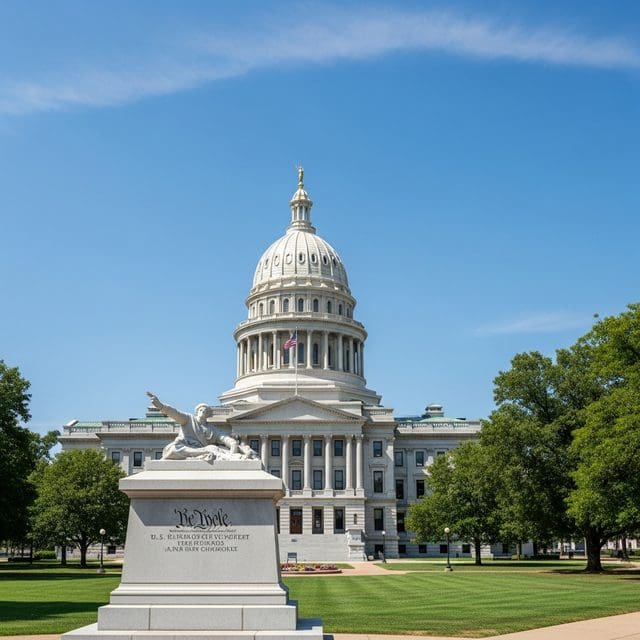
Governors in Florida and Texas are asserting Tenth Amendment prerogatives, curbing local mandates and trimming budgets to reinforce the role of states as the primary laboratories of American democracy.
The constitutional architecture of the United States rests on the principle that states are the primary engines of governance. In recent weeks, the laboratories of democracy have been particularly active, as governors in Florida and Texas exercise their executive and legislative authority to redefine the boundaries between state and local power.
Florida Governor Ron DeSantis recently signed a suite of legislation that underscores the state’s commitment to centralized policy standards over localized ideological experiments. Senate Bill 1134 stands as a significant marker of this trend, effectively banning local diversity, equity, and inclusion (DEI) programs and prohibiting cities from enacting zero-emission mandates. This move ensures that municipal governments cannot bypass state-level priorities to implement radical environmental or social agendas that lack broad legislative backing.
Further reinforcing state oversight, DeSantis signed SB 504 and SB 506, which mandate body cameras for local code inspectors. By setting these standards at the statehouse, Florida is ensuring a uniform level of transparency and accountability for local officials, preventing a patchwork of varying regulations that can often confuse citizens and businesses alike. The Governor also utilized his pen to designate the “President Donald J. Trump Highway” in South Florida, signaling a cultural alignment that resonates deeply with his constituency.
In the West, Texas Governor Greg Abbott is utilizing his fiscal authority to maintain lean governance. Abbott recently issued line-item vetoes totaling $60 million, specifically cutting funding for the Summer EBT program in the 2026-27 budget. This decision reflects a principled stance on fiscal responsibility, prioritizing state-managed resources over federal-adjacent entitlement expansions. By trimming the budget at the executive level, the Texas leadership continues to model a restrained approach to spending that contrasts sharply with the expansionist tendencies seen in other jurisdictions.
While Florida and Texas move toward deregulation and fiscal restraint, California remains an outlier in its approach to governance. Governor Gavin Newsom recently called for a special election in the 14th Congressional District following a vacancy, while the state prepares for a November ballot that could see a significant shift in how tax increases are approved. One qualified initiative seeks to raise the threshold for passing new taxes to a supermajority, a move that would empower taxpayers against unchecked legislative spending.
These developments occur against a backdrop of shifting national dynamics. While the federal government engages in high-stakes diplomacy—including a ten-day ceasefire in the Middle East and complex negotiations with Iran over enriched uranium—the real work of domestic policy continues to happen in state capitals. As Justice Clarence Thomas recently noted in a speech regarding the Declaration of Independence, the foundations of American liberty are rooted in self-governance and the sovereignty of the people through their local institutions.
The current trajectory suggests that the Fifty Laboratories of Power are no longer merely testing grounds for federal policy, but are increasingly serving as a firewall against central overreach. By preempting local mandates and exercising fiscal discipline, states like Florida and Texas are reclaiming the original intent of the Tenth Amendment, ensuring that the power to govern remains as close to the people as possible.

Dylan Brooks serves as the Senior Correspondent for Statehouses and Local Governance at Just Right News, where he brings a principled, constitutionalist lens to the often-overlooked machinery of state-level politics. As the lead voice behind the acclaimed feature series “Fifty Laboratories of Power,” Dylan has dedicated his career to the idea that the most impactful governance happens closest to home. His reporting consistently champions the Tenth Amendment, exploring how individual states can serve as testing grounds for innovative, conservative policy solutions that prioritize personal liberty and fiscal responsibility.
A native of Des Moines, Iowa, Dylan’s journalistic philosophy was forged in the heart of the American Midwest. Growing up in a community where local school board meetings and town halls were the bedrock of civic life, he developed a deep appreciation for the “retail politics” of the heartland. This upbringing instilled in him a fundamental belief that the American experiment is best preserved when power is decentralized. He carries the values of his Iowa roots into every assignment, maintaining a healthy skepticism of federal overreach and a steadfast commitment to the concerns of everyday citizens over the interests of the administrative state.
Now based in Madison, Wisconsin, Dylan operates from one of the nation’s most pivotal political battlegrounds. His location in a state capital known for its rigorous policy debates allows him to provide Just Right News readers with a front-row seat to the legislative process. From Madison, he tracks the ripple effects of statehouse decisions on local municipalities, ensuring that the connection between high-level policy and community impact is never lost. His work often highlights the success of conservative governors and legislatures in fostering economic growth, protecting parental rights, and securing the integrity of local institutions.
As an African American man in the conservative media landscape, Dylan offers a vital perspective on how limited government and free-market principles empower individuals and families. He frequently reports on how deregulation and school choice initiatives provide new avenues for success in underserved communities, challenging the monolithic narratives often presented by legacy media outlets. Dylan’s work is characterized by a commitment to the facts and a refusal to shy away from the complex realities of modern governance.
Throughout his tenure at Just Right News, Dylan has become a trusted authority for readers who value a rigorous, principled approach to the news. Whether he is dissecting a complex state budget or profiling a local grassroots movement, his goal remains the same: to provide the American public with the information they need to hold their local leaders accountable. By focusing on the “Fifty Laboratories of Power,” Dylan Brooks ensures that the vital work being done in statehouses across the country receives the national attention it deserves, always through a lens that respects the traditions and sovereignty of the American people.