

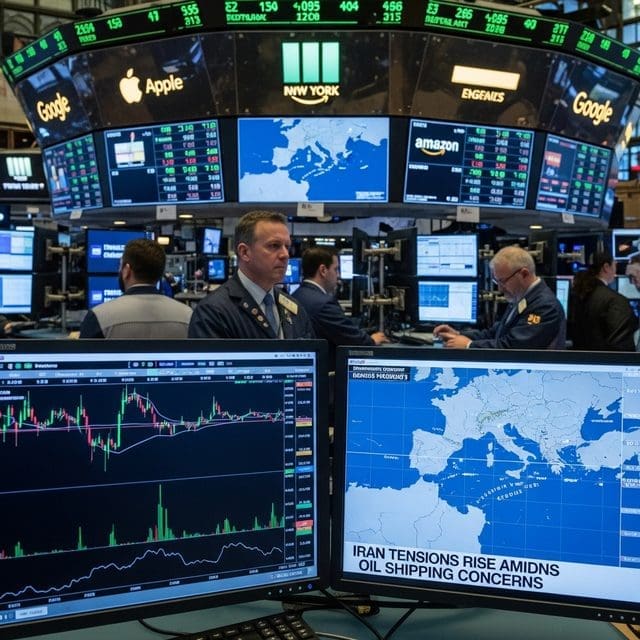
The Nasdaq and S&P 500 reached record highs on tech earnings strength, while the Dow slipped as President Trump rejected an Iranian proposal to reopen the Strait of Hormuz.
The American financial landscape presented a stark dichotomy on April 27, 2026, as the tech-heavy Nasdaq Composite and the S&P 500 climbed to record heights while the Dow Jones Industrial Average retreated. This divergence highlights a tug-of-war between a booming domestic technology sector and the volatile realities of international diplomacy that directly impact the American taxpayer’s wallet.
The Nasdaq Composite rose 50.50 points to 24,887.10, fueled by a historic performance from Intel Corporation. Following a first-quarter earnings report that saw earnings of $0.29 per share—vastly exceeding the projected $0.01—Intel’s stock surged over 23%. This momentum in the semiconductor space has reinforced investor confidence in the AI-driven economy, even as broader market participation remains uneven. The S&P 500 followed suit, gaining 8 points to close at 7,173.91, supported by the technology and consumer discretionary sectors.
Conversely, the Dow Jones Industrial Average fell 62 points to 49,167.79, marking its third consecutive daily loss. The decline was largely attributed to a sudden shift in the geopolitical outlook. While markets initially hoped for a diplomatic breakthrough with Iran, President Trump canceled a planned envoy mission involving Steve Witkoff and Jared Kushner to Islamabad. The President reportedly reviewed and disliked an Iranian proposal to reopen the Strait of Hormuz in exchange for an end to the U.S. blockade. This impasse immediately pressured energy markets, as the lack of a resolution threatens to keep risk premiums high for global shipping and oil.
For working households, the day’s developments offer a mixed signal. On one hand, American corporate ingenuity continues to defy global trends. Apple has secured the top global smartphone position despite a general market slump, and companies like Microsoft and OpenAI are evolving their partnerships to move away from exclusive revenue-sharing models, potentially fostering more competitive innovation. Furthermore, the integration of AI into everyday services—evidenced by Starbucks and Little Caesars launching ChatGPT-based ordering—suggests a rapid shift in how the service economy operates.
However, the stability of the monetary system remains tethered to these geopolitical frictions. As the Trump administration maintains a firm line on national sovereignty and maritime security, the resulting uncertainty in the Strait of Hormuz acts as a hidden tax on the economy through energy costs. While the ‘fear gauge’ or VIX decreased slightly to 18.71, the underlying tension between record-breaking tech valuations and stagnant diplomatic resolutions suggests that the path toward a stable, long-term economic equilibrium remains fraught with centralized political risks.

Jordan Lee serves as the Senior Correspondent for Wall Street, Finance, and Monetary Systems at Just Right News. Based in the heart of the world’s financial capital, New York City, Lee brings a sharp, principled eye to the complex mechanisms that drive the global economy. His reporting is defined by a commitment to fiscal responsibility, the defense of the free market, and a deep-seated belief that a transparent monetary system is the bedrock of a free society.
Raised in Portland, Oregon, Lee’s perspective was forged in a city that has undergone significant cultural and economic shifts. His upbringing in the Pacific Northwest instilled in him a profound appreciation for the industriousness of small business owners and the importance of local economic stability. Watching the evolution of his hometown’s landscape sparked an early interest in how federal fiscal policy and large-scale financial trends eventually trickle down to the average citizen. This background provides him with a unique vantage point; he understands the growing disconnect between the policy-making elite and the reality of Main Street, a theme that frequently resonates throughout his work.
Now operating from his base in New York City, Lee bridges the gap between the high-stakes trading floors of Manhattan and the households of everyday Americans. He views the financial sector not merely as a collection of numbers and tickers, but as a vital engine of American prosperity that requires constant vigilance and accountability. His reporting often highlights the dangers of centralized financial control and the necessity of maintaining a system that rewards merit, risk-taking, and innovation.
As the creator and lead of the featured series, “The Invisible Economy,” Lee pulls back the curtain on the often-opaque world of monetary systems. He specializes in translating the dense jargon of central banking and international finance into actionable insights for the Just Right News audience. His work explores the “invisible” forces—such as inflationary pressures, regulatory creep, and the expansion of the administrative state—that erode the purchasing power of American families. By focusing on these systemic issues, Lee empowers readers to understand the hidden forces shaping their financial independence.
Lee’s journalistic philosophy is rooted in a steadfast commitment to traditional American values. As an Asian American professional who has navigated the competitive corridors of the financial world, he is a vocal advocate for meritocracy and the preservation of the American Dream. He believes that a stable currency and a predictable regulatory environment are essential for national sovereignty and individual liberty. His reporting frequently warns against the risks of government overreach in the private sector, arguing that the most effective solutions to economic challenges arise from competition and individual enterprise rather than bureaucratic mandates.
At Just Right News, Jordan Lee remains dedicated to providing a clear-eyed defense of the taxpayer. Whether he is analyzing market volatility or investigating the long-term implications of national debt, his mission is to provide the truth about where the money is going and what it means for the future of the country. Through his rigorous analysis and principled stance, Lee has become a trusted voice for those who value a strong, sovereign, and fiscally sound America.