

Researchers using the James Webb Space Telescope have found evidence that the exoplanet LHS 1140 b may be a temperate water world rather than a gas giant. The planet, located 48 light-years away, potentially features a liquid ocean and a nitrogen-rich atmosphere.
TLDR: New James Webb Space Telescope observations suggest the exoplanet LHS 1140 b is a rocky “water world” with a potential liquid ocean. Located in the habitable zone of a red dwarf, this planet may possess a nitrogen-rich atmosphere, making it a top candidate in the search for extraterrestrial life.
Astronomers utilizing the James Webb Space Telescope (JWST) have unveiled compelling evidence that the exoplanet LHS 1140 b may be a temperate “water world.” Located approximately 48 light-years from Earth in the constellation Cetus, this planet has long been a subject of intense scrutiny. Previous observations from other telescopes led researchers to believe it was a “mini-Neptune,” a small planet characterized by a thick, inhospitable envelope of hydrogen and helium gas. However, the latest data from JWST’s Near-Infrared Imager and Slitless Spectrograph (NIRISS) has fundamentally altered this classification.
The international research team, spearheaded by the Université de Montréal, conducted a series of transit observations during a dedicated observational campaign. As the planet passed in front of its host star, the telescope captured the starlight filtering through the planet’s outer layers. This spectral analysis revealed a lack of the light-scattering signatures associated with hydrogen-rich atmospheres. Instead, the data pointed toward a much denser composition, suggesting a rocky core surrounded by a significant amount of water. Estimates now suggest that water could constitute between 10% and 20% of the planet’s total mass, a staggering figure compared to Earth’s 0.02%.
LHS 1140 b orbits a low-mass red dwarf star, which is significantly smaller and cooler than our Sun. Because the star emits less heat, the planet’s 25-day orbital period places it firmly within the habitable zone. This “Goldilocks” region is where temperatures are neither too hot nor too cold to prevent liquid water from pooling on a planetary surface. Unlike many other planets orbiting red dwarfs, LHS 1140 b appears to be relatively calm, with its host star showing fewer signs of the violent solar flaring that can strip away atmospheres.
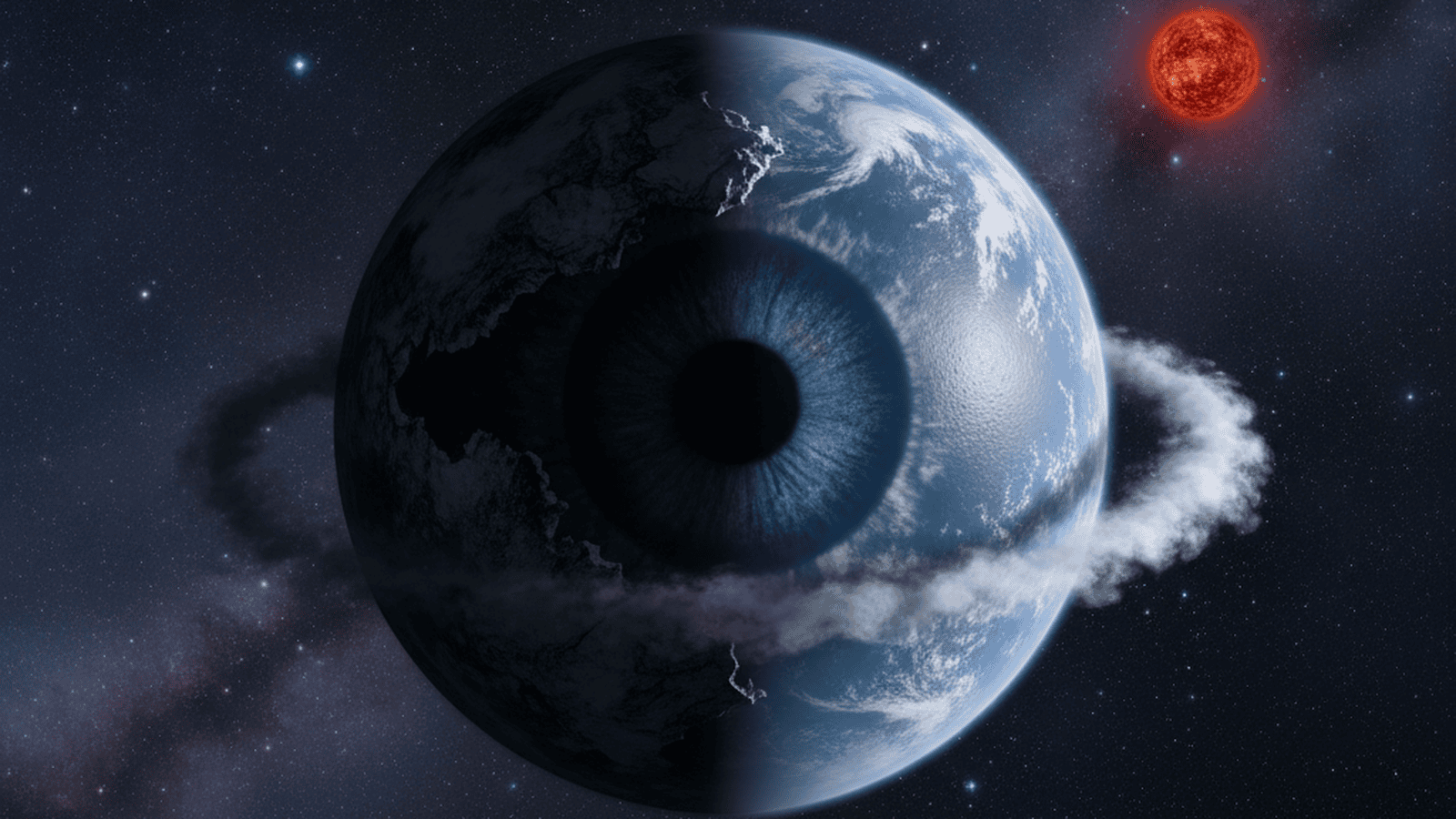
One of the most fascinating models proposed by the researchers is the “eyeball” planet configuration. Due to gravitational forces, LHS 1140 b is likely tidally locked, meaning one hemisphere permanently faces the star while the other remains in perpetual darkness. While the dark side and much of the day side might be encased in thick ice, climate simulations suggest that the sub-stellar point—the spot directly beneath the star—could reach temperatures high enough to maintain a liquid ocean. This open-water region could span roughly 4,000 kilometers, offering a stable environment for potential biological processes.
The presence of an atmosphere is another critical factor in the planet’s habitability. The JWST data provided the first hints of a nitrogen-rich atmosphere, which would be a landmark discovery. Nitrogen is essential for life as we know it and helps maintain a stable climate by providing atmospheric pressure. If confirmed, LHS 1140 b would represent the first time a temperate exoplanet has been shown to possess a secondary atmosphere—one that formed after the planet’s initial birth rather than being captured from the primordial solar nebula.
This discovery positions LHS 1140 b as a superior candidate for atmospheric characterization compared to the well-known TRAPPIST-1 system. While the TRAPPIST planets are easier to detect, they orbit a much more active star, making the retention of an atmosphere difficult. LHS 1140 b offers a more stable laboratory for studying the conditions necessary for life. Future research cycles with JWST will focus on identifying specific gases like carbon dioxide and oxygen, which would further clarify the planet’s potential to support an ecosystem. The search for life beyond our solar system has found a new, high-priority target.

Mason Reed serves as a Staff Writer for Just Right News, where he spearheads the Future Frontiers & Special Projects desk. In an era defined by rapid technological shifts and evolving social landscapes, Mason provides a steady, principled voice, examining the innovations of tomorrow through the lens of traditional American values. His work is most prominently featured in his signature series, “The Next Horizon,” where he explores the intersection of emerging technology, national sovereignty, and the preservation of individual liberty.
A native of San Diego, California, Mason’s worldview was shaped by the unique culture of his hometown. Growing up in a region defined by its strong military presence and its history of maritime industry, he developed a deep-seated respect for the institutions that provide national stability and the entrepreneurial spirit that drives the American economy. This upbringing instilled in him a belief that true progress is not found in discarding the past, but in building upon a foundation of proven principles. His reporting often reflects this San Diego influence, emphasizing the importance of a robust national defense and the necessity of maintaining a competitive edge in the global marketplace.
Now based in San Francisco, Mason operates from the heart of the world’s technological engine. Living and working in the Bay Area provides him with a front-row seat to the advancements—and the ideological challenges—emanating from Silicon Valley. While many in the region embrace a “move fast and break things” mentality, Mason’s reporting serves as a vital counterweight. He offers Just Right News readers a “boots on the ground” perspective, documenting how radical local policies and the concentration of tech power impact the everyday lives of citizens. His proximity to the industry allows him to cut through the marketing jargon of big tech to uncover the real-world implications for privacy, free speech, and the nuclear family.
In his “Future Frontiers” beat, Mason tackles complex subjects ranging from the ethics of artificial intelligence to the burgeoning private space race. He approaches these topics with a healthy skepticism toward centralized bureaucracy, championing instead the decentralized innovations that empower individuals. Through “The Next Horizon,” he highlights the pioneers and thinkers who are working to ensure that the future remains a place where human dignity and constitutional rights are protected. He believes that the rapid pace of change requires more than just technical expertise; it requires a moral compass rooted in the Western tradition.
Throughout his tenure at Just Right News, Mason has remained committed to the idea that the future is something to be shaped, not merely accepted. His writing is characterized by a rigorous defense of American exceptionalism and a belief that the country’s best days lie ahead, provided it remains true to its founding ideals. Whether he is investigating the impact of automation on the American workforce or profiling the next generation of aerospace engineers, Mason Reed ensures that his readers are equipped with the insights they need to navigate a changing world with confidence and clarity.