

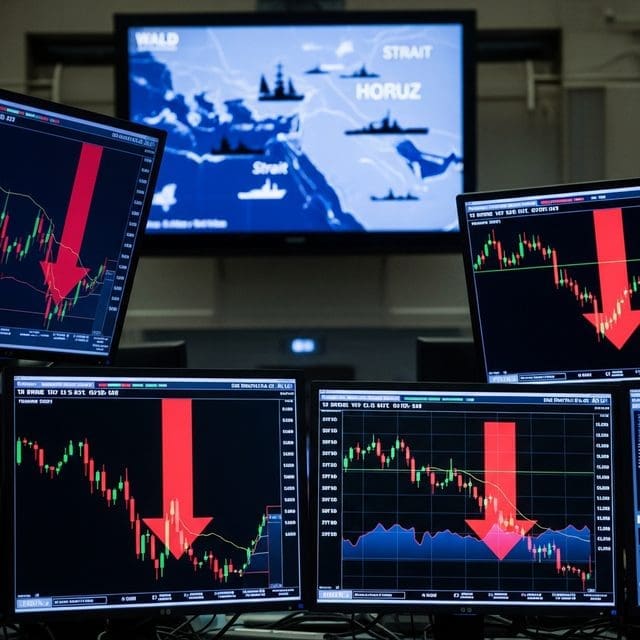
Escalating tensions in the Strait of Hormuz and resurgent energy inflation have halted the market’s record-breaking momentum as the Federal Reserve prepares for its April policy meeting.
The invisible hand of the market is currently being gripped by the visible fist of geopolitical conflict. As of April 20, 2026, the closure of the Strait of Hormuz by Iranian forces and the subsequent seizure of an Iranian-flagged vessel by the USS Spruance have sent shockwaves through the financial system. Oil futures surged approximately 6% following the latest disruption, a move that directly threatens the stability of the American domestic economy and the purchasing power of the taxpayer.
This energy shock is already manifesting in the data. The March Consumer Price Index (CPI) revealed a sharp 3.3% year-over-year increase, driven largely by a staggering 21.2% monthly jump in gasoline prices. For the Federal Open Market Committee (FOMC), which is scheduled to meet on April 28-29, these figures represent a significant setback. The CME FedWatch tool now indicates a 97.7% probability that the federal funds rate will remain held at the current range of 3.5% to 3.75%. The prospect of a June rate cut has withered to just 9% as officials weigh the necessity of further hikes to combat war-driven inflation.
On Wall Street, the reaction has been one of cautious retreat. S&P 500 E-mini futures fell 0.73% to 7,109, while the Nasdaq100 futures dropped 0.61% to 26,661 in premarket trading. This pullback follows a historic 13-session winning streak for the Nasdaq, suggesting that the market’s appetite for risk is finally hitting the ceiling of reality. The 10-year Treasury yield, a critical benchmark for mortgage and corporate lending, has climbed to 4.27%, up significantly since the onset of the Iran conflict.
Banking sector earnings provide a bifurcated view of the current landscape. Bank of America reported a robust Q1 net income of $8.6 billion, with earnings per share of $1.11 beating expectations. This performance was fueled by a 30% surge in equities trading revenue as volatility provided a lucrative environment for institutional desks. Conversely, Goldman Sachs saw its shares slip 1.9% despite a profit of $5.63 billion, as a $910 million miss in fixed-income trading and rising loan provisions signaled growing concerns over credit quality.
Regional banks remain particularly vulnerable to the current environment, with some institutions facing implied post-earnings moves of over 20%. As energy costs remain elevated—with U.S. Energy Secretary Chris Wright warning that gasoline may stay above $3 per gallon into 2027—the pressure on the American consumer will eventually translate into higher delinquency risks for these smaller lenders.
The immediate focus remains on the April 23 ceasefire deadline. Should diplomacy fail, the threat of further military action in the Gulf of Oman will likely cement higher energy costs into the structural baseline of the economy. For the Fed, the mandate of price stability is increasingly at odds with a global landscape that refuses to cooperate with the central bank’s preferred narrative of a soft landing.

Jordan Lee serves as the Senior Correspondent for Wall Street, Finance, and Monetary Systems at Just Right News. Based in the heart of the world’s financial capital, New York City, Lee brings a sharp, principled eye to the complex mechanisms that drive the global economy. His reporting is defined by a commitment to fiscal responsibility, the defense of the free market, and a deep-seated belief that a transparent monetary system is the bedrock of a free society.
Raised in Portland, Oregon, Lee’s perspective was forged in a city that has undergone significant cultural and economic shifts. His upbringing in the Pacific Northwest instilled in him a profound appreciation for the industriousness of small business owners and the importance of local economic stability. Watching the evolution of his hometown’s landscape sparked an early interest in how federal fiscal policy and large-scale financial trends eventually trickle down to the average citizen. This background provides him with a unique vantage point; he understands the growing disconnect between the policy-making elite and the reality of Main Street, a theme that frequently resonates throughout his work.
Now operating from his base in New York City, Lee bridges the gap between the high-stakes trading floors of Manhattan and the households of everyday Americans. He views the financial sector not merely as a collection of numbers and tickers, but as a vital engine of American prosperity that requires constant vigilance and accountability. His reporting often highlights the dangers of centralized financial control and the necessity of maintaining a system that rewards merit, risk-taking, and innovation.
As the creator and lead of the featured series, “The Invisible Economy,” Lee pulls back the curtain on the often-opaque world of monetary systems. He specializes in translating the dense jargon of central banking and international finance into actionable insights for the Just Right News audience. His work explores the “invisible” forces—such as inflationary pressures, regulatory creep, and the expansion of the administrative state—that erode the purchasing power of American families. By focusing on these systemic issues, Lee empowers readers to understand the hidden forces shaping their financial independence.
Lee’s journalistic philosophy is rooted in a steadfast commitment to traditional American values. As an Asian American professional who has navigated the competitive corridors of the financial world, he is a vocal advocate for meritocracy and the preservation of the American Dream. He believes that a stable currency and a predictable regulatory environment are essential for national sovereignty and individual liberty. His reporting frequently warns against the risks of government overreach in the private sector, arguing that the most effective solutions to economic challenges arise from competition and individual enterprise rather than bureaucratic mandates.
At Just Right News, Jordan Lee remains dedicated to providing a clear-eyed defense of the taxpayer. Whether he is analyzing market volatility or investigating the long-term implications of national debt, his mission is to provide the truth about where the money is going and what it means for the future of the country. Through his rigorous analysis and principled stance, Lee has become a trusted voice for those who value a strong, sovereign, and fiscally sound America.