

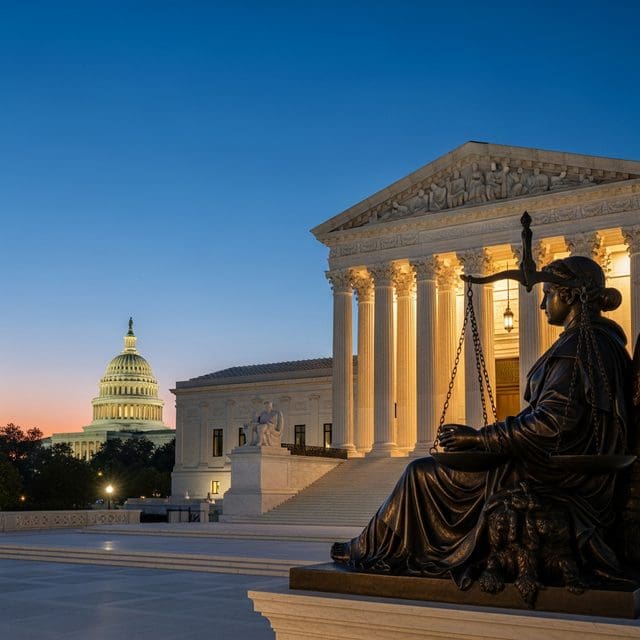
The Trump administration navigates heightened security protocols and legislative budget maneuvers after an assassination attempt at the White House Correspondents’ Association dinner.
Federal agencies and the executive branch are operating under heightened scrutiny this week following the April 26 assassination attempt on President Donald Trump at the White House Correspondents’ Association dinner. The suspect, identified as 31-year-old Cole Allen of Torrance, California, is scheduled for a court appearance today. Acting Attorney General Todd Blanche stated that Allen appears to have acted alone, though his writings—which described him as a “friendly federal assassin”—have prompted a broader review of domestic security protocols.
The incident has not slowed the administration’s legislative or regulatory agenda. Senate Republicans recently approved a budget resolution allocating $70 billion for Immigration and Customs Enforcement (ICE) and Border Patrol, utilizing a procedural maneuver to bypass the filibuster. This funding surge coincides with a recent administrative directive from the Trump administration instructing ICE to limit certain types of arrests and avoid warrantless home entries, an apparent effort to refine enforcement tactics amid ongoing constitutional critiques of agency overreach.
Simultaneously, the Supreme Court of the United States has begun reviewing the constitutionality of law enforcement’s use of cell phone location data. The case examines the use of “geofence warrants,” a digital-age tool that allows investigators to identify every mobile device in a specific area during a crime. For constitutionalists, the ruling will serve as a critical benchmark for Fourth Amendment protections against the administrative state’s expanding surveillance capabilities.
On the economic front, the Federal Reserve is expected to maintain the federal funds rate at 3.5 to 3.75 percent during its upcoming meeting on April 28-29. This stability comes as the executive branch continues to utilize unilateral authority to shape domestic policy. For instance, Executive Order 14401, signed on April 18, has already begun reallocating $50 million toward psychedelic research for mental health, mandating prioritized reviews from the FDA and DEA.
While the administration remains focused on domestic security and fiscal policy, foreign entanglements persist. President Trump recently clarified that U.S. officials will not travel to Pakistan for Iran peace negotiations, insisting that foreign adversaries must engage on American soil or via direct communication. This posture of executive strength, coupled with the recent $1.5 million in grants from the American Water Charitable Foundation and the ongoing Smile Cookie community campaigns, illustrates a federal landscape attempting to project normalcy and order despite the recent breach of presidential security.

Miles Harrington serves as the Senior Correspondent for Federal Systems & Executive Power at Just Right News, where he brings a disciplined, constitutionalist lens to the inner workings of the American government. With a focus on the mechanics of the federal bureaucracy and the limits of executive authority, Harrington has established himself as a vital voice for readers who value transparency, accountability, and the preservation of the separation of powers.
A native of Richmond, Virginia, Harrington’s perspective is deeply rooted in the traditions of the Old Dominion. Growing up in a city defined by its historical significance and its role as a center of American jurisprudence, he developed an early appreciation for the foundational principles of the Republic. His upbringing in Richmond—a place where the legacy of the Founding Fathers is woven into the landscape—instilled in him a belief that the federal government should remain within its constitutional bounds. This background informs his skepticism of centralized overreach and his commitment to reporting on the ways in which the administrative state impacts the lives of everyday citizens.
In his current role, Harrington specializes in the complexities of federal systems. He doesn’t just report on the headlines of the day; he digs into the structural shifts within the executive branch that often go unnoticed by the mainstream press. Whether he is analyzing the implications of a new federal regulation or investigating the expansion of agency jurisdiction, his work is characterized by a rigorous adherence to the facts and a dedication to the rule of law.
Harrington is perhaps best known for his signature feature series, “How Washington Works.” Through this ongoing project, he demystifies the often-opaque processes of the nation’s capital, pulling back the curtain on the “Deep State” and the unelected officials who wield significant influence over national policy. By breaking down complex legislative maneuvers and executive orders, he empowers Just Right News readers to understand the true levers of power in Washington. His reporting serves as a necessary check on the federal government, ensuring that the actions of those in power are held up to the light of public scrutiny.
Now based in Washington, D.C., Harrington operates at the epicenter of the political world, yet he remains intentionally distanced from the “Beltway bubble.” His proximity to the halls of power allows him to maintain a robust network of sources across the federal landscape, but his heart remains in the principled conservatism of his Virginia roots. He views his role not merely as a reporter, but as a steward of the public trust, dedicated to providing the clarity and context that conservative voters need to navigate an increasingly complex political environment.
Through his sharp analysis and unwavering commitment to the truth, Miles Harrington continues to be a cornerstone of the Just Right News team. His work ensures that the principles of limited government and executive restraint remain at the forefront of the national conversation, providing a crucial service to those who believe in a government that is truly of, by, and for the people.