

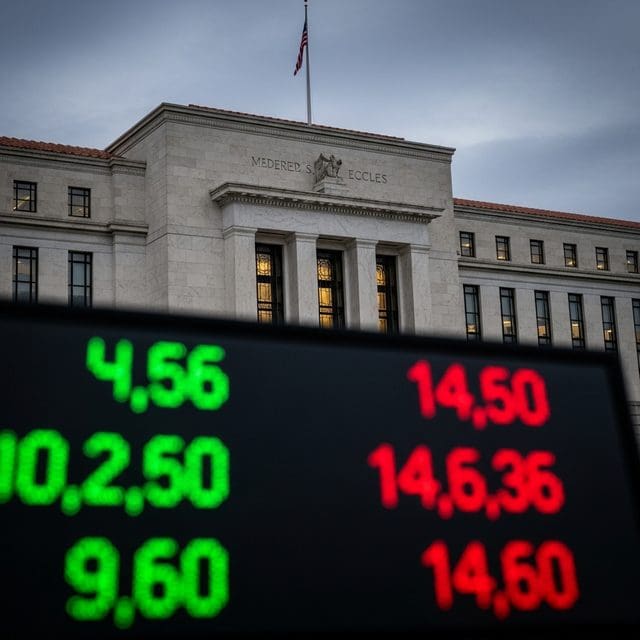
Wall Street prepares for Jerome Powell’s final FOMC meeting as successor Kevin Warsh clears a key Senate hurdle, while $100 oil and ‘Magnificent Seven’ earnings dominate the economic outlook.
The American financial landscape is navigating a rare convergence of institutional upheaval and geopolitical friction. On April 27, 2026, the path for a leadership transition at the Federal Reserve became clear as Senator Thom Tillis announced his support for Kevin Warsh. This endorsement followed the Department of Justice’s decision on April 24 to drop its criminal probe into sitting Chair Jerome Powell, citing a lack of evidence. With the final Republican hurdles removed, Warsh is positioned to take the helm of a central bank currently wrestling with a renewed energy crisis.
Crude oil prices have surged past $100 per barrel following the April 22 Iranian attacks on tankers in the Strait of Hormuz. While Iran has proposed reopening the waterway in exchange for a cessation of hostilities and a delay in nuclear talks, the immediate impact on global logistics remains a primary concern for the Federal Open Market Committee. The Fed is widely expected to maintain the federal funds rate at its current level during the April 28-29 meeting, which is likely to be Powell’s final session as Chair.
Cross-Atlantic policy divergence is becoming a focal point for currency traders. While the Fed holds steady, the European Central Bank and the Bank of England are also expected to pause on April 30 to assess the Hormuz energy shock. However, Citi analysts suggest the ECB may be forced into two rate hikes by summer 2026 if energy-driven inflation persists. This potential divergence has pushed the euro higher, with some analysts forecasting a rise above $1.20 against the dollar.
In the banking sector, European regulators are moving to maintain decorum during a period of consolidation. Germany’s BaFin recently ordered UniCredit to cease “unobjective” advertisements targeting Commerzbank, highlighting the friction in cross-border banking mergers. Domestically, the S&P 500 is buoyed by a blended Q1 earnings growth rate of 15.1%, significantly outperforming the 13.0% growth seen just a week prior.
This week marks a critical juncture for the “Magnificent Seven” technology giants. Microsoft, Alphabet, Meta, and Amazon are scheduled to report on April 29, followed by Apple on April 30. Despite Meta facing a setback with China blocking its $2 billion autonomous AI acquisition, market sentiment remains cautiously bullish, with call option volumes outpacing puts for most of the group. In the industrial sector, General Motors is expected to report Q1 revenue of approximately $43.6 billion on April 28, providing a barometer for the health of the American consumer amid rising fuel costs.
As the invisible economy of central banking shifts toward a Warsh-led era, the interplay between $100 oil and corporate profitability will determine if the current market resilience can be sustained. For the American taxpayer, the stability of the monetary system now rests on whether the Fed can navigate these supply-side shocks without stifling the domestic growth reflected in recent earnings data.

Jordan Lee serves as the Senior Correspondent for Wall Street, Finance, and Monetary Systems at Just Right News. Based in the heart of the world’s financial capital, New York City, Lee brings a sharp, principled eye to the complex mechanisms that drive the global economy. His reporting is defined by a commitment to fiscal responsibility, the defense of the free market, and a deep-seated belief that a transparent monetary system is the bedrock of a free society.
Raised in Portland, Oregon, Lee’s perspective was forged in a city that has undergone significant cultural and economic shifts. His upbringing in the Pacific Northwest instilled in him a profound appreciation for the industriousness of small business owners and the importance of local economic stability. Watching the evolution of his hometown’s landscape sparked an early interest in how federal fiscal policy and large-scale financial trends eventually trickle down to the average citizen. This background provides him with a unique vantage point; he understands the growing disconnect between the policy-making elite and the reality of Main Street, a theme that frequently resonates throughout his work.
Now operating from his base in New York City, Lee bridges the gap between the high-stakes trading floors of Manhattan and the households of everyday Americans. He views the financial sector not merely as a collection of numbers and tickers, but as a vital engine of American prosperity that requires constant vigilance and accountability. His reporting often highlights the dangers of centralized financial control and the necessity of maintaining a system that rewards merit, risk-taking, and innovation.
As the creator and lead of the featured series, “The Invisible Economy,” Lee pulls back the curtain on the often-opaque world of monetary systems. He specializes in translating the dense jargon of central banking and international finance into actionable insights for the Just Right News audience. His work explores the “invisible” forces—such as inflationary pressures, regulatory creep, and the expansion of the administrative state—that erode the purchasing power of American families. By focusing on these systemic issues, Lee empowers readers to understand the hidden forces shaping their financial independence.
Lee’s journalistic philosophy is rooted in a steadfast commitment to traditional American values. As an Asian American professional who has navigated the competitive corridors of the financial world, he is a vocal advocate for meritocracy and the preservation of the American Dream. He believes that a stable currency and a predictable regulatory environment are essential for national sovereignty and individual liberty. His reporting frequently warns against the risks of government overreach in the private sector, arguing that the most effective solutions to economic challenges arise from competition and individual enterprise rather than bureaucratic mandates.
At Just Right News, Jordan Lee remains dedicated to providing a clear-eyed defense of the taxpayer. Whether he is analyzing market volatility or investigating the long-term implications of national debt, his mission is to provide the truth about where the money is going and what it means for the future of the country. Through his rigorous analysis and principled stance, Lee has become a trusted voice for those who value a strong, sovereign, and fiscally sound America.