

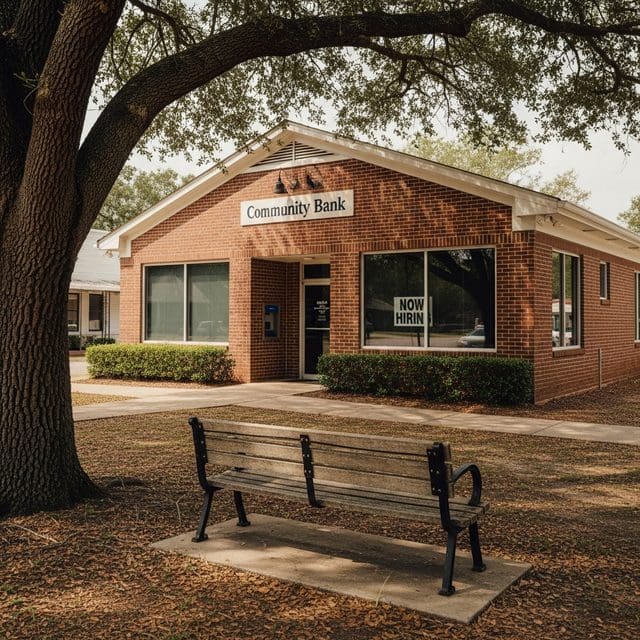
Regional banking earnings show robust growth in the South and West, but new data suggests many Americans are losing thousands in potential wealth through common retirement planning errors.
The American economic landscape this week presents a study in contrasts, as robust performance in the regional banking sector meets sobering data regarding the long-term financial security of the working class. While community-focused financial institutions report significant growth, the path to upward mobility for many families remains obstructed by systemic complexities in retirement planning and a widening gap in passive income generation.
In the South, Baton Rouge-based Business First Bancshares reported a first-quarter adjusted profit of $23.52 million, comfortably exceeding analyst expectations. This performance was mirrored in the West by Sierra Bancorp, which saw its diluted earnings per share jump 47% year-over-year. These figures suggest that local capital markets remain healthy, providing a foundation for community investment. However, the strength of these institutions does not always translate directly to the balance sheets of the families they serve, particularly those relying on the social safety net as a springboard toward independence.
New research from FinanceBuzz highlights a critical friction point in the journey toward self-sufficiency: the mismanagement of employer-sponsored retirement accounts. Data indicates that common 401(k) errors, such as failing to maximize employer matches or misallocating assets, are costing individual savers as much as $60,000 in lost retirement income. For a worker attempting to move from public assistance to middle-class stability, such a loss represents a devastating blow to multi-generational wealth creation.
The challenge of building a durable safety net is further complicated by an energy market in flux. Following Iranian interference with oil tankers in the Strait of Hormuz on April 22, crude oil prices have surged above $100 per barrel. For low-income households, these rising costs act as a regressive tax, siphoning away the very discretionary income needed to participate in the wealth-building strategies currently outperforming the broader market. While Real Estate Investment Trusts (REITs) are currently outpacing the S&P 500, providing lucrative passive income for those with existing capital, the entry barrier for the working poor remains high.
True economic mobility requires more than just institutional stability; it necessitates a culture of financial literacy and a policy environment that rewards long-term discipline. As Bank of Marin Bancorp navigates a projected revenue decline despite raising $45 million in capital, the broader lesson for the social safety net is clear. Government programs may provide temporary relief, but the restorative power of work is only realized when individuals are equipped to capture and keep the fruits of their labor.
Bridging the wealth gap will depend on whether the resilience seen in the banking sector can be replicated at the kitchen table. Without addressing the knowledge gaps that lead to significant retirement losses, the cycle of dependency remains difficult to break, even as the national economy shows signs of institutional strength.

James Foster serves as the Senior Correspondent for Inequality and the Social Safety Net at Just Right News, where he brings a principled and nuanced perspective to the most pressing economic challenges facing the nation. With a career dedicated to exploring the intersection of policy and personal responsibility, Foster has become a leading voice in documenting how government programs and economic shifts impact the American family. His reporting is characterized by a commitment to the “human element,” moving beyond cold statistics to highlight the stories of resilience, work, and community that define the modern American experience.
Foster’s perspective is deeply rooted in his upbringing in Birmingham, Alabama. Growing up in a city with a rich industrial heritage and a history of economic transformation, he witnessed firsthand the importance of the dignity of work and the strength of local institutions. In Birmingham, he saw how the most effective safety nets were often those woven by neighbors, faith-based organizations, and local civic groups. This background instilled in him a lifelong skepticism of “one-size-fits-all” solutions from distant bureaucracies, favoring instead the localized, community-driven support systems that he frequently champions in his writing.
Now based in Atlanta, Georgia, Foster operates from one of the most dynamic and rapidly evolving metropolitan hubs in the South. His location provides a front-row seat to the stark contrasts of the modern economy. From the gleaming towers of Atlanta’s financial districts to the struggling neighborhoods on the city’s periphery, Foster finds the stories that illustrate the complexities of upward mobility. His reporting from the Sun Belt serves as a microcosm for the national debate on poverty, highlighting how inflation, housing costs, and labor market shifts affect the working class in real-time.
As the lead for the acclaimed feature series “America’s Balancing Act,” Foster explores the delicate tension between providing a necessary hand up and fostering long-term independence. The series has become a cornerstone of Just Right News, offering a deep dive into the unintended consequences of social welfare policies. Foster’s work often focuses on the “cliff effect” and other systemic hurdles that can inadvertently discourage employment, arguing that true compassion is measured by how many people are empowered to leave the safety net, rather than how many are added to it.
Throughout his tenure, Foster has remained dedicated to the mission of Just Right News, providing a clear-eyed, conservative analysis of social issues. He believes that a free society thrives when individuals are empowered and the private sector is allowed to innovate. Whether he is interviewing small business owners about the challenges of a changing workforce or documenting the success of private charitable initiatives, Foster’s goal is to provide readers with the truth about the state of the American Dream. His work serves as a vital reminder that while the challenges of inequality are great, the solutions are often found in the strength of the American spirit and the preservation of traditional values.