

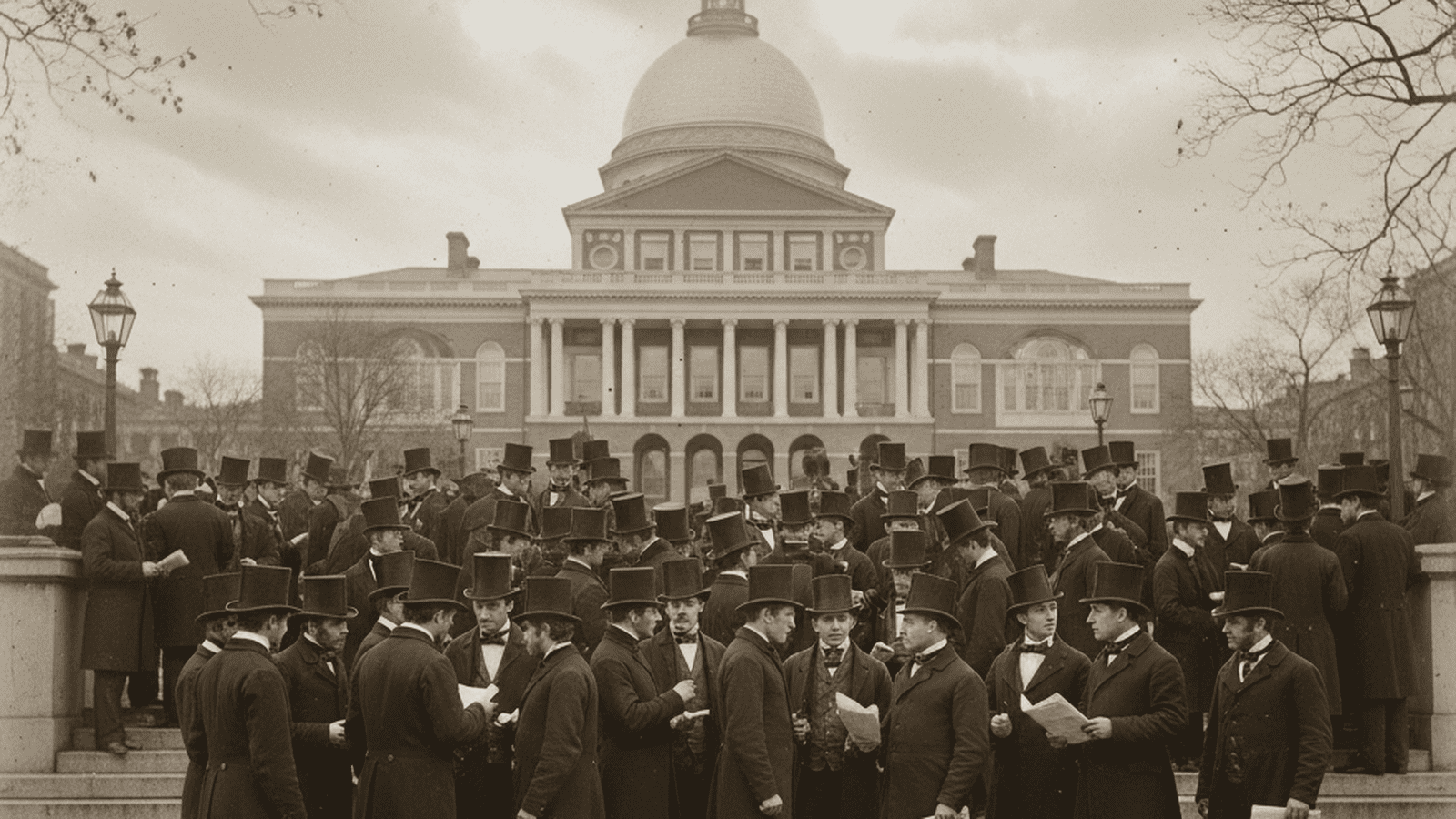
In 1854, the American Party, commonly known as the Know-Nothings, achieved a total parliamentary realignment in Massachusetts by capturing nearly every seat in the state legislature. This political earthquake signaled the final collapse of the Whig Party in the United States and reshaped the New England political landscape.
TLDR: The 1854 Massachusetts election saw the secretive American Party seize the governorship and almost every legislative seat. This unprecedented realignment destroyed the state’s Whig establishment and paved the way for the modern Republican Party by blending nativist sentiment with radical social reforms.
The political landscape of Massachusetts underwent a seismic shift in 1854 that remains one of the most dramatic parliamentary realignments in United States history. For decades, the Whig Party had dominated the Commonwealth, representing the interests of the industrial and merchant classes. However, the mid-1850s brought a perfect storm of social and political upheaval. The passage of the Kansas-Nebraska Act in 1854, which threatened to expand slavery into new territories, shattered the existing party system. Simultaneously, a massive wave of Irish and German immigration sparked deep-seated anxieties among the native-born Protestant population. Into this vacuum stepped a secretive new organization: the American Party.
Originally known as the Order of the Star-Spangled Banner, the party’s members were famously instructed to say “I know nothing” when questioned about their activities by outsiders. This secrecy masked a highly disciplined grassroots organization that capitalized on the perceived failures of the Whig establishment. While the Whigs attempted to maintain a moderate stance on the burning issues of the day, the Know-Nothings offered a potent, if controversial, mixture of nativism and populist reform. They organized in secret lodges, using passwords and handshakes to maintain internal security while they prepared to upend the state’s political order.
The November 1854 election results were nothing short of a political earthquake. The Know-Nothings captured the governorship with Henry J. Gardner, a former Whig, and achieved a total sweep of the State Senate, winning all forty seats. In the House of Representatives, the victory was equally absolute; the party secured 376 seats, leaving the opposition with a mere three representatives. This total realignment effectively liquidated the Whig Party in Massachusetts overnight, ending a political dynasty that had seemed unassailable just years prior. The scale of the victory was so complete that it remains the most lopsided legislative result in the history of any American state.
The 1854 legislature was unlike any that had come before it. It was composed largely of political novices—men who had never held public office and who hailed from the working and middle classes. This “People’s Legislature” included mechanics, farmers, and clergymen who were often more radical than the elites they replaced. Despite their exclusionary nativist platform, which sought to restrict the voting rights of immigrants through a proposed twenty-one-year residency requirement, these lawmakers moved with surprising speed to enact a series of progressive measures that the Whigs had long blocked.
The legislative record of the 1854-1855 session was remarkably prolific. The new government abolished imprisonment for debt, expanded the legal rights of married women, and established the nation’s first state insurance commission. Most significantly, the realignment led to the desegregation of Massachusetts public schools in 1855, a landmark achievement in civil rights. This paradox—a party built on nativism passing progressive social legislation—was a hallmark of the Massachusetts Know-Nothings. Many members were staunch abolitionists who viewed the “Slave Power” of the South as a far greater existential threat to the republic than the influence of the Vatican.
To combat the Fugitive Slave Law, the legislature passed a rigorous Personal Liberty Act, which effectively nullified federal efforts to return escaped slaves from Massachusetts soil. This direct challenge to federal authority signaled that the state was moving toward a more confrontational stance on slavery. However, the Know-Nothing dominance was short-lived. The party’s internal contradictions, particularly the tension between its Northern and Southern wings over the issue of slavery, led to its rapid decline. By 1856, the political energy that had fueled the 1854 sweep began migrating to the newly formed Republican Party. This transition ensured that the Whigs would never return to power, cementing a new political era defined by the struggle against the expansion of slavery and the rise of the modern administrative state.

Julie Harris serves as a Staff Writer for Just Right News, where she tackles some of the most pressing and complex issues facing the nation today. As the lead reporter for the Migration, Demographics & Cultural Shifts beat, Julie provides a grounded, principled perspective on how the movement of people and the changing makeup of communities are reshaping the American landscape. Her work is defined by a commitment to exploring the long-term consequences of social change, prioritizing the stability of local institutions and the preservation of national identity.
Her deep understanding of these issues is rooted in her upbringing in Tucson, Arizona. Growing up in a prominent border state, Julie witnessed firsthand the intricate realities of migration and the profound impact it has on local infrastructure, law enforcement, and the social fabric. This early exposure instilled in her a respect for the rule of law and a keen awareness of the challenges that arise when federal policies fail to align with the needs of border communities. Her reporting often reflects this lived experience, bringing a necessary level of nuance to topics that are often treated with abstraction in coastal newsrooms.
Now based in Santa Fe, New Mexico, Julie continues to report from the heart of the American Southwest. Her location provides a unique vantage point to observe the intersection of traditional regional cultures and the modern shifts brought about by both internal and external migration. In Santa Fe, a city defined by its rich history and distinct cultural heritage, she finds a perfect environment to explore how communities strive to maintain their character while navigating the pressures of a rapidly changing world. This perspective allows her to bridge the gap between policy debates in Washington and the reality of life in the high desert.
At Just Right News, Julie’s work is characterized by a dedication to examining the data and the human stories that define the “New Mosaic” of America. Her signature feature series, “The New Mosaic,” has become a cornerstone of her reporting. Through this series, Julie explores the evolving social architecture of the United States, documenting how shifts in population affect everything from local economies to the political landscape. She brings a critical eye to the narrative of demographic inevitability, instead asking how these shifts impact the average citizen’s sense of belonging and the integrity of the American social contract.
Julie’s background and her dedication to conservative principles make her a vital voice in contemporary journalism. She understands that demographics are more than just numbers on a spreadsheet; they represent the future of the American family and the nation’s enduring legacy. Through her diligent reporting and insightful analysis, Julie Harris ensures that her readers are informed about the forces shaping their world, providing a perspective that is as thoughtful as it is necessary for the modern era.