

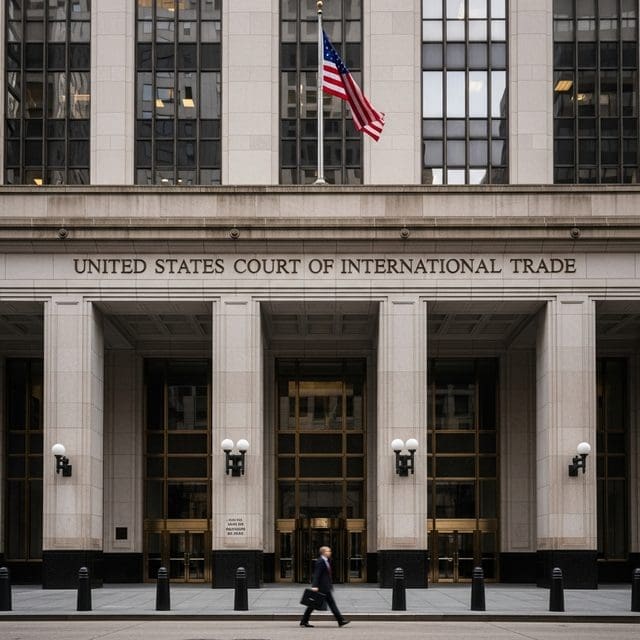
The Trump administration faces a critical legal defeat over global tariffs while advancing a new rule to strip job protections from 50,000 senior federal employees.
The executive branch is navigating a dual-track challenge of judicial resistance to its trade agenda and a structural overhaul of the federal bureaucracy. A federal appeals panel at the Court of International Trade recently declared the administration’s 10% across-the-board global tariff scheme illegal. This follows a Supreme Court ruling limiting emergency trade powers, stalling the White House’s primary economic lever and forcing a pivot toward narrower statutory authorities. While the administration briefly raised the levy to 15% under a different statute, that authority is restricted to 150 days without congressional approval, leaving long-term trade strategy in legal limbo.
In response, the administration is re-routing trade policy through Section 232 national security and Section 301 unfair trade practice investigations. The legal uncertainty has created a complex landscape for domestic markets. While 2025 consumer prices did not spike as sharply as feared, the prospect of court-ordered refunds for illegal duties and delayed pass-through costs suggests inflationary volatility for 2026. A May 29 Politico poll indicates over 60 percent of Americans believe the war with Iran and trade disruptions have increased everyday costs, suggesting public skepticism of administration economic shielding efforts.
Beyond trade, the administration is pursuing a re-engineering of the administrative state. A February 2026 rule seeks to reclassify approximately 50,000 senior civil servants into an at-will category, stripping job protections from 2% of the federal workforce. By removing these protections, the White House gains authority to terminate senior personnel perceived as internal opponents without lengthy merit-based appeals. This follows an initiative offering buyout packages to nearly 2 million federal employees, a strategy designed to reshape the civil service from the top down.
Fiscal transparency has also become a tool for executive control. A January 2026 budget memo directed agencies to review all grants, loans, and awards to over a dozen Democratic-led states and Washington, D.C. Framed as a crackdown on improper spending, the audit requires agencies to catalog all federal funding from 2025 through projected 2027. This scrutiny, combined with the sidelining of internal watchdogs, reflects a strategy to centralize control over personnel and the purse while challenging the autonomy of opposing jurisdictions.
Diplomatically, the administration continues high-stakes negotiations that intersect with domestic policy. Vice President Vance confirmed on May 29 that the U.S. remains in talks with Iran regarding nuclear provisions for a ceasefire extension. However, President Trump’s demand for Arab nations to normalize ties with Israel as a peace prerequisite was rejected by Pakistan. Domestically, healthcare policy continues to be refined by the courts; the Eastern District of Texas recently dismissed a No Surprises Act lawsuit, while CMS finalized a rule to modernize the Independent Dispute Resolution framework. As the administration enters its second year, the tension between executive ambition and judicial constraints remains the defining characteristic of the current political era.

Miles Harrington serves as the Senior Correspondent for Federal Systems & Executive Power at Just Right News, where he brings a disciplined, constitutionalist lens to the inner workings of the American government. With a focus on the mechanics of the federal bureaucracy and the limits of executive authority, Harrington has established himself as a vital voice for readers who value transparency, accountability, and the preservation of the separation of powers.
A native of Richmond, Virginia, Harrington’s perspective is deeply rooted in the traditions of the Old Dominion. Growing up in a city defined by its historical significance and its role as a center of American jurisprudence, he developed an early appreciation for the foundational principles of the Republic. His upbringing in Richmond—a place where the legacy of the Founding Fathers is woven into the landscape—instilled in him a belief that the federal government should remain within its constitutional bounds. This background informs his skepticism of centralized overreach and his commitment to reporting on the ways in which the administrative state impacts the lives of everyday citizens.
In his current role, Harrington specializes in the complexities of federal systems. He doesn’t just report on the headlines of the day; he digs into the structural shifts within the executive branch that often go unnoticed by the mainstream press. Whether he is analyzing the implications of a new federal regulation or investigating the expansion of agency jurisdiction, his work is characterized by a rigorous adherence to the facts and a dedication to the rule of law.
Harrington is perhaps best known for his signature feature series, “How Washington Works.” Through this ongoing project, he demystifies the often-opaque processes of the nation’s capital, pulling back the curtain on the “Deep State” and the unelected officials who wield significant influence over national policy. By breaking down complex legislative maneuvers and executive orders, he empowers Just Right News readers to understand the true levers of power in Washington. His reporting serves as a necessary check on the federal government, ensuring that the actions of those in power are held up to the light of public scrutiny.
Now based in Washington, D.C., Harrington operates at the epicenter of the political world, yet he remains intentionally distanced from the “Beltway bubble.” His proximity to the halls of power allows him to maintain a robust network of sources across the federal landscape, but his heart remains in the principled conservatism of his Virginia roots. He views his role not merely as a reporter, but as a steward of the public trust, dedicated to providing the clarity and context that conservative voters need to navigate an increasingly complex political environment.
Through his sharp analysis and unwavering commitment to the truth, Miles Harrington continues to be a cornerstone of the Just Right News team. His work ensures that the principles of limited government and executive restraint remain at the forefront of the national conversation, providing a crucial service to those who believe in a government that is truly of, by, and for the people.