

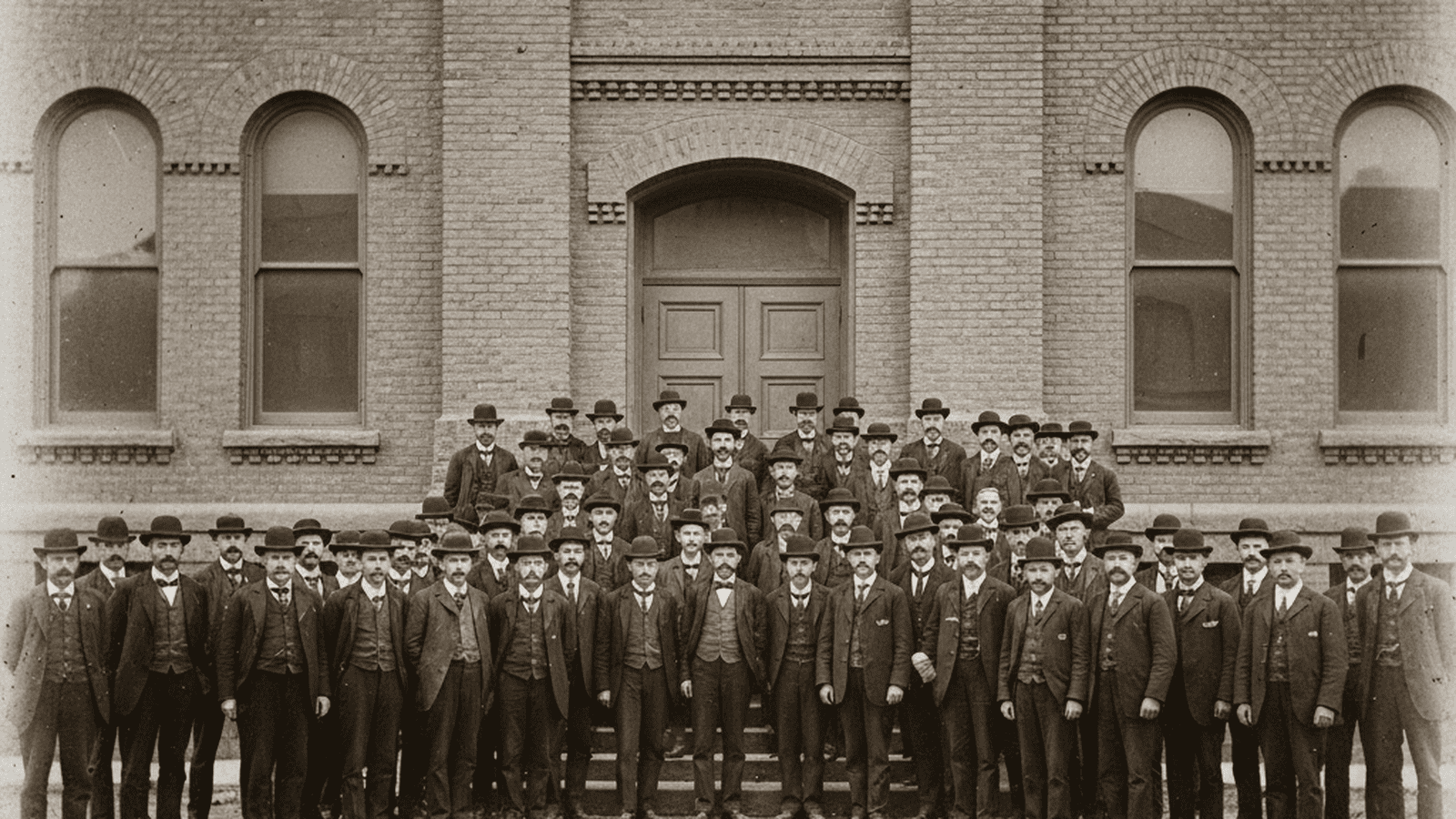
In 1891, the Utah Territory dissolved its religious-based political parties to align with the national Republican and Democratic platforms. This strategic realignment was a crucial step in the United States granting Utah statehood in 1896.
TLDR: To secure statehood, Utah leaders disbanded the Mormon-aligned People’s Party in 1891, forcing a shift toward national political affiliations. This top-down realignment ended decades of sectarian political warfare and integrated the territory into the United States’ federal two-party system.
In the closing decades of the 19th century, the Utah Territory found itself at a profound political impasse that stalled its long-held aspirations for statehood. Since the arrival of the pioneers in 1847, the region’s civic life had been governed by a unique “theodemocracy.” By the 1870s and 1880s, this had solidified into a rigid, two-party system that was entirely local and sectarian. The People’s Party served as the political vehicle for the Church of Jesus Christ of Latter-day Saints, while the Liberal Party acted as the opposition for the “Gentile” (non-Mormon) minority. This binary structure created a political culture that was fundamentally isolated from the national Republican and Democratic platforms, a situation that federal authorities in Washington, D.C., found increasingly intolerable.
The federal government viewed Utah’s religious bloc voting as a threat to republican principles. This tension was exacerbated by the practice of plural marriage, which the government sought to eradicate through punitive legislation. The Edmunds-Tucker Act of 1887 was the most severe of these measures, disenfranchising many residents, dissolving the church as a legal entity, and seizing its assets. It became clear to territorial leaders that the price of admission to the Union was not only the abandonment of polygamy but also the total dismantling of their indigenous, faith-based political system.
The catalyst for change arrived in 1890 with the “Manifesto,” a declaration by Church President Wilford Woodruff that officially advised against further plural marriages. With the primary social obstacle removed, the focus shifted to political reform. In June 1891, the leadership of the People’s Party took the extraordinary step of formally dissolving the organization. This was not a grassroots movement born of shifting ideologies, but a calculated, top-down strategic realignment designed to prove Utah’s compatibility with American pluralism.
The transition was managed with remarkable precision. To ensure that Utah would not become a one-party state—which would have invited further federal intervention—church and territorial leaders actively encouraged members to divide themselves between the national Republican and Democratic parties. Historical accounts from rural settlements describe local bishops and leaders literally dividing their congregations, advising those on one side of the chapel to become Democrats and those on the other to become Republicans. This “division by the aisle” was intended to create an artificial but functional two-party balance that mirrored the national landscape and demonstrated that the electorate was not a monolithic religious bloc.
The Liberal Party initially met these developments with deep-seated cynicism. They suspected that the dissolution of the People’s Party was a tactical ruse, a “Mormon trick” designed to maintain ecclesiastical control under the guise of national party labels. For two years, the Liberals maintained their organization, continuing to campaign on an anti-clerical platform. However, the momentum of national politics proved irresistible. As the newly formed local branches of the Republican and Democratic parties began to engage in heated debates over national issues—such as the protective tariff and the free coinage of silver—the old sectarian grievances began to lose their relevance. Recognizing that the era of local religious parties had passed, the Liberal Party finally disbanded in 1893.
This strategic realignment cleared the final hurdles for statehood. In 1894, President Grover Cleveland signed the Enabling Act, and on January 4, 1896, Utah was admitted as the 45th state. The 1891 realignment remains a landmark event in American history, representing a rare instance where a regional population deliberately overhauled its entire political identity to satisfy federal requirements for inclusion. While it ended decades of sectarian warfare, it also permanently integrated the Mountain West into the federal two-party system, shaping the state’s political trajectory for the century to come.

Dylan Brooks serves as the Senior Correspondent for Statehouses and Local Governance at Just Right News, where he brings a principled, constitutionalist lens to the often-overlooked machinery of state-level politics. As the lead voice behind the acclaimed feature series “Fifty Laboratories of Power,” Dylan has dedicated his career to the idea that the most impactful governance happens closest to home. His reporting consistently champions the Tenth Amendment, exploring how individual states can serve as testing grounds for innovative, conservative policy solutions that prioritize personal liberty and fiscal responsibility.
A native of Des Moines, Iowa, Dylan’s journalistic philosophy was forged in the heart of the American Midwest. Growing up in a community where local school board meetings and town halls were the bedrock of civic life, he developed a deep appreciation for the “retail politics” of the heartland. This upbringing instilled in him a fundamental belief that the American experiment is best preserved when power is decentralized. He carries the values of his Iowa roots into every assignment, maintaining a healthy skepticism of federal overreach and a steadfast commitment to the concerns of everyday citizens over the interests of the administrative state.
Now based in Madison, Wisconsin, Dylan operates from one of the nation’s most pivotal political battlegrounds. His location in a state capital known for its rigorous policy debates allows him to provide Just Right News readers with a front-row seat to the legislative process. From Madison, he tracks the ripple effects of statehouse decisions on local municipalities, ensuring that the connection between high-level policy and community impact is never lost. His work often highlights the success of conservative governors and legislatures in fostering economic growth, protecting parental rights, and securing the integrity of local institutions.
As an African American man in the conservative media landscape, Dylan offers a vital perspective on how limited government and free-market principles empower individuals and families. He frequently reports on how deregulation and school choice initiatives provide new avenues for success in underserved communities, challenging the monolithic narratives often presented by legacy media outlets. Dylan’s work is characterized by a commitment to the facts and a refusal to shy away from the complex realities of modern governance.
Throughout his tenure at Just Right News, Dylan has become a trusted authority for readers who value a rigorous, principled approach to the news. Whether he is dissecting a complex state budget or profiling a local grassroots movement, his goal remains the same: to provide the American public with the information they need to hold their local leaders accountable. By focusing on the “Fifty Laboratories of Power,” Dylan Brooks ensures that the vital work being done in statehouses across the country receives the national attention it deserves, always through a lens that respects the traditions and sovereignty of the American people.