

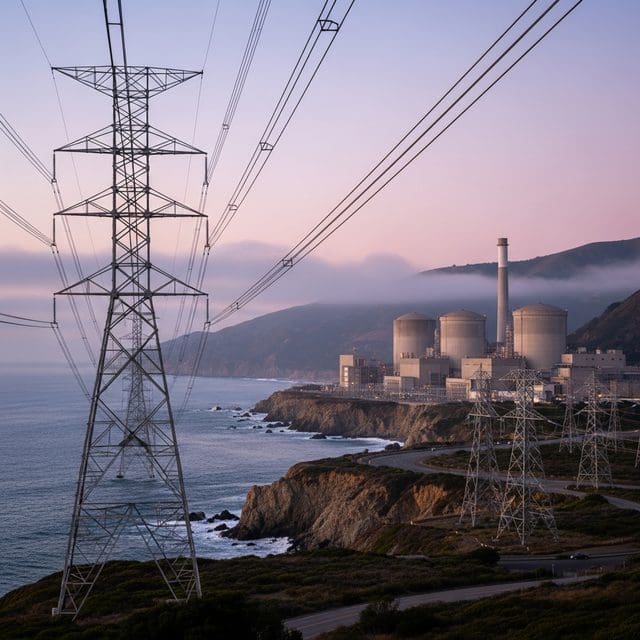
Regulatory hurdles and transmission bottlenecks are forcing California to delay offshore wind projects while relying on aging nuclear power and out-of-state imports to maintain grid reliability.
California’s ambitious transition to a carbon-free power grid is hitting a wall of regulatory friction and logistical reality. Despite a historic buildout of solar and storage, state regulators now admit that California is significantly off track for its 2030 offshore wind goals. The California Public Utilities Commission recently proposed pushing back nearly 2.9 gigawatts of procurement at Morro Bay by four years, moving the target from 2032 to no later than 2036. This delay highlights the specific kind of permitting and planning bottlenecks that critics argue are sabotaging the state’s environmental mandates.
This slowdown has drawn sharp criticism from cultural observers and policy analysts alike. Comedian Bill Maher recently blasted California Democrats for these lengthy permitting delays, arguing the state is losing its competitive edge to “Waffle House, car states” like Georgia or Texas that maintain more pragmatic regulatory environments. Maher’s critique underscores a growing frustration with a bureaucracy that mandates green energy while simultaneously making it nearly impossible to build the necessary infrastructure to deliver it. The state has added barely any in-state wind capacity in a decade, yet analysts warn it must find a way to add between 5.2 and 10.3 gigawatts of new wind by 2030 to stay on its current path.
The reliability of the grid currently rests on a precarious mix of emergency measures and legacy assets. To keep the lights on through the summer of 2026, the state is leaning heavily on over 17,000 megawatts of battery storage and the extended operation of the Diablo Canyon nuclear plant—a facility many environmental advocates previously fought to close. While the grid technically meets the “one day in ten years” loss-of-load standard on paper, officials warn that transmission bottlenecks and the rapid rise of power-hungry data centers are narrowing the margin for error. This rising load comes at a time when American consumers are already under financial duress; recent data indicates citizens are burning through financial cushions at an accelerating pace, with many withdrawing emergency savings just to cover rising energy costs.
In-state wind development has been particularly stagnant, leading California to look beyond its borders for relief. The SunZia transmission project, a massive 3-gigawatt line designed to carry wind energy from New Mexico, is emerging as a critical “back-door” solution to California’s siting constraints. With at least 2.1 gigawatts of that line reserved for California consumers, the state is effectively outsourcing its green energy production to avoid its own restrictive regulatory framework. This reliance on out-of-state imports is a pragmatic pivot, but it underscores the failure of the state to streamline its own internal development processes.
Further complicating the landscape is a looming federal-state confrontation. California is pushing forward with a $4.7 billion plan at the Port of Long Beach to stage massive offshore turbines, aiming for 25 gigawatts of capacity by 2045. However, this project is proceeding in open defiance of a federal program that has paid some developers to walk away from offshore leases. This creates a high-stakes political environment where state policy is increasingly at odds with federal market signals.
For the American taxpayer and the California ratepayer, the cost of these delays is tangible. As the state attempts to balance aggressive emissions targets with the fundamental need for a stable grid, the shift toward expensive imported power and the maintenance of aging facilities suggests that the transition will be far more costly than the slogans suggest. Without significant permitting reform to allow for the 22.5 to 25.5 gigawatts of wind needed by 2045, California risks a future of high costs and diminished reliability.
Mark Davis serves as the Senior Correspondent for Energy, Climate, and Resource Economics at Just Right News. In an era where the conversation around the environment is often dominated by alarmism and top-down mandates, Mark provides a vital, market-oriented perspective on the complex forces shaping our world. As the lead voice behind the acclaimed feature series “Power and the Planet,” he explores the intersection of environmental policy, global energy markets, and the fundamental economic principles that sustain modern civilization.
Mark’s pragmatic approach to resource management was forged in the high desert of his hometown, Albuquerque, New Mexico. Growing up in a region defined by both its breathtaking natural beauty and its rugged, resource-dependent landscape, he developed an early appreciation for the delicate balance between conservation and utilization. New Mexico’s unique position as a hub for both traditional energy production and cutting-edge scientific research provided Mark with a front-row seat to the evolution of the American energy sector. This upbringing instilled in him a deep-seated belief that true environmental stewardship is inseparable from economic prosperity and technological innovation.
Now based in Boulder, Colorado, Mark operates from the heart of the nation’s climate research community. While Boulder is often seen as a bastion of environmental idealism, Mark utilizes his post to provide a necessary counterweight, grounded in the realities of resource economics. He understands that energy policy does not exist in a vacuum; it has tangible consequences for the American taxpayer, the stability of the national power grid, and the strength of the domestic manufacturing sector. By reporting from the front lines of the climate debate, he is able to challenge prevailing narratives with hard data and a commitment to the principles of the free market.
Throughout his tenure at Just Right News, Mark has distinguished himself by focusing on the “Resource Economics” aspect of his beat. He frequently highlights the hidden costs of rapid energy transitions and advocates for an “all-of-the-above” energy strategy that prioritizes American energy independence. His work often shines a light on the geopolitical implications of resource scarcity, arguing that a secure nation must first be an energy-secure nation. Whether he is analyzing the impact of federal land-use regulations or investigating the supply chains required for new technologies, Mark remains focused on how policy decisions affect the lives and livelihoods of everyday citizens.
In “Power and the Planet,” Mark continues to bridge the gap between complex scientific concepts and the economic realities facing the country. He rejects the false choice between a healthy environment and a thriving economy, instead seeking out solutions that leverage American ingenuity and private-sector competition. For Mark, reporting on the climate is not about following the latest trends, but about ensuring that the conversation remains tethered to the foundational values of liberty, property rights, and fiscal responsibility. His contributions ensure that Just Right News readers receive a comprehensive, clear-eyed view of the challenges and opportunities defining the future of our planet.