

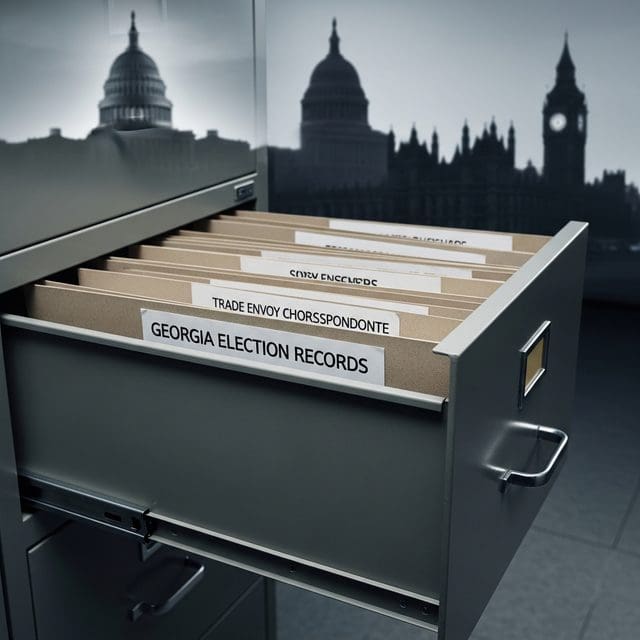
Legal battles in the U.S. and UK reveal a pattern of government resistance to releasing primary records concerning election integrity and high-level diplomatic misconduct.
A series of escalating legal maneuvers in the United States and the United Kingdom has exposed a widening gap between public demands for transparency and the administrative state’s desire for secrecy. From the Georgia Secretary of State’s office to the inner workings of the British monarchy, government entities are increasingly utilizing judicial disqualifications, privilege doctrines, and the ‘ongoing investigation’ exception to keep primary source documents under lock and key.
In the United States, the Department of Justice has moved to disqualify U.S. District Judge Eleanor Ross from the case of United States v. Raffensperger. The DOJ argues that Ross’s attendance at an event honoring Fulton County District Attorney Fani Willis, combined with a prior judicial investigation that identified courthouse sexual misconduct and partisan activity, creates an appearance of bias that necessitates her removal. This recusal fight sits atop a contentious records battle where the DOJ is suing Georgia Secretary of State Brad Raffensperger to obtain election records under federal voter-registration laws. Conversely, Georgia has pursued access to DOJ communications with voting-rights groups, a move that led the D.C. Circuit in 2025 to broaden FOIA Exemption 5 to cover work-product shared under common-interest agreements.
Despite these hurdles, some progress in the paper trail has been made. Judge J.P. Boulee recently issued a directive requiring the DOJ to unseal the warrant affidavit and related documents behind the FBI’s raid on Fulton County’s 2020 ballots by a fixed February deadline. While these documents are expected to be heavily redacted, they represent a rare breach in the wall of silence surrounding federal election probes. This transparency push comes as domestic politics remain volatile; a post-runoff poll released May 29, 2026, shows State Rep. James Talarico leading Ken Paxton by three percentage points in the Texas Senate race, while more than 60 percent of Americans express frustration over the economic impacts of ongoing foreign conflicts.
Across the Atlantic, the British government is facing its own reckoning over the preservation and disclosure of sensitive records. Thames Valley Police are currently assessing a dossier regarding Prince Andrew’s trade envoy dealings with tax-haven tycoon David Rowland. The material, which includes leaked emails, suggests Andrew used taxpayer-funded trade trips to tout the Rowlands’ Luxembourg private bank and shared confidential Treasury and Foreign Office material. Although the Mail on Sunday first alerted Buckingham Palace to this material in 2019, detectives only recently opened a misconduct in public office probe. The seven-year delay has raised sharp questions about why Palace officials failed to escalate the dossier when the evidence was first presented.
Keir Starmer’s government is currently resisting full disclosure of the appointment files related to Andrew’s envoy role. Downing Street has refused to publish the records, citing the risk of compromising the live criminal investigation. Parallel to the police inquiry, UK departments are conducting a complex records trawl across multiple ‘legacy bodies.’ Ministers have warned that while some files are being prepared for release, others may have been destroyed over the years, and key material will remain sealed until at least 2029. This strategy of withholding documents while investigations are active mirrors the tactics seen in the U.S. courts.
These developments highlight a systemic tension: while courts and police eventually press for access to confidential dossiers and internal communications, the administrative process often ensures that by the time the records reach the public, the political or legal moment has shifted. For the investigative journalist, the challenge remains stripping away the partisan rhetoric to follow the document trail that these institutions are so desperate to hide.
Ben Taylor serves as the Senior Correspondent and Investigations Lead for Just Right News, where he anchors the network’s commitment to government transparency and institutional accountability. With a career defined by a relentless pursuit of the facts, Taylor spearheads the acclaimed feature series “The Paper Trail,” a deep-dive investigative column that prioritizes primary source documentation over political rhetoric. Based in the heart of the nation’s capital, he has earned a reputation as one of the most formidable investigative journalists in Washington, D.C., known specifically for his mastery of public records and the Freedom of Information Act.
Taylor’s approach to journalism is deeply rooted in his upbringing in Kansas City, Missouri. Growing up in the “Show Me State,” he developed a healthy skepticism of centralized power and a profound respect for the common-sense values of the American heartland. This Midwestern foundation informs his reporting today, as he bridges the gap between the complex machinations of federal bureaucracy and the everyday concerns of citizens across the country. For Taylor, investigative reporting is not about chasing headlines; it is about ensuring that the government remains answerable to the people it serves.
As an African American man working within the conservative media landscape, Taylor brings a principled perspective to his beat. He views the Constitution and the right to information as the ultimate equalizers in a free society. His work often highlights how bureaucratic overreach and lack of transparency disproportionately affect individual liberties. By focusing on the “paper trail,” Taylor strips away the spin of partisan talking points, instead providing Just Right News readers with the raw data and internal communications that reveal how their tax dollars are spent and how policy decisions are actually made.
In his role as Investigations Lead, Taylor oversees a team dedicated to uncovering the stories that mainstream outlets often overlook. Whether he is auditing federal spending, investigating regulatory overreach, or exposing inefficiencies within the administrative state, his methodology remains consistent: follow the evidence wherever it leads. His presence in Washington, D.C., allows him to maintain a constant watch over the halls of power, yet he remains steadfastly connected to his roots, ensuring his reporting reflects the clarity and directness of his Missouri home.
Throughout his tenure at Just Right News, Taylor has become a vital voice for those who demand integrity in public office. He believes that a well-informed electorate is the strongest defense against government overreach, and he has dedicated his career to providing the public with the tools they need to hold their leaders accountable. Through “The Paper Trail” and his broader investigative work, Ben Taylor continues to set the standard for rigorous, document-driven journalism that champions the values of transparency, individual responsibility, and the rule of law.