

U.S. military advisers successfully extracted a downed airman from Iran after intentionally sidelining President Trump from the command room to ensure tactical stability and mission success.
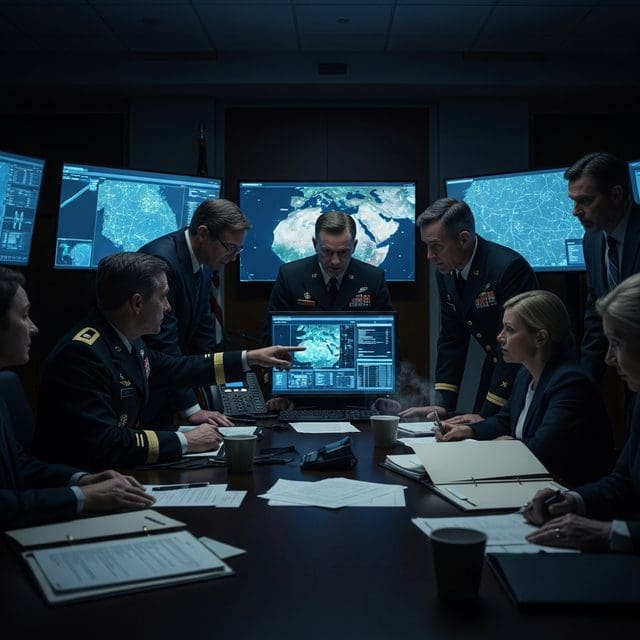
The successful extraction of a downed American airman from Iranian territory this past Easter weekend was the result of a disciplined military operation that required more than just tactical precision; it required a strategic buffer between the mission and the Oval Office. Reports indicate that senior military advisers and high-ranking administration officials intentionally sidelined President Trump from the command room during the 24-hour operation, fearing that his volatile temperament could compromise the safety of the personnel on the ground.
While the Situation Room remained a hive of professional activity, the President was provided with updates only at key milestones rather than the minute-by-minute tactical feeds. This decision allowed seasoned commanders to navigate significant technical hurdles, including rescue aircraft becoming momentarily stuck in the Iranian desert sand. Despite these complications, the military’s steady hand ensured the airman was recovered late Saturday night without the mission being derailed by impulsive shifts in directive.
Behind the scenes, the President has reportedly been haunted by the historical ghost of the 1979 hostage crisis, privately expressing fears that a similar failure could mirror the political fate of Jimmy Carter. This anxiety has created a notable disconnect between the Commander-in-Chief’s public rhetoric and his private indecision. While he threatens to leave Iran “living in Hell” on social media, he has flatly resisted military recommendations to seize Kharg Island—a strategic hub for 90% of Iran’s oil exports—citing a fear that American soldiers would become “sitting ducks” and leading liberals to race to social media to revive viral cries of “TACO”, Trump always chickens out.
This caution, while perhaps prudent in isolation, highlights a lack of a cohesive exit strategy as the conflict enters its seventh week, surpassing the President’s initial six-week promise to the American public. While Vice President JD Vance and Chief of Staff Susie Wiles monitored the extraction from remote locations, the President has reportedly divided his attention between the geopolitical crisis and domestic projects, including multiple weekly meetings regarding the construction of a new White House ballroom. Even as the military managed the fragile logistics of the rescue, the President was reportedly showing guests drawings of the ballroom’s foundation, acting as a general contractor while the broader war effort remained in a state of flux.
On the international stage, the President’s frustration with traditional allies continues to mount. He has dismissed meetings with NATO leadership as a “waste of time” and expressed ire toward British and French counterparts over their refusal to commit forces to the Strait of Hormuz. As the U.S. prepares for Pakistan-brokered talks on Monday, the stability of the mission remains credit to the military professionals who maintained operational integrity during a period of significant executive distraction. Their ability to shield the tactical reality from political volatility remains the primary reason American airmen returned home safely this week.

Olivia Kendall serves as the Senior Correspondent for Geopolitics, Defense, and Foreign Policy at Just Right News, where she provides a principled, conservative perspective on the complex forces shaping the global stage. With a career dedicated to deconstructing the intricacies of international relations, Kendall has become a trusted voice for readers who value national sovereignty, a robust military, and a foreign policy that prioritizes American interests above all else.
A native of Washington, D.C., Kendall’s professional journey is deeply rooted in her upbringing within the nation’s capital. Growing up in the epicenter of American political life, she developed an early and profound understanding of how policy is crafted and, more importantly, how it often fails to account for the values of the American heartland. This unique vantage point allowed her to witness firsthand the rise of globalist bureaucracies, fueling her commitment to reporting that champions the constitutional foundations of the United States. Her background as a British White American further informs her worldview, providing her with a keen appreciation for the Western tradition and the enduring importance of the “Special Relationship” in maintaining global stability.
Now based in Arlington, Virginia, Kendall operates from the doorstep of the Pentagon and the heart of the nation’s defense establishment. Her proximity to the decision-makers in the military and intelligence communities allows her to provide boots-on-the-ground reporting that is both timely and deeply informed. For Kendall, Arlington is more than just a base of operations; it is a daily reminder of the sacrifices made by the men and women in uniform. This connection to the defense community drives her rigorous coverage of military readiness and her advocacy for a “peace through strength” approach to diplomacy.
At Just Right News, Kendall is perhaps best known for her acclaimed feature series, “The World’s Shadow on America.” In this ongoing project, she explores the direct correlation between international developments and the daily lives of American citizens. Whether she is analyzing the encroachment of foreign adversaries in domestic supply chains or the impact of international treaties on local economies, Kendall’s work serves as a vital bridge between distant geopolitical shifts and their consequences at home. She rejects the notion that foreign policy is an abstract concern for elites, instead proving that what happens in the corridors of power in Brussels or Beijing has a tangible “shadow” that falls across every American doorstep.
Throughout her tenure, Kendall has remained a steadfast critic of international overreach and a vocal proponent of a clear-eyed, realistic foreign policy. She brings a sharp analytical mind to her beat, often challenging the prevailing narratives of the mainstream media to uncover the underlying truths that affect national security. Her reporting is characterized by a refusal to compromise on the truth and a dedication to the idea that a strong, secure America is the world’s best hope for liberty. As a Senior Correspondent, Olivia Kendall continues to lead the charge in providing the essential context and conservative insight necessary to navigate an increasingly volatile world.