

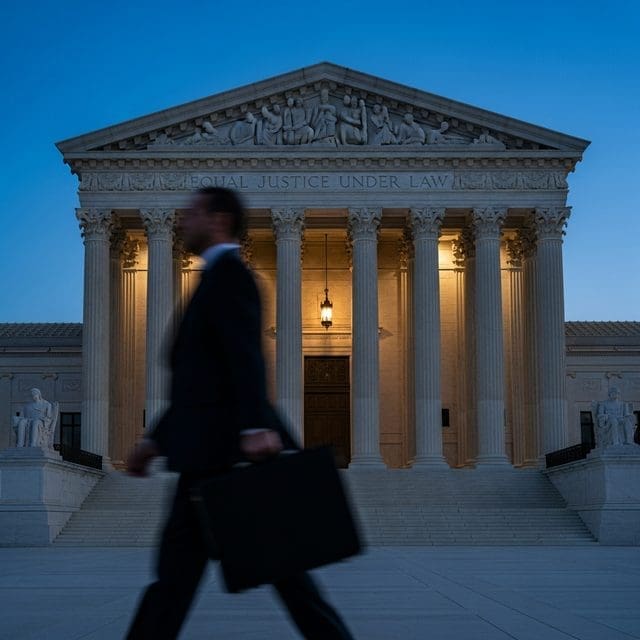
A landmark Supreme Court ruling has curtailed presidential tariff authority while the administration issues new executive orders targeting collegiate athletics and federal election integrity.
The constitutional boundary between executive discretion and legislative authority has become the central flashpoint in Washington this spring. On April 21, 2026, the federal government launched a massive tariff refund system, a direct consequence of a February 20 Supreme Court ruling that fundamentally checked the administration’s trade maneuvers. Chief Justice John Roberts, writing for a 6-3 majority, rejected the premise that the executive branch possesses unilateral authority to impose tariffs under the guise of economic security. This decision has forced the Department of the Treasury to process reimbursement claims for approximately $166 billion in duties previously collected from American businesses.
While the judiciary has reined in the administration’s trade reach, the executive branch continues to utilize federal funding as a lever to influence domestic institutions. On March 31, 2026, the President signed an executive order aimed at stabilizing college sports by imposing a five-year playing window and a single-transfer limit on NCAA athletes. The order directs the Department of Education, the Federal Trade Commission, and the Attorney General to evaluate whether universities that deviate from these standards remain suitable for federal grants and contracts. This move effectively ties billions in federal research and education funding to compliance with athletic administrative rules.
Simultaneously, the administration has moved to centralize election oversight through a new executive order on citizenship verification. Signed on the same day as the NCAA order, this directive requires the Department of Homeland Security and the Social Security Administration to compile State Citizenship Lists from federal databases at least 60 days before federal elections. Furthermore, the U.S. Postal Service has been given a 60-day window to implement new rulemaking for tracked mail-in ballots featuring unique barcodes. The Attorney General has been instructed to prioritize prosecutions for non-citizen voting under 18 U.S.C. 611.
These maneuvers occur against a backdrop of increasing international tension and domestic labor unrest. In the Gulf of Oman, the USS Spruance recently intercepted an Iranian-flagged cargo ship, highlighting the continued use of military assets to enforce maritime security. Domestically, the Department of Education is facing scrutiny over proposed regulations that could disqualify 92 percent of beauty and wellness programs from federal aid, further expanding the administrative state’s influence over vocational training.
As the 2026 midterm elections approach, the tension between the Supreme Court’s insistence on limited executive power and the administration’s aggressive use of agency rulemaking suggests a period of prolonged litigation. The administration’s reliance on executive orders to bypass traditional legislative processes remains a point of contention for those who advocate for a strict adherence to the separation of powers defined in the Constitution.

Miles Harrington serves as the Senior Correspondent for Federal Systems & Executive Power at Just Right News, where he brings a disciplined, constitutionalist lens to the inner workings of the American government. With a focus on the mechanics of the federal bureaucracy and the limits of executive authority, Harrington has established himself as a vital voice for readers who value transparency, accountability, and the preservation of the separation of powers.
A native of Richmond, Virginia, Harrington’s perspective is deeply rooted in the traditions of the Old Dominion. Growing up in a city defined by its historical significance and its role as a center of American jurisprudence, he developed an early appreciation for the foundational principles of the Republic. His upbringing in Richmond—a place where the legacy of the Founding Fathers is woven into the landscape—instilled in him a belief that the federal government should remain within its constitutional bounds. This background informs his skepticism of centralized overreach and his commitment to reporting on the ways in which the administrative state impacts the lives of everyday citizens.
In his current role, Harrington specializes in the complexities of federal systems. He doesn’t just report on the headlines of the day; he digs into the structural shifts within the executive branch that often go unnoticed by the mainstream press. Whether he is analyzing the implications of a new federal regulation or investigating the expansion of agency jurisdiction, his work is characterized by a rigorous adherence to the facts and a dedication to the rule of law.
Harrington is perhaps best known for his signature feature series, “How Washington Works.” Through this ongoing project, he demystifies the often-opaque processes of the nation’s capital, pulling back the curtain on the “Deep State” and the unelected officials who wield significant influence over national policy. By breaking down complex legislative maneuvers and executive orders, he empowers Just Right News readers to understand the true levers of power in Washington. His reporting serves as a necessary check on the federal government, ensuring that the actions of those in power are held up to the light of public scrutiny.
Now based in Washington, D.C., Harrington operates at the epicenter of the political world, yet he remains intentionally distanced from the “Beltway bubble.” His proximity to the halls of power allows him to maintain a robust network of sources across the federal landscape, but his heart remains in the principled conservatism of his Virginia roots. He views his role not merely as a reporter, but as a steward of the public trust, dedicated to providing the clarity and context that conservative voters need to navigate an increasingly complex political environment.
Through his sharp analysis and unwavering commitment to the truth, Miles Harrington continues to be a cornerstone of the Just Right News team. His work ensures that the principles of limited government and executive restraint remain at the forefront of the national conversation, providing a crucial service to those who believe in a government that is truly of, by, and for the people.