

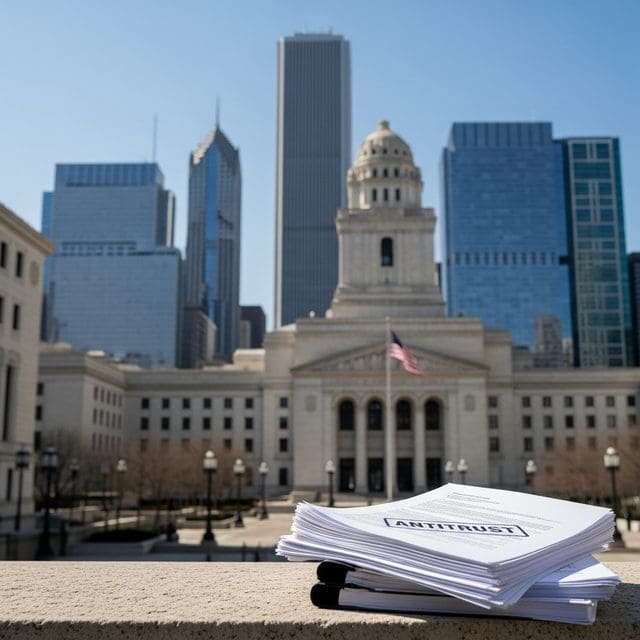
Recent legal rulings and regulatory actions have stalled major mergers in the media and healthcare sectors, signaling a renewed push to protect market competition and consumer pricing from monopolistic expansion.
The landscape of American corporate power faced a significant reckoning this week as federal courts and regulators moved to dismantle several high-profile attempts at market consolidation. From local newsrooms to surgical suites, the push for larger, more dominant monopolies is meeting stiff resistance from a legal system increasingly skeptical of the benefits of industry concentration.
In a major blow to media consolidation, U.S. District Judge Troy L. Nunley issued a preliminary injunction on April 17, 2026, halting the integration of Nexstar Media Group and Tegna. Despite receiving prior clearance from the FCC and DOJ, the $6.2 billion deal—which would give Nexstar control of 265 stations across 44 states—is now under intense scrutiny. The court found the merger likely violates the Clayton Act, citing a market share exceeding 30 percent in 31 local markets. For now, Tegna must operate as an independent entity, protecting local news diversity and preventing the artificial inflation of retransmission fees that ultimately hit consumer cable bills.
The healthcare sector is seeing similar enforcement vigor. The Federal Trade Commission (FTC) recently celebrated the abandonment of a proposed merger between Alcon, Inc. and LENSAR, Inc. The deal would have united two primary competitors in the market for femtosecond laser-assisted cataract surgery systems. FTC Bureau of Competition Director Daniel Guarnera noted that the evidence of consumer harm was so substantial that the firms chose to walk away rather than face a courtroom battle. LENSAR will retain a $10 million deposit from Alcon following the termination, while patients maintain the benefits of price competition in essential medical technology.
Under the leadership of Chair Andrew Ferguson, the FTC has also turned its attention to the digital advertising ecosystem. On April 15, 2026, the commission took action against major ad agencies including WPP, Publicis, and Dentsu for alleged collusion through the Global Alliance for Responsible Media. Regulators argue these agencies used “brand safety” standards as a pretext to demonetize specific news sites, distorting the market for digital speech. The resulting court orders ban these common standards, theoretically restoring a free-market approach to advertiser choice.
These enforcement actions come at a time of heightened economic pressure. As the U.S. Energy Department warns of sustained high gasoline prices following disruptions in the Strait of Hormuz, the cost of living remains a primary concern for American households. By challenging mergers that threaten to hike prices for healthcare and information, regulators are attempting to ensure that corporate giants do not use market dominance to further squeeze the individual consumer.
While Nexstar has signaled its intent to appeal to the Ninth Circuit, the current judicial trend suggests a higher bar for approval. The FTC has also adjusted its 2026 Hart-Scott-Rodino filing thresholds to $133.9 million, ensuring that more significant transactions fall under federal review. For the independent business owner and the average citizen, these interventions represent a necessary check on the unchecked expansion of corporate influence.

Greg Sanders serves as the Senior Correspondent for Corporate Power and Antitrust at Just Right News, where he brings a principled, conservative perspective to the complex intersection of big business, government regulation, and the American consumer. With a career dedicated to investigative depth and economic clarity, Greg has become a leading voice in examining how the consolidation of industry power impacts the foundational values of the free market and individual liberty.
Raised in Denver, Colorado, Greg’s reporting is deeply informed by the Western spirit of independence and a healthy skepticism of centralized authority. Growing up in the shadows of the Rockies, he witnessed firsthand the importance of local entrepreneurship and the vital role that small-medium enterprises play in sustaining vibrant communities. This upbringing instilled in him a belief that the American Dream is best preserved when the playing field remains level and when competition—rather than backroom deals between corporate lobbyists and federal regulators—dictates success. For Greg, the rugged individualism of his home state serves as a constant reminder that the economy should serve the people, not the other way around.
Now based in Chicago, Illinois, Greg operates from the heart of the nation’s industrial and financial crossroads. His location in the Midwest provides him with a unique vantage point to observe the real-world consequences of corporate overreach. From the boardrooms of the Loop to the manufacturing hubs that define the region, he tracks the movement of capital and the shifting tides of market influence. Chicago’s history as a center of trade and labor offers a rich backdrop for his work, allowing him to bridge the gap between high-level economic theory and the lived experiences of hardworking Americans who feel the squeeze of monopolistic practices.
At Just Right News, Greg’s beat focuses on the “new monopolies” and the rise of “woke” corporate culture. He argues that when corporations become too large, they often abandon their fiduciary duties to shareholders in favor of social engineering and political posturing. His reporting seeks to hold these “Titans” accountable, ensuring that the power of the purse is not used to silence dissent or bypass the democratic process. He is a firm advocate for the idea that true conservatism requires a vigilant defense of competition, preventing any single entity—public or private—from exerting undue control over the lives of citizens.
This mission is most clearly seen in his acclaimed feature series, “The Titans and the Toll.” In this ongoing project, Greg explores the human cost of market consolidation, from the erosion of consumer choice to the decline of local economies. Through rigorous analysis and boots-on-the-ground reporting, he documents how the concentration of power in sectors like tech, agriculture, and finance creates a “toll” paid by the average family.
Greg Sanders remains committed to the idea that a transparent, competitive market is the greatest engine for prosperity ever devised. Through his work at Just Right News, he continues to provide the essential oversight necessary to protect that engine from the encroaching influence of corporate giants and the bureaucratic structures that enable them.